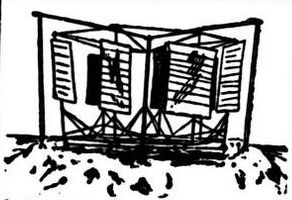
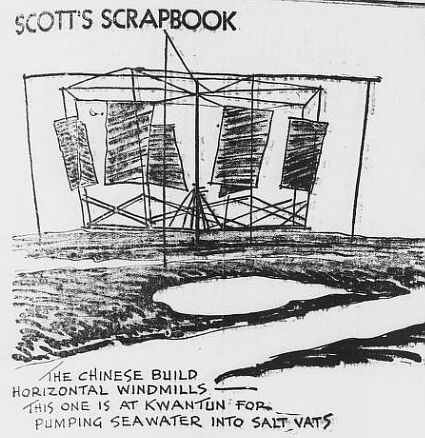
Other coverage of horizontal windmills:
Note: I have largely taken descriptions at face value - if a mill was described as a horizontal windmill, then I have included it here. Some of these instances may have been reduced size models, that may have demonstrated the technology, but were not actually capable of doing real work. I also have some specific reservations about late 19th century Caribbean sugar mills - there were clearly some earlier sugar mills that were driven by horizontal windmills, since we have engravings of these, but especially towards the end of the 19th century, I suspect that most of the descriptions relate to the local terminology which was applied to cast iron roller mills with horizontal rollers driven by a vertical windmill, in an attempt to distinguish them from earlier less efficient vertically arranged rollers. It's also possible that sometimes the horizontal adjective may have been added not to describe the orientation of the sails, but to distinguish horizontal mill(stones) from vertical edge runner stones.
| location | |
| county | |
| name | |
| date | |
| designer | |
| purpose | |
| condition | |
| ngr | |
| note | |
| millid | 2796 |
Thomas Mortimer's first horizontal mill, built to succeed an adjacent post mill.
| location | |
| county | |
| name | |
| date | |
| designer | |
| purpose | |
| millid | 11126 |
Thomas Mortimer's second horizontal mill.
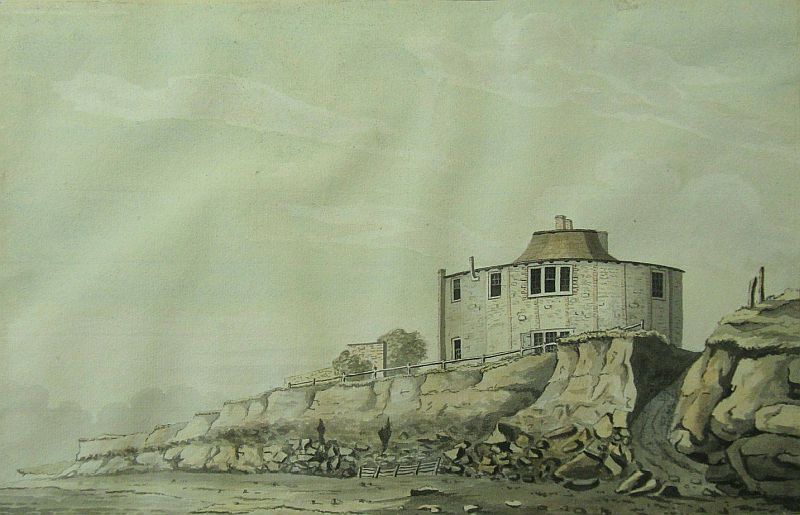
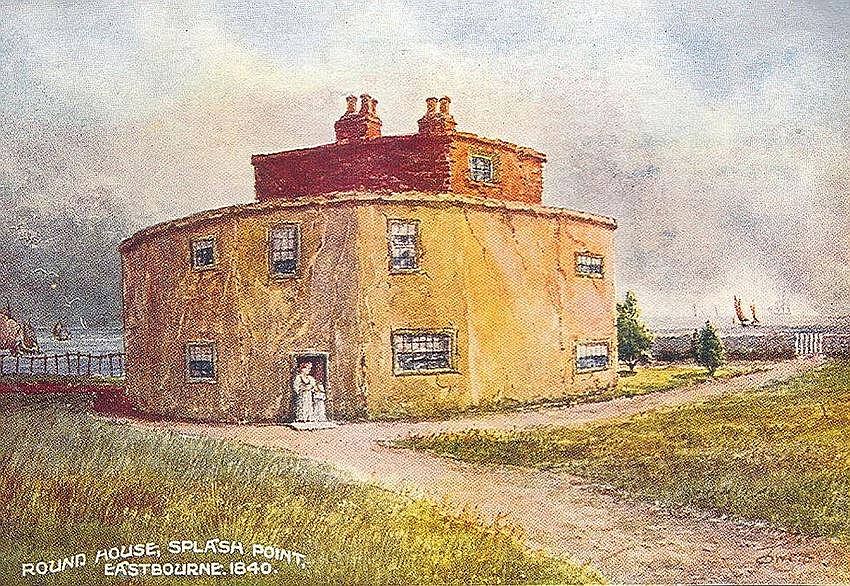
the old gentleman (Mortimer) had built a similar one on the beach, but having been dismantled of the wooden machinery atop, by a violent storm - the stone carcase was by the ingenuity of our friend [James Gandon] the summer before, converted into commodious apartments for two families to reside in during the bathing season - one of the rooms of this building was made use of as a study to paint, etc.'.Laurence Stevens says that Mortimer leased the site in 1757, (presumably building the mill soon after), but it stopped working after storm damage in 1768, and it was converted to a house the next year, by James Gandon. Cliff erosion caused the building to disappear in 1840.
| location | |
| county | |
| designer | |
| date | |
| purpose | |
| condition | |
| ngr | |
| demise |
Thomas Mortimer's third and final horizontal mill.
Diary of Thomas Jones, December 21, 1770[John Hamilton] Mortimer's father had been in his time a great dealer in flour, and owner of three or four corn mills, but at present, as he was far advanced in years, he kept only one upon his hands, and that chiefly for amusement ... This mill was built of a circular form upon rising ground above the town ... the vanes of which moved, not in a vertical, but horizontal direction, and the current of wind was regulated by valves, which were opened or shut according to the point it came from ... it was said to be one of his own inventionThomas Mortimer died in 1774, and the mill passed to daughters Elizabeth and Catherine. Elizabeth (a spinster) was the owner at the time it caught fire: Sussex Advertiser, May 6, 1811
About noon on Friday last the horizontal mill, belonging to Mrs. Mortimer, of Eastbourne, caught fire from the velocity of its motion, owing to the dry state of its machinery, which had not been properly supplied with grease. The flames spread rapidly, and the structure, being wholly of wood, was in a short time reduced to ashes, together with about five loads of wheat and a quantity of meal. The mill was insured to the amount of Five Hundred Pounds, but would require more than double that sum to re-instate it.Sussex Advertiser, 3 June 1811
To Millers, and Others.The NRHE has a record for this mill Eastbourne
TO BE SOLD, BY AUCTION, By T. WHITE,
At the Lamb Inn, Eastbourne, on Thursday the 6th day of June next, between the hours of six and eight in the evening, (unless previously disposed of by private contract)
PIECE of LAND, containing One Rood, situate upon Ocklyn Hill, in the parish of Willingdon, being the scite of a horizontal Windmill, lately burnt down. The premises are Leasehold, for a term of 199 years, 156 of which are unexpired, under a yearly rent of Five Shillings.
The Land is desirably situated between the parishes of Eastbourne and Willingdon, for the purpose of erecting a Windmill, and business to a considerable extent was carried on for upwards of Half a Century in the late Mill.
The Iron Work and Materials of the late Windmill now remaining, are to be taken by the Purchaser at a fair valuation. For further particulars, apply, to Mr. Gell, Solicitor, Eastbourne.
A horizontal windmill, built by Thomas Mortimer in 1770 and burnt down in 1811, was excavated in 1970. The excavations also found the cruciform trench of a Medieval post mill, dated from pottery to 1200-1350. Both mills were corn mills.The 1970 excavations by Laurence Stevens found a 15.85m diameter circular chalk block foundation, with evidence that they enclosed a burnt wooden floor. There were 51 fragments of French Burr stone found, some very small, but 3 were large enough to show a worked surface, including part of the eye of the stone.
| location | |
| county | |
| date | |
| designer | |
| owner | |
| purpose | |
| building |
George Medley was a British politician, who had made a fortune as a wine merchant in Portugal. His home Buxted Place, Sussex was clearly used by Hooper as a reference installation for the horizontal windmill. Since the mansion at Buxted Place was damaged by fire in 1940, and reduced from 3 storeys to just 2 in the reconstruction, it is likely any remains of the windmill, had it been on the mansion itself, and by definition at roof height, would not have survived this.
This installation was given as reference in Hooper's piece in the London Magazine, October 1776, p465
This engine may be placed on the wing of any gentleman's house representing a turret, or where there is a turret, it may be fixed within the same to draw water, and for sundry uses in a family, as may be seen at George Medley's, Esq. at Buxstead-place in Sussex.From this description, it is clear that the windmill had been installed in an existing "turret", which was probably on an outbuilding, rather than the house itself. Since the fire took hold of the house, it's possible that the building that had carried the turret was not affected.
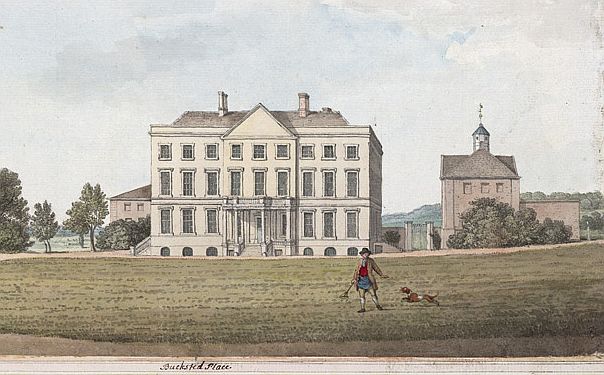
George Medley was also associated with another windmill, offering a reward when it was subject to arson: The General Evening Post 21 February 1761
I GEORGE MEDLEY, of Buxted-Place, in the County of Sussex, hereby promise as a Reward, to any Person or Persons, the Sum of Fifty Pounds, on Conviction of the Offender or Offenders who set Fire to a Windmill, commonly called or known by the Name of Friston-Mill, near Friston-Place and Seaford in the said County, last Night or this Morning; to be paid by the said George Medley, or his Executors or Administrators. Buxted-Place, Feb. 14, 1761. GEORGE MEDLEY.
| location | |
| county | |
| date | |
| designer | |
| owner | |
| purpose |
HOOPER'S MACHINE FOR DRAWING WELL WATER BY WIND
Situated at Mr. Gilbert's at East-Borne. ... [readers are invited to view] one of the said machines, lately erected and now in full work, which raises water out of a well 266 feet deep. ... [The inventor will be on hand at Eastbourne to meet] any Noblemen or Gentlemen ... desirous of speaking to the inventor.
| location | |
| county | |
| name | |
| owner | |
| date | |
| purpose |
Plan of an intended patent horizontal wind engine for Sir John Bridger, Coombe Place. Drawing by Thomas Spencer, showing elevation and ground plan. About 1 in. to 21½ ins. Date: 1784T E Evans describes the plan in SIAS newsletter no. 47, July 1985 noting that
Papers relating to the Coombe Estate and Coombe House, especially calculations of rents and income, c. 1760-80, lands purchased and sheep leazes owned.
Description: ... agreement with Thomas Marchant for the erection of a newly invented engine for drawing water by wind, 1779, see plan No. SHR/2837 ...
| location | |
| county | |
| name | |
| date | |
| builder | |
| owner | |
| purpose | |
| condition |
[summarized]
Originally built by Sir Charles Barry (1795-1860) as a Wind Pump in 1830 to supply the Italianate villa that he had designed for Thomas Attree. It is some 60'/18m high, and possibly one of the oldest surviving concrete buildings existing in Britain, being built from 'Ranger's Artificial Stone'/'Ranger's Lime Concrete', which was invented by a builder from Ringmer. As a horizontal wind pump it proved to be under powered and the rotor was removed and the pumping mechanism was converted to steam. In 1863 the Attree Villa and estate was purchased by George Duddell who used the steam engine to drive a printing press to produce his newspaper the 'Brighton Daily Mail'. Later uses of 'The Pepper Box' included being an Observation Tower during WWII, Accommodation for a Scout Troop and an Artists Studio. The base being extended and used as Public Lavatories! Attree Villa was Grade II listed, but despite that was demolished using water in 1972.
| location | |
| county | |
| name | |
| designer | |
| date | |
| purpose |
Findon, Muntham House, 1789, S. H. Grimm. British Library, Add. MS. 5673, f. 57 [102]The well, and visits to see the "machinery" or the "well house" which may have included the windmill are mentioned in the Diary of William Davy, steward at Muntham
Anthony Browne, Viscount Montague, bought Muntham, the Middleton family home for over a century, in 1743 and developed the site apparently as a hunting lodge. ... William Frankland (1720-1805) purchased the estate from Montague in 1765 and set about creating a gentleman's residence. ... Frankland devoted his time to collecting and operating a variety of mechanical devices. There were rooms given over to lathes, spinning and winding machines ("he makes all his own cloth", a visitor in 1789 noted), printing presses, time pieces "together with electrifying machines and optical instruments in an almost endless variety", and mechanical musical instruments. This collection was dispersed by sale after his death. By 1794 he had devised, also, a horizontal windmill to raise water for the house from a well measured at 350 feet in 1773.
1794 Feb 12th. The Chain & Bucket fell into the well.Sussex Industrial History no. 8, 1978 notes that the windmill was apparently so successful in providing a copious water supply at Muntham that it allowed the fishponds to be enlarged, and though it may be stretching the cause/effect relationship rather, 45 years later (in 1839) a later owner added fountains.
14th Jas Osburn went down the Well & brought up the Chain & some of the Buckets
15th Jas. Osburn & Jas. Baker went down the Well & brought up Sundry thing
18th Jas Osburn & Jas Baker went down the Well & brought up Buckets & Sundry things
...
June 18th. Mr. Hore the Banker & 3 Ladies from Worthing came to Muntham to see the Machinery ... they gave Mr. Hasted 5 shillings, with which Osburn & Glassbrook went to Mr. Gravely at Torrington & bought beer at the rate of 14d pr Gallon, brought it home & gave every one their proper share about the house, except Dick & Thorp, who were at Cricket.
June 19th Miss Wyatt & Niece the Housekeeper from Mitchelgrove & Mrs. Tate from Findon came to Muntham to see the Machinery, & gave Osburn a Shilling to which the Workmen added a little more & bought Beer at the Gun, brought it home & drank it in the afternoon.
...
July 21st. Alderman Boydel & wife came to see the Well house .. Miss Goring call'd [for the same purpose]
| location | |
| name | |
| county | |
| date | |
| designer | |
| builder | |
| purpose | |
| note |
| location | |
| county | |
| name | |
| date | |
| designer | |
| purpose | |
| millid | 11010 |
| location | |
| county | |
| date | |
| owner | |
| purpose |
RAINIER'S COAL GIFT.
On the 23rd July, 1802, Admiral Peter Rainier bequeathed £400 to be invested in the funds for the use of the poor of the parish of St. Mary, the dividends to be paid to the minister, churchwardens, and overseers, to be laid out in coals, to be purchased when cheap, and to be given to the poor of the parish at Christmas. The money was invested in the purchase of £594 15s. 11d. consols, the interest on which is £17 16s. 10d. In a deed dated 9th June, 1833, it is stated that the stock had been transferred to and was standing in the names of Richard Harrisson, fellmonger, Joseph Birch, gentleman, James Wood, timber merchant, Richard Hope, hoyman, (since dead,) Isaac Witherden, jun., given, (also dead,) and Anthony, Slaughter, tanner, all of the parish of St. Mary.
SANDWICH, Nov. 30.
About half-past 11 it blew a dreadful hurricane from s.s.w., and which raged with undiminished violence till about one. St. Peter's and St. Mary's Churches are greatly damaged on the roofs and windows, several stacks of chimnies fell, perforating the roofs, and doing extensive damage to the ground floor, at Mr. Bunton's a large stack of chimnies fell, carrying great, part of the roof with it, and scattering the fire all over the room below. Mr. H. Nethersole's mill, situate on Mill Wall, had the top blown off and smashed to pieces, and the one occupied by Mr. J. Nethersole, at Word, about one mile distant, was blown down at the same time and destroyed. Mr. Staughton's lofty horizontal mill received serious injury. Several vessels are on the flats and the Downs, dismasted. The damage is estimated at £3,000.
LONDON GAZETTES
TUESDAY, May 5
ASSIGNMENTS.
...
Anthony Slaughter, Sandwich, tanner.
To Tanners and others - Sandwich, Kent - An eligible Investments for Capitalists.
By DENNE and HICKS, at the King's Arm Inn, Sandwich, on WEDNESDAY, the 3rd day of June, 1840, at Twelve for One o'clock precisely. THE following very Desirable FREEHOLD PROPERTY, situate in the Town and Port of Sandwich, in the county of Kent; in two lots, viz .- Lot. 1. All that valuable Messuage or Tenement, with the kitchen, yard, washhouse, and other hereditaments and premises thereunto belonging, together with the very large, valuable, and old established Tan Yard, containing 150 pits capable of taking in 100 hides per week; the goods when manufactured admit of an easy transit by barges which sail weekly to London. In the yard is a horizontal Windmill for grinding bark, of great power, working two pair of stones, and a Coffee Mill; a large and substantial brick built Storehouse, consisting of a ground floor used as a weighing house and carpenter's store, the first story used as a rolling bed and warehouse, and the upper floor used as a wool storehouse, wherein the trade of a woolstapler was formerly carried on, and which is divided into compartments and fitted up for that purpose; also two extensive lower and upper air dry sheds, opening to the east and west, for the purpose of drying leather; also a leather house; large and commodious bark barn, capable of holding about 200 tons of bark; also a horse mill with a large loft over it, adjoining to which is a beam house, with grainers and lime pits, close to the stream which passes and supplies the yard: also a stable, turf shelves, and sundry outhouses. The dwelling house contains on the ground floor, three parlours, counting house, storeroom, kitchen, washhouse with two rooms over it, and on the upper floors nine excellent bed rooms and dressing room; there is a good walled garden stocked with choice fruit trees, nearly adjoining the dwelling house. The above property is situate in the parish of Saint Mary the Virgin, in Sandwich, in a populous part of the county of Kent, twelve miles from Canterbury and Dover, nine from Margate, seven from Ramsgate, and six from Deal, and is so centrical, that a large collection of the raw material, and a plentiful supply of bark may be always had; the property is now in the occupation of Mr. Anthony Slaughter, who is now carrying on the trade.
Lot 2. All that Messuage or Tenement, with the stable, storehouse, lodge, land, fellmonger's yard, and other hereditaments and premises thereunto belonging : the stable is built for three horses, and there is a good loft over it; also a wool storehouse and beam house; the fellmonger's yard containing six pits, and the whole is situate in the parish of Saint Mary the Virgin aforesaid, and now in the occupation of the said Anthony Slaughter, or his undertenants.
The Lots may be viewed on application to Mr. Slaughter, and for further particulars apply to him; to the Auctioneers; at the offices of Mr. Mourilyan, solicitor, Sandwich; and at the offices Messrs. Hall, Bishop, and Mourilyan, solicitors, 2, Verulam-buildings, Gray's Inn, London. All letters to be post paid.
N.B. Printed particulars may be had three days previous to the day of sale by applying as above.
Household Furniture, Paintings, Prints, &c. &c.
SANDWICH.
BE SOLD BY AUCTION, By DENNE and HICKS.
ON the PREMISES, on THURSDAY, the 2d July, 1840, all the HOUSEHOLD FURNITURE, LINEN, CHINA, GLASS, BOOKS, PAINTINGS, PRINTS, and other EFFECTS of Mr. ANTHONY SLAUGHTER;
COMPRISING four-post and tent bedsteads with moreen and dimity furnitures, feather beds, bolsters and pillows, horse-hair mattresses, blankets and counterpanes, mahogany wardrobe, circular chest of drawers, dressing tables, pier and dressing glasses, mahogany dining, card, and Pembroke tables, sets of mahogany chairs, couch covered with moreen, loose squab and pillow, carpets and hearth rugs, large mahogany book case, eight-day clock in mahogany case, sideboard, counting-house desk, iron book case, barometer, several very fine oil paintings in handsome carved gilt frames, among which will be found original portraits of Shakspeare, Milton, Culpepper, &c., numerous prints framed and glazed, including a fine proof engraving from Stothard's celebrated picture of the "Pilgrimage to Canterbury," about 100 volumes of books, and the usual assortment of China, glass, linen, and kitchen requisites.
The whole will be particularised in catalogues, to be had of the AUCTIONEERS three days prior to the Sale. May be viewed on the Morning of the day of Sale, which will commence at Eleven o'clock.
SANDWICH.
TO BE SOLD BY AUCTION, By DENNE and HICKS,
ON THE BUTTS, adjoining the Premises of Mr. Anthony Slaughter, on THURSDAY next, July 30th, 1840;
A capital ROAD HORSE, rising nine years old, one spring cart, one heavy ditto, two cart harnesses, two trucks, two barrows, one lead pump, the iron, wood, and brass work of two Bark Mills, comprising wheels, shafts, boxes, &c. &c., upwards of two hundred frames used for drying glue, an excellent spar forty-two feet long, set of gin poles, several lots of capital oak posts and close fencing, quantity of fire-wood, and working tools, half a barrel of tar, and other useful articles.
May be viewed on the morning of the day of sale, which will commence in the afternoon at One o'clock.
TO TANNERS AND OTHERS.
SANDWICH, KENT.
AN ELIGIBLE INVESTMENT FOR CAPITALISTS.
TO BE SOLD BY AUCTION, By Mr. HERRING,
AT the AUCTION MART, in the City of LONDON, on TUESDAY, the 1st day of DECEMBER, 1840, at Twelve for One o'clock precisely, the following very desirable
FREEHOLD PROPERTY,
situate in the town and port of SANDWICH, in the county of Kent, in Two Lots, viz.:-
Lot 1 .- All that valuable MESSUAGE or TENEMENT, with the kitchen, yard, washhouse, and other hereditaments and premises thereunto belonging, together with the very large, valuable, and old-established TAN YARD, containing 150 pits, capable of taking in 100 hides per week. The goods, when manufactured, admit of an easy transit by barges, which sail weekly to London. In the yard is a horizontal windmill for grinding bark, of great power, working two pair of stones and a coffee mill
...
The property was recently in the occupation of Mr. Anthony Slaughter, who carried on the trade of a tanner there for several years.
Lot 2 .- All that MESSUAGE or TENEMENT, with the stable, storehouse, lodge, land, feltmonger's yard, and other hereditaments and premises thereunto belonging. The stable is built for three horses, and there is a good loft over it; also a wool store house and beam house; the feltmonger's yard, containing six pits; and the whole is situate in the parish of Saint Mary the Virgin aforesaid, and late in the occupation of the said Anthony Slaughter or his undertenants.
The lots may be viewed, and further particulars known on application to the Auctioneer, 109, Fleet-street, London; at the Offices of Mr. MOURILYAN, solicitor, Sandwich; and at the Offices of Messrs. HALL, BISHOP, and MOURILYAN, solicitors, 2, Verulam-buildings, Gray's Inn, London. All letters to be post paid.
N.B.- Printed particulars may be had three days previous to the day of sale, by applying as above.
NOTICE.
THE Creditors of ANTHONY SLAUGHTER, late of the town and port of SANDWICH, in the county of Kent, TANNER, may receive a FIRST and FINAL DIVIDEND of Three Shillings and Seven Pence in the Pound, on the amount of their respective debts, by personal application at the Offices of Mr. MOURILYAN, at Sandwich aforesaid, on any day after the Tenth day of August instant, between the hours of nine and four.
By order of the Trustees,
JOHN MOURILYAN, Solicitor. Sandwich, 4th August, 1841.
To Tanners, Builders, Farmers, and others. SANDWICH. TO BE SOLD BY AUCTION, By Mr. JOHN HICKS, (WITHOUT RESERVE), ON WEDNESDAY, the 16th day of MARCH, 1842, on the Premises (the Sale to commence at Ten o'clock) :- All the MATERIALS of that substantial brick-built DWELLING HOUSE, and the fixtures therein, lately occupied by Mr. Anthony Slaughter; likewise the horizontal WINDMILL with the entire machinery for working the same; also all that extensive range of OUTBUILDINGS, comprising a large brick-built storehouse with slated roof, containing first, second, and third floors, and fittings as formerly used in the wool trade; two long timber built drying sheds with tiled roof, barn, stable, mill-house and beam-house the whole of the plank contained in the plant, a quantity of stone paving and bricks, also a lead cistern in oak frame; the whole of which will be put up in lots, to be taken down and removed from the premises. May be viewed, and particulars and catalogues had seven days prior to the day of sale, on application to the Auctioneer, Market-street, Sandwich. N. B.- The FREEHOLD LAND whereon the above buildings stand, and the garden ground near, which is also Freehold, with the wall round the same, will be SOLD by AUCTION, in Two Lots, shortly, and if not disposed of by Private Contract, respecting which application may be made to Mr. KENNETT, Solicitor, Dover.
NOTICE.
THE Creditors of ANTHONY SLAUGHTER, late of the Town and Port of SANDWICH, in the County of Kent, Tanner, may receive a SECOND and FINAL DIVIDEND of 1 1/2d. in the pound on the amount of their respective Debts, by personal application at the Offices of Mr. MOURILYAN, at Sandwich aforesaid, on any day after the 30th day of December instant, between the hours of Nine and Four.
By order of the Trustees, JNO. MOURILYAN, Solicitor.
Sandwich, 24th December, 1844.
DEATHS
On the 14th inst., at Sandwich, Ann, wife of Anthony Slaughter, aged 86 years.
DEATHS
Sandwich-April 27, Anthony Slaughter, aged 89.
SANDWICH, KENT.
Messrs. NETHERSOLE & HONEYBALL
Are favoured with instructions to SELL BY AUCTION,
On WEDNESDAY, JUNE 30TH, 1886, at HARNET STREET, SANDWICH,
about 120 OIL AND WATER COLOUR PAINTINGS,
A Quantity of Old Proof and other ENGRAVINGS, BOOKS, CHINA, SURPLUS FURNITURE, &c,
The Property of the late ANTHONY SLAUGHTER, Esq.
The Paintings include Works by the following well-known Artists: Van Galen, Peter de Hooge, Droogsloot, Van Leyden, Benjamin Cayp, Peter de Bloot, Zoffany, Sebastian Pether, John Wilson the Elder, Geo. Chambers, James Ward, R A, Fuseli, W. H. Croome, Old Croome, Herbert Vickers, Copley Fielding, D. Cox, John Varley, Rippingale, &c.
On View the day previous to and on the Morning of Sale.
SALE TO COMMENCE AT 12.30.
Catalogues with full particulars to be obtained of the AUCTIONEERS, Deal and Teynham, Kent; at the Kentish Observer Office, Canterbury; and of Mr. W. DENNE, Sandwich.
| location | |
| county | |
| name | |
| date | |
| tenant | |
| purpose |
to be sold by auction, a freehold newly erected corn mill called Newland Mill, situated upon the declivity of Cockam Hill. The mill contains three pairs of stones, two of them French, the other peak and there is room for a fourth pair. The French are supposed capable of grinding and dressing more than four hundred loads a year. All the stones have regulators by which means one man is enabled to conduct the whole business of grinding and dressing at the same time. And oil cake being in great demand in that neighbourhood, where none is to be had nearer than from London; a further advantage is offered, as it might at an easy expense be converted into an exceedingly good oil and flour mill conjointly.Maidstone Journal and Kentish Advertiser, Tuesday 16 October 1798
To be viewed by applying to G.W. Lewis, Westerham, or on the premises where printed particulars may be had. Also of Mr Barrett, millwright, Sevenoaks.
BY T. KIPPS,
At the King's Arms Inn, in Westerham, Kent; on Wednesday, the 17th of October, 1798, at Twelve o'Clock; subject to such Conditions of Sale, as shall be then and there produced; the two following FREEHOLD ESTATES, either together or separate:
I. A very large and convenient Horizontal Windmill, for grinding of Corn; situate on a suitable piece of Land, at Cuckham Hill, in the parish of Westerham aforesaid; now in the occupation of Mr, W. Bignold, as tenant at will, at the very low yearly rent of Twenty Pounds. This Mill has been built but few years, on which no expence has been spared to make it complete; it works two pair of exceeding good French Stones, and one pair of Peek Stones, one Boulter and one Masham, with every convenient Apparatus; flour and corn bins, suitable for carrying on a large trade, there is a kitchen adjoining the Mill, and a small stable disjoined.
II. A Valuable FREEHOLD ESTATE, adjoining the above; Comprising a House, barn, stable, oasthouse and hay barn, a farm yard, large orchard, ditto garden, and five pieces of arable, meadow and hop-ground; also, a Cottage, with the garden ground thereunto belonging; containing in the whole about Twenty Acres be the same more or less; now or late in the occupation of Mr. Thomas Farmer, and his under-tenant, at the yearly rent of Twenty-one Pounds, but at the Time of Sale will be in Hand.
The whole may be viewed at any time preceding the sale, by applying to Mr. W. Bignold, Miller and Shopkeeper, at Cockham Hill, aforesaid.
For further particulars enquire of J. W. Lewis, Esq. Westerham; or of the Auctioneer, Sevenoaks.
HORIZONTAL CORN MILL, NEAR WESTERHAM KENT.- By Mr. SMITH,
At Garraway's, on TUESDAY the 28th inst. at Twelve,
A Valuable FREEHOLD CORN MILL, forming a Cube of 50 feet diameter, containing three floors constructed and finished in the most complete manner, at Crockham Hill, 5 miles from Westerham, and 24 from London, in the county of Kent. The Mill is capable of grinding twenty loads of corn per week, with Binns to contain upwards of four hundred quarters, three pair of stones (now at work) screens and sack tackle, strong shaft, going geers, &c. A miller's apartment, containing three rooms, yard, piggery, and space for garden; containing altogether about one acre. May be viewed by applying to Mr. Bignold, on the Premises, of whom particulars may be had six days preceding the Sale; also at the King's Arms, Westerham; Greyhound, Croydon; Bell, Bromley; White Hart, Godstone; at Garraway's; and of Mr. Smith, No. 62 Broad-street, near the Royal Exchange.
To CORNFACTORS, MILLERS, and BUILDERS.- To be Sold, with immediate possession, a valuable Freehold horizontal Corn-mill, situate at Cookham Hill, near Westerham, Kent, about 50 feet diameter; containing three floors, constructed and finished in the most complete and substantial manner; brick and stone foundation, timber and weather boarded, three pair of stones (two pair of French and one of peak,) two boulting-mills and very complete machinery, with cottage, stable, and yard adjoining. The late occupier of the above mill has undertaken an extensive concern in America, and the owner resides in a distant part of the kingdom. It will therefore be peremptorily sold; and is well worth the attention of Builders, to take down and convert the materials, as the timbers are of large dimensions and of the first quality, being all cut out of Riga and Memel timber, die-square. There are about 2000 cubic feet of Fir and Oak Timber, in scantlings; 11,000 feet of half-inch and three-quarters; and 12,000 of inch and inch and quarter, of red deal. Mr. Steer, of Cookham Hill, will shew the premises. For particulars and price, apply to Mr. Fulcher, at P. T. Richardson's, Esq. Fore-street, Limehouse; or to Mr. Bignold, Solicitor, 79, Cheapside, London.
| location | |
| county | |
| name | |
| date | |
| designer | |
| purpose | |
| note |
All the works of the Ordnance at Sheerness, Harwich, and Landguard Fort, including the well sinking, were under the direction of Captain Page. Mr. Cole, Mr. Hooper, of Margate (who made the horizontal windmill at the Sheerness well), and also the well-sinkers, were under Captain Pages superintendance and orders, as the commanding engineer. They all deserved his best acknowledgments for their attention in their respective departments, and he gave them due praise for their conduct in his public reports. ... King's Well, Fort Townshend, Sheerness. ... The experiments in trying the different strata, and preparing the materials, commenced the 17th of April, 1781; the well in Fort Townshend was begun 4th June, the same year, and finished 4th July, 1782. ... To the Comptroller of the Navy. Upper Fitzroy-street, April 14, 1795. Sir, I HAVE great pleasure in complying with the desire you have honoured me with, to have my opinion upon the supply of water for the dock-yard, from the well that was sunk at Sheerness, under my direction, in the late war. ... The machinery of the well is made to draw water either by wind or horses; in calm weather by the latter, but never to have the two powers of wind and horses used at the same time. This operation should be under the care of a skilful man, to reside on the spot. An uniform mode of drawing water should be observed; neither to have it too suddenly lowered by the wind, or the operation to cease altogether for want of horses, in a calm; and the drawing of water should be in the night, as well as in he daytime; the object certainly being of sufficient importance to warrant the expense of an extra watchman.I'm not sure what the original source of this quote is! Dockyard Horizontal Windmill
This well is worked by horizontal wheels that will raise, with a smart breeze of wind, two tons of water within the hour; a supply thought sufficient for the wants of the place, and such as has made only one vessel necessary for bringing water to Sheerness, and even that is now considered rather as a job than matter of necessity.
Over the well at Sheerness a machine is erected, which raises the water by means of an horizontal windmill, working an endless chain. This chain, consisting of jointed double bars, with a number of buckets fixed thereon, at certain distances from each other, continually descending into, and ascending out of the water, to an elevation of eight or nine feet above the top of the well, may be supposed to reduce the water as far as it reaches to the mean temperature of the air above; and thus I found it; for 51 degrees had been the mean temperature of the air near the sea-shore for several days before. At the bottom of the well, near to which the chain never descends, I found the temperature 56 degrees; above 7 degrees warmer than that at Dover well.
...
JAMES SIX.
Canterbury, August 1, 1787.
| location | |
| county | |
| date | |
| purpose |
TO BUILDERS, BRICKLAYERS, ENGINEERS, AND OTHERS,
BEXLEY, KENT.
MR. T. DANN has received instructions to SELL by AUCTION, on WEDNESDAY, May 18, at 12, all the MATERIALS of the recently erected Buildings and Machinery of a horizontal Windmill and Factory, together with the Plant, large iron boilers, and furnaces used in refining nickel.
The material comprise a quantity of sound timber in plates, rafters, joists, window frames and glazed sashes, door frames and doors, large quantity of good pantiles aud sound brick work, a pair of upright iron-bound stones with cast-iron wheels, iron-bound vats, cisterns, work benches, &c.
At the same time will be sold the LEASE of the PREMISES for the remaining term, of which Seven Years and a Half are unexpired at Midsummer next, at the very low rent of 32 per annum. The Premises consist of a detached Family Residence, standing on nearly half an acre of land, with Coach House and Stable and well-stocked Garden. The House contains six good bed-rooms, large drawing and dining-rooms, breakfast-room and study, store-room, kitchen, and other offices, with a well of excellent water.
Particulars may be had, one week previous to the sale, of the Auctioneer, Bexley, Kent.
| location | |
| name | |
| county | |
| date | |
| designer |
FOR SALE AT GRAVESEND.
TENDERS are invited for the Purchase and Removal of a Rollason's WIND MOTOR, erected on the Rifle Range, Gravesend. - For further particulars apply to the Commanding Royal Engineer, Gravesend.
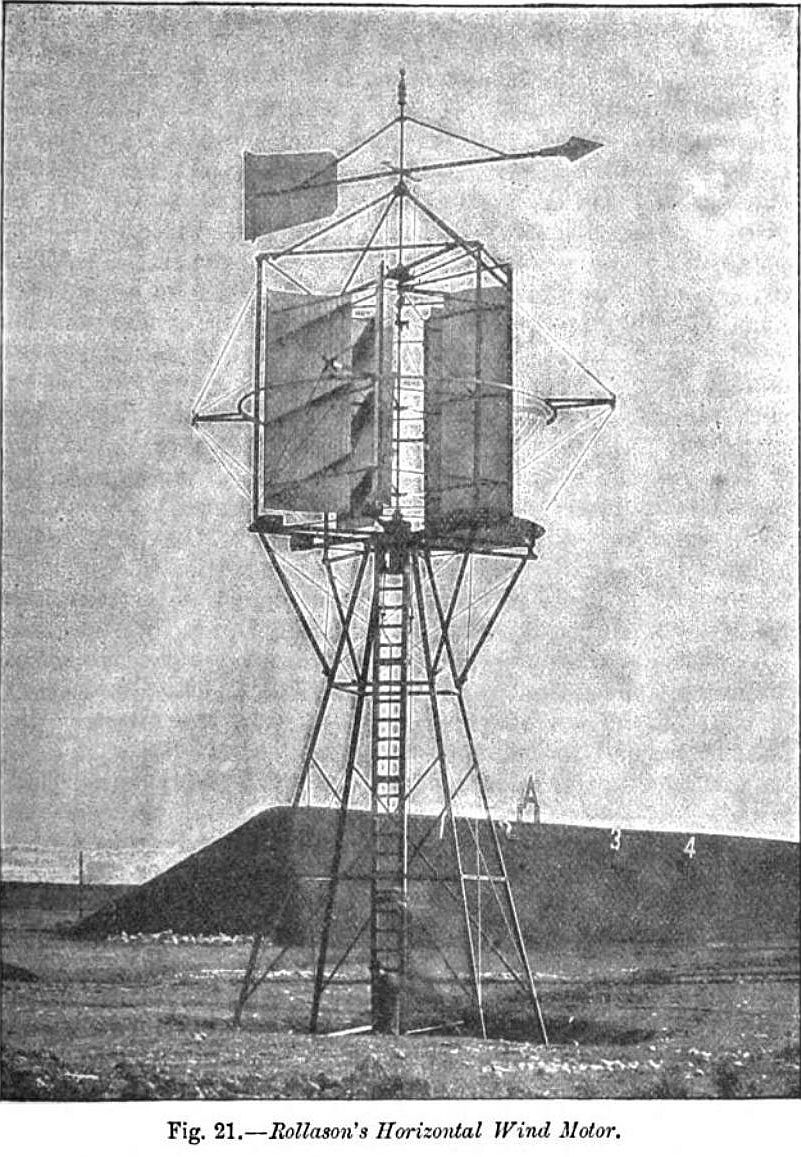
| location | |
| county | |
| name | |
| date | |
| owner | |
| purpose | |
| sails | |
| building |
Plate X. The Diving Vessel, Windmill, &c
...
Description of the D. of Argyll's horizontal windmill for raising water;
...
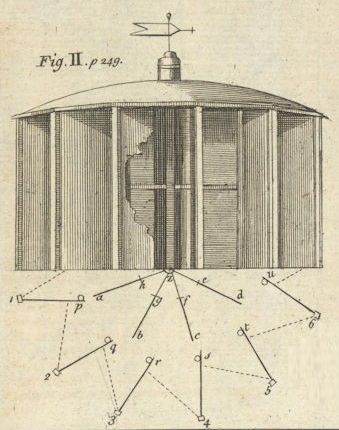
FIG. II. A View of the D. of Argyle's horizontal Windmill, for raising Water, at his Seat on Hounslow Heath; with a half Plan of the same.
DESCRIPTION of it.
THERE is a square brick building, about 15 feet high, and 20 feet in front every way, upon which the HORIZONTAL WINDMILL is placed.
It has eight flyers, or sails of board, which are fixed to 4 wooden diameters, d, c, b, a &c. which pass thro' the upper right axeltree z, and are each 10 feet long. The flyers are 7 feet and half high, and three feet broad from a to h, b to g &c.
There are 12 outer shutters , or doors , 1 p, 2 q, 4 r, &c. which swing on hinges, fixed to the upright posts, 1, 2, 3, 4, &c. these doors are kept open with iron hooks, viz. such as are used to casements; they open to an angle of 68 degrees against the round slender posts, p, q, r, &c. So that whatever quarter the wind is in, it is thereby directed to act upon the flyers, and turn them round in the course d, c, b, a, on the upright axletree z.
The upright axletree z reaches down into the lower room, within 3 feet and half of the floor, where its gudgeon rests on an horizontal piece of timber.
Round the bottom part of this axletree is fixed a lantern- or drum- wheel, about 8 or 9 inches diameter, with its iron rounds, which are about 8 inches long.
This lantern turns two iron crown, or cogg wheels; one of these wheels is about 28 inches diameter, the other 8 inches less, in diameter; they are fixed to a square iron box, which slides to and fro on the large iron axletree, so as to have either the lesser or the greater crown wheel apply'd to the lantern, according as the wind is stronger or weaker, one crown wheel being on one side the upright axle, the other on the opposite side.
At the other end of the iron axletree are two cranks, or crooks, each 4 inches deep; which by the revolution of the axletree, by means of levers, rails and depress two pistons 8 inches at a stroke, in barrels of 4 inches diameter; they do not force or impel, but draw up the water like common pumps.
This engine is always at work when the wind blows, and raises the water about 20 feet high, but only in a small quantity, unless with a strong wind. And when the wind is very strong, they are obliged to shut one or two of the outer doors, or shutters, to check its force; so that the engine requires some attendance.
If the diameter of the circulating flyer, or sail-wheel, were larger, they conclude it would raise more water, but then its revolutions would be slower.
The reason why this engine does not, with equal winds, act with so much force as common windmills do, seems to be this; that the common windmill yields only obliquely to the progressive motion of the wind; but the flyers, or sails, of this horizontal mill, make way more directly in the course of the wind; and, consequently, the impeding force of the wind on the flyers, is abated in the proportion which the circular velocity of the flyers bears to the velocity of the wind. After all, perhaps, one of those windmills, with a long vane to it, to make it turn of itself to the wind, would be better; such are common in Holland to drain land, and there is one of these, near the turnpike going to Chelsea.
| location | |
| county | |
| designer | |
| date | |
| purpose | |
| sails | |
| building |
Letter from Joseph Thornhill to the Royal Society about a model of a windmill, 10/4/1764
Ipswich Journal, Saturday 15 December 1764His Majesty having been graciously pleased to grant to Jos. Thornhill the Letters Patent for sole making and vending of a new-invented and horizontal Windmill or Machine; we hear that one of the said Wheels is already erected at Knightsbridge.Discussed in a letter written by Benjamin Franklin to Thomas Gilpin
To Thomas Gilpin
London March 18. 1770
...
I have seen but two horizontal Windmills in all my Travels. The first was at Rhode island ... . The other is now here at Knightsbridge near London, on the Top of a House for manufacturing painted Oil Cloths, and is used for grinding the Colours. The horizontal Wheel is in an octagon Tower with a Roof, but open all round the Sides; the Vanes are fix'd as in the Polish Mill; but to make it go, there are moveable Shutters, sufficient when properly plac'd to prevent the Wind acting on the coming Side of the Sails, and by leaving half the Tower open suffer it to act on the going side. This needs Attention and Care to shift the Shutters as the Wind changes and therefore seems not so good as the Polish Mill; nor is either of them so good as yours.
| location | |
| name | |
| county | |
| date | |
| purpose |
PUMPING WATER by WIND. - To be SOLD HORIZONTAL WINDMILL, suitable to Farmers and others; this Mill is so constructed that when it is fixed up it wants no attendance, as it will work day or night - it will act let the wind be in what quarter it may; price 10 guineas. Inquire at the Imperial Baths, Gloucester-street, Hackney-fields - where the Mill has been at work the last seven years.I think the Imperial Baths was actually the name given to a basin in the Regents Canal owned by the Imperial Gas Company. London Courier and Evening Gazette, Saturday 23 July 1825
A young man, only twenty-one years of age, the son of Mr. Waltham, of the Nag's Head, Hackney-road was drowned on Wednesday evening, whilst bathing in the basin belonging to the Imperial Gas Company, Hackney-fields. Mr. Waltham was a good swimmer, and had gone to the new bathing house, erected at the corner of the Regent's Canal and the above basin, from which any person who is desirous to indulge in swimming, may get into either. He had reached the front of the gas-house, when he suddenly disappeared, as it is conjectured from cramp, and though the utmost exertion was used, life was totally gone before the body was found. He was taken to his father's, the Nag's Head, to await the inquest. It is a serious fact, that no less than eight persons have been drowned in the vicinity of this spot within the last ten days - viz: two females, three men, and three boys. The women were suicides, the rest accidents from bathing.There is no longer a Gloucester Street in Hackney, but the remains of the Imperial Gas works (where the gas holders have been redeveloped) are on a site just south of the Regent's canal.
| location | |
| county | |
| name | |
| date | |
| designer | |
| owner | |
| sails | |
| building | |
| purpose | |
| millid | 11433 |
| location | |
| county | |
| sails | |
| building | |
| millid | 11430 |
| location | |
| county | |
| date | |
| purpose |
Horizontal windmill. — A mill of this description is in operation on the banks of the Regent's Canal, near the Kingsland road, which is a very material improvement on those that have hitherto been erected in this country; it is not enclosed in a case of wooden shutters, in the ordinary way, but merely consists of a series of vanes, movable on pivots, and so arranged that they present a thin edge to the mill on one side of the main shaft, and a resisting flat surface on the other. The cost is comparatively small.
| location | |
| name | |
| county | |
| date | |
| note |
Valuable Plant, Implements in Trade, Four Steam Engines, Gasometer, Purifier and Gas Mains, 200 Tons of Iron, and numerous Effects, of an Engineer and Machinist, and valuable Premises, Limehouse.The auction seems to have been rescheduled - later ads state WEDNESDAY the 6th [December], but the lots seem unchanged.
By Mr. JOHN HENFREE,
On the Premises, in FORE-STREET, LIMEHOUSE, between Duke Shore and Limehouse Bridge Dock House,
On TUESDAY, the 28th Instant, and following Day, at Eleven precisely, by direction of the Executors,
THE SECOND PART of the PLANT, Implements, Stock in Trade, Machinery, and other Property, to clear the Premises; consisting of nearly 200 tons of wrought and cast iron, in pipes of various sizes, parts of engine boilers, steam pipes and stop cocks, hydraulic and steam engine, cylinders and cylinder ends, retorts, condensers, gas pipes, shafts, spur, mitre, bevil, crane and band wheels, engine rods, steam boiler tubes, sugar refiner's furnace bars, loam rings, kentledge and other ballast, carronades, and melting iron; brass engine pumps, copper pumps, valve, cocks, plamer box and brasses, old brass and copper, a very powerful lathe with slide and common rest, capital stocks and dies, screw tools and tackle, wharf cranes, expensive model of a horizontal windmill, and other valuable property.
The Estate comprises a very spacious Iron Yard, covered in, with Warehouse, convenient Dwelling-house, and excellent Wharf on the Bank of the Thames.
The Premises may be viewed till the Sale, and the Stock two days prior, when Catalogues and Particulars may be had of Mr. Wilson, Solicitor, 1. Staple's Inn, Holborn; and of the Auctioneer, 172, Shadwell.
| location | |
| name | |
| county | |
| owner | |
| date | |
| purpose | |
| note |
The PANTOMIMES and other EXHIBITIONS, &c.The Polytechnic Institution was established by George Cayley in Regent Street in August 1838 to demonstrate new inventions and technologies to the public. It now forms part of the University of Westminster. Further history can be found in The Education of the Eye: History of the Royal Polytechnic Institution 1838-1881.
POLYTECHNIC INSTITUTION.- Amongst the establishments instituted for the double purposes of amusement and instruction, the Polytechnic Institution comes first on the list. Foremost amongst its attractions is the diving bell, by means of which persons can go fifteen feet under water, and be brought back again to terra firma in the short space of two minutes and a half; and in order to prevent every thing like danger there are eight persons to work it, although four only are necessary, and the chain by which it is lowered into the water is capable of carrying a weight of twelve tons, although even when the diving bell is fully loaded with passengers it never exceeds three. The diver, dressed in the water-proof dress recommended by Mr. Dean, walks through the cistern at the same distance (fifteen feet) under water, and arranges the experiment in view of the spectators adopted by Col. Pasley for blowing up the Royal George, which is daily accomplished by means of voltaic electricity. An Archimedean Screw Steamer in operation - the launching of an 84-gun ship by means of a very beautiful and accurate model - the working of three water-wheels on the principle of the common water-mills - the passage of boats through the series of perfect model locks, and the mode employed by steamers on the American rivers of overcoming the rapids and mounting the stream in spite of them, form the other exhibitions on the water, of which there is a superficies of 700 feet. The attention of the visitor is then attracted to the pneumatic telegraph, as at present worked at the Great Western Railway; whence he is called to the Hall of Manufactures, where glass blowing, spinning, weaving, and printing are all in active progress, and at the same time are exhibited the brick making machine invented by Messrs. Cottam and Hallem, for making bricks at the rate of two thousand an hour, an horizontal wind mill, and other objects of attraction, the modus operandi of which are all explained by suitable attendants.
| location | |
| county | |
| date | |
| designer | |
| sails | |
| building | |
| purpose | |
| millid | x2 |
| location | |
| name | |
| county | |
| date | |
| designer | |
| sails | |
| building | |
| purpose |
Having installed the system in December 1893, The Rollason company had a big press day, inviting a load of press (and perhaps some engineers) to see their works wind motor at Willesden Junction on 17th April 1894. Lots of the reports are very similar, clearly incorporating text supplied by the company.
Westminster Gazette, 18 April 1894THE WINDMILL OF THE FUTURE?Southern Echo, 18 April 1894
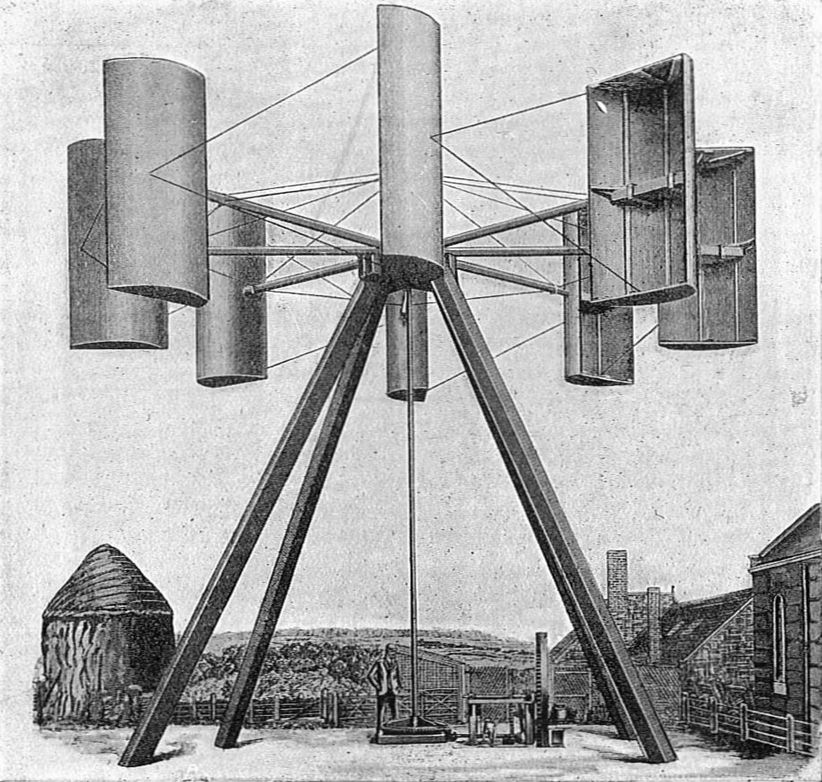
What bids fair to be the windmill of the future is the Rollason Wind Motor, shown yesterday to a number of Pressmen at Willesden Junction. Instead of having the ordinary windmill sails the Rollason is of horizontal design, with five concave sails attached to a vertical steel shaft which revolves on rollers immersed in oil. The whole apparatus is surprisingly simple, and strikes the unskilled observer as extremely efficient. The Rollason has stood some months' test quite satisfactorily. No gale can interfere with its working, though the sails revolve seventy times a minute, the apparatus weighing three tons, and it catches the slightest breeze that blows. The ordinary windmill has to be stopped in anything more than a capful of wind. On the lower end of the shaft is gear for driving a dynamo, which charges accumulators of sufficient capacity to provide for a dead calm. We know, on the authority of the Clerk of the Weather, that a calm never lasts in England longer than four days - at least none has for the last ten years; and a little known fact is worth mentioning en passant that in this country there are more breezes in the summer than the winter. But, it may be asked, what is the Rollason Wind Motor used for? For any purpose for which an orthodox windmill is now employed. The specimen at Willesden generates electricity for electric lighting, and there are automatic arrangements of the machinery by means of which the dynamo can be disconnected from the accumulators when the wind drops, and the dynamo can be stopped when the accumulators are fully charged, and restarted as soon as any current is used from the accumulators. Thus the apparatus can be allowed to work all night and on Sundays without any attention being required. The Rollason Motor costs no more than a steam engine, and can be obtained by those using gas power for four years' purchase. That is, the company owning the motor supply it free of charge on receiving the equivalent to the gas bill paid in any fairly large factory in the course of four years. Practical men are very sanguine as to the future of the Wind Motor, and they do not, we think, speak without book. Any passenger travelling through Willesden Junction can see the apparatus, which is prominently set up in a field near the station.
A NEW WIND MOTOR.Echo (London), 18 April 1894
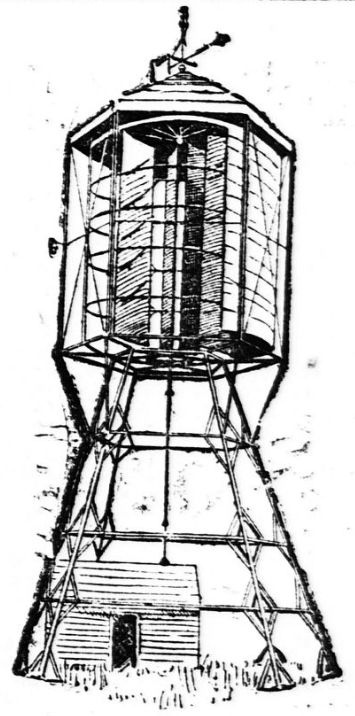
An exhibition was given at Willesden yesterday of the Rollason Wind Motor, an invention for generating electricity and other purposes. It is a new form of windmill, horizontal in design, erected in a skeleton turret. Inside the turret is a vertical steel shaft with five concave sails so arranged that the wind actuates three at the same time. On these revolving the power developed is transmitted by a shaft running down the centre of the supporting framing into a building on the ground. There are also several automatic arrangements whereby the motor runs without attention, and the inventor claims that the ease with which it can be erected anywhere will make it the cheapest mode of supplying motive power for pumping, electric lighting, or other machinery.
A WIND MOTOR.South Wales Echo, 18 April 1894
A large number of scientific men visited Harlesden yesterday to inspect the Rollason Wind Motor. This form of motor is quite a departure from the ordinary construction of wind mills, it being a horizontal design or arrangement erected within a skeleton turret. The motor is 20ft. in diameter, and is erected on an open iron structure, 30ft. high, and is being used for generating electricity for lighting purposes. The power developed by the motor is transmitted by a vertical shaft to which are attached concave sails running down the centre of the supporting framing into a wooden building on the ground. On the lower end of the shaft is provided suitable gearing for working the necessary mechanism for driving the dynamo which charges accumulators of sufficient capacity to provide for a calm or an extremely light breeze. The invention will doubtless prove a very valuable one, for the motive power can not only be utilised for the generation of electricity but also for factory purposes, and as a mechanical agent for working pumps or other machinery. It is claimed that the motor can take up a slight breeze or accommodate itself to a gale.
THE WIND AND ELECTRICITY.St James's Gazette, 18 April 1894
On the invitation of the directors of Rollason's Wind Motor Company, representatives of the Press assembled at Willesden Junction yesterday to inspect the "Rollason wind motor." This is a new invention for bringing the currents of air into the service of electricity. The motor is, in fact, a new form of windmill, differing materially however from those one is accustomed to see in rural districts. It is horizontal in design, and erected within a skeleton turret fixed to the top of an iron structure about thirty feet high. Within the turret is a vertical shaft, to which five concave sails are attached. The principle is, therefore, simple. The mechanism is so finely adjusted that on the least breath of wind the sails and shaft revolve. The shaft runs from the top of the turret to the ground below, and to it at the lower end suitable gearing is provided for working the necessary apparatus for driving the dynamo. Here, then, are very simple means for obtaining motor power. Of course it will be said that on some days there must be insufficient wind to set the sails in motion. The objection, in fact, applied to the early part of yesterday afternoon, but this is at once met by the provision of accumulators, of which there may be any number, and by means of which a sufficient storage may always be ready for use on calm days. It is claimed that the simplicity of the invention and the ease with which it may be installed and maintained in almost any situation, but especially in out-of-the-way districts, will render it of the very greatest utility. The motor at Willesden is being used for generating electricity for lighting purposes.
A NOVEL WINDMILL.Hampstead News, 19 April 1894
In these days the natural force obtainable from the winds of heaven has been somewhat neglected by engineers. It is rather curious that so little has been done to take advantage of such an obviously powerful and cheap agent by means of reliable appliances; yet it is a fact that the windmills hitherto in existence are, for the most part, such primitive contrivances as to be useless except under favourable conditions of the elements. A step in the right direction has been taken by the Rollason Wind Motor Company, who have devised a mill which, it is claimed, is workable in the lightest breeze or the fiercest gale, blow the wind whence it listeth, and utilizes the force derived from the wind to generate and store up electricity for application to any purpose for which driving power is required. The motor differs in appearance and construction from the windmill at present in use. The five sails, some 7 ft. wide and 20ft. high, ingeniously arranged to take full advantage of whatever breeze there may be, are fitted on a skeleton iron turret, and are fixed to a steel shaft revolving in the centre. By means of this shaft the power derived from the motor is transmitted below to gearing suitable for working the necessary mechanism for driving the dynamo. The electricity generated by the dynamo is then stored in accumulators for use as required. Among the ingenious details of this invention are provisions for automatically disconnecting the dynamo from the accumulators when the wind drops, and for stopping the dynamos when the accumulators are fully charged, or for restarting it as soon as any current begins to be used. These arrangements obviate in a great measure the necessity of constant attention to the machinery. It is claimed that the motor can be fixed to the roofs of dwelling houses or factories for lighting purposes; or it can be utilized for driving machinery of any kind. It is certainly a cheap and handy contrivance, and we shall be surprised if the Rollason Wind Motor does not meet with a large measure of success.
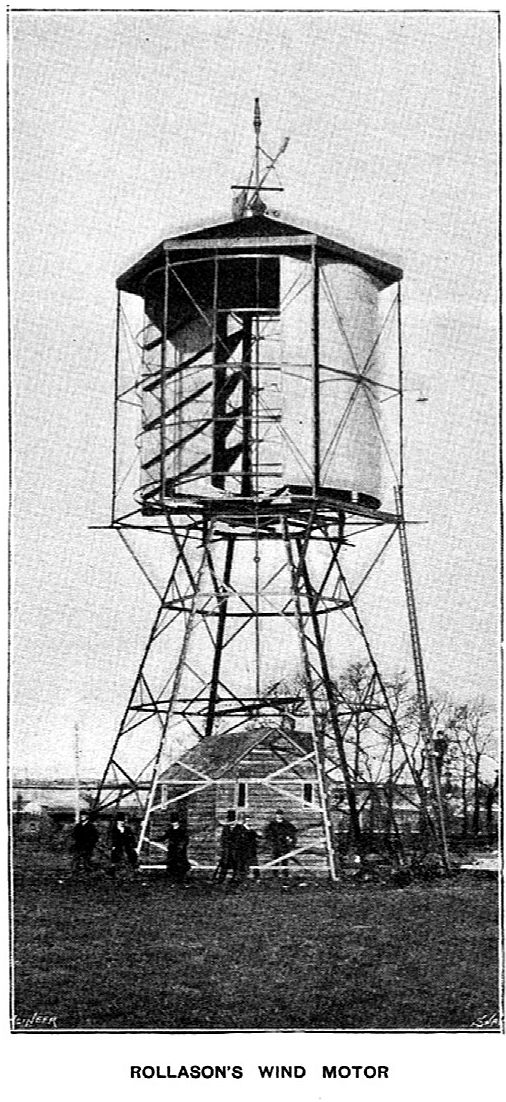
The first public exhibition of Rollason's wind motor took place on Tuesday at Harlesden. The motor, which is intended primarily for the generation of electricity, stands thirty feet high, and is mounted on a light steel derrick. There are five concave sails to it with sloping deflectors on their inner faces, and the side on which these, in revolving, approach the wind is protected from it by a shield. This shield is movable, and is connected with a large vane on top of the skeleton turret in which the motor works, and as the wind changes the vane and shield follow and so keep the proper quarter protected.The Engineer, April 20, 1894
ROLLASON'S WIND MOTOR.Typical of the press, some of them seem to have been there more for the food than the technology! Kilburn Times, 21 April 1894
We recently had an opportunity of examining a new type of wind motor built by Rollason's Wind Motor Company, of Berners-street, London. The motor has been designed to produce motive power for electric lighting and other purposes, and a specimen has been built and erected in a large field close to Willesden Junction Station. A complete electrical installation, consisting of dynamo, accumulators, and switchboard, is installed in a wooden building at the base of the motor, and the outward appearance of the plant is shown in Fig. 1, which is taken from a photograph....
we understand that a number of orders has already been received by the company, which is about to start works close to Willesden Junction station, where it will manufacture the complete plants.
A modern windmill Performing wonders at Willesden.Royal Cornwall Gazette, 26 April 1894
On Tuesday afternoon a good number of Pressmen and engineers assembled at the Royal Oak Hotel, Harlesden, on the invitation of the directors of the Rollason's Wind Motor Company, 13, Berners-street, W., for the purpose of inspecting the "Rollason Wind Motor" near Willesden-junction. Before going to inspect this new invention for bringing the currents of air into the service of electricity, the large company sat down to an excellent luncheon at the Royal Oak Hotel. The luncheon was presided over by Mr. H. Fletcher, Chairman of the Company, who was supported by Colonel Brown, F.R.A S., Messrs. J. R. and C. A. Rollason, Mr. Allistone, Solicitor to the Company, and Mr. G. H. Cole, Secretary. After ample justice had been done to the good things provided, the Chairman gave the usual loyal and patriotic toasts, which were duly acknowledged. He afterwards gave the toast of the Press, saying that it gave him great pleasure to see so many representatives of that intelligent profession present that afternoon. With the toast he coupled the name of Mr. Mackay, the representative of the "Standard," to which that gentlemen suitably replied, and in conclusion, gave the toast of the directors of the Rollason Wind Motor Co., associating with it the name of Col. Brown, to which that gentleman replied in a most humorous speech. He explained some of the working power of the windmill, and said the great feature of all this utilisation of a hitherto untaxed force of nature, was that it cost an infinitesimal sum to procure the electric light in comparison with the cost of the steam engine to work the dynamo. All that anyone needed to do was to erect a Rollason windmill above his house and a little dynamo in communication with it indoors, then he could generate electricity to light his house through. (Hear, hear.) The mill was calculated to revolutionise the system of setting the electric dynamo at work, and supplying motive power for machinery in factories. The company was afterwards conveyed in cabs to a field near Willesden Junction, in which the Motor was to be seen at work, and the whole of the machinery and its mode of working, was fully explained by Mr. Rollason.
THE WIND AND ELECTRICITY.Blackburn Standard, 12 May 1894
On the invitation of the directors of Rollason's Wind Motor Company, representatives of the Press assembled at Willesden Junction to inspect the "Rollason Wind Motor." This is a new invention for bringing the currents of air into the service of electricity. The motor is, in fact, a new form of windmill, differing materially, however, from those one is accustomed to see in rural districts. It is horizontal in design, and erected within a skeleton turret fixed to the top of an iron structure about thirty feet high. Within the turret is a vertical steel shaft, to which five concave sails are attached. The principle is therefore simple. The mechanism is so finely adjusted that on the least breath of wind the sails and shaft revolve. The shaft runs from the top of the turret to the ground below, and to it at the lower end suitable gearing is provided for working the necessary apparatus for driving the dynamo. Here, then, are very simple means for obtaining motor power. Of course it will be said that on some days there must be insufficient wind to set the sails in motion. The objection, in fact, applied to the early part of the previous afternoon, but this is at once met by the provision of accumulators, of which there may be any number, and by means of which a sufficient storage may always be ready for use on calm days. It is claimed that the simplicity of the invention and the ease with which it may be installed and maintained in almost any situation, but especially in out-of-the-way districts, will render it of the very greatest utility. The motor at Willesden is being used for generating electricity for lighting purposes.
A WIND MOTOR.Bridge of Allan Gazette, 23 January 1897
"Raising the wind" has long been a favourite occupation, and the Rollason Wind Motor Company have an idea which will enable them to profitably use the wind when raised. Out in a field at Willesden they have erected what looks like a lighthouse containing the motor. This is horizontal in design, and erected within a skelton turret fixed to the top of an iron structure about 30 feet high. Within the turret is a verticle steel shaft, to which five concave sails are attached. The mechanism is so finely adjusted that on the least breath of wind the sails and shafts revolve.The shaft runs from the top of the turret to the ground below, and to it at the lower end suitable gearing is provided for working the necessary apparatus for driving the dynamo and generating electricity. Of course it will be said that on soma days there must be insufficient wind to set the sails in motion. The objection is at once met by the provision of accumulators, of which there may be any number, and by means of which a sufficient storage may always be ready for use on calm days. It is claimed that the simplicity of the invention and the ease with which it may be installed and maintained in almost any situation, but especially in out-of-the-way districts, will render it of the very greatest utility. The motor at Willesden is being used for generating electricity for lighting purposes.
A motor working a complete electrical plant at Willesden Junction ran, it is stated, from December, 1893, to the middle of February, 1895, without once being touched or re-oiled in any way, and during that time it withstood without any damage two of the severest gales.
Other Images:
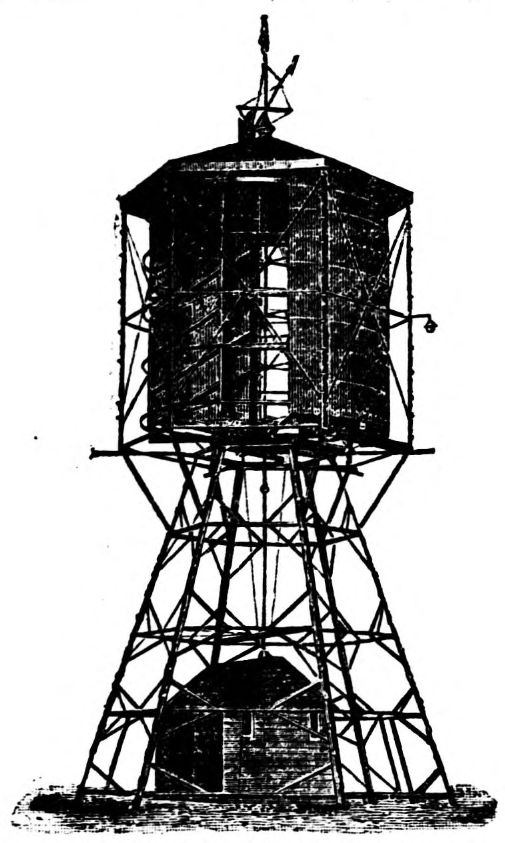
| location | |
| name | |
| county | |
| date | |
| designer | |
| sails | |
| purpose | |
| note |
| location | |
| name | |
| county | |
| date | |
| purpose | |
| owner |
A VAWT installed on a glass tower of the B&Q store. video
| location | |
| county | |
| date | |
| owner | |
| note |
Whilst not explicitly specified as a windmill, it is unlikely given the location that this horizontal mill was water driven, so was most likely wind driven.
FURNITURE, LIVE AND DEAD FARMING STOCK, &c. HANWELL-PARK, MIDDLESEX.
By Mr. WINSTANLEY,
By Order of the Executors of WM. HARWOOD, Esq. deceased, on the Premises, on WEDNESDAY the 16th instant and two following days, at Eleven o'Clock,
ALL the genteel and excellent HOUSEHOLD FURNITURE, Books, and other Effects, at Hanwell-park, Middlesex, near the Hats Inn, on the Uxbridge-road; consisting of a fashionable drawing-room suit, large mahogany library-case, 14 feet wide; curious English and oriental. fire-arms, swords, &c. strongly mounted with silver, mathematical instruments, a pair of 15-inch globes, by Blunt; collection of books, in elegant bindings, about 80 loads of well-got meadow-hay, seven quarters of wheat, 30 ditto of oats and beans, 50 fleeces of wool, five carts, a jockey-cart, and a tilted ditto, new harness, ploughs, and harrows, land-rolls, and other farming-implements, six cart-horses, a poney, an ass, 50 sheep, 25 lambs, two sows, four store-pigs, two yard-dogs, poultry, 150 handsome park-hurdles, brewing, garden, dairy, and stable utensils, green-house plants, a horizontal mill, a bee-house, 50 dozen wine-bottles, a large stock of ale and beer, a quantity of useful materials, old iron, fire-wood, and various other effects. To be viewed two days preceding the sale, when catalogues may be had on the premises; and of Mr. Winstanley, Paternoster-row, at 6d. each, to be returned to purchasers.
| location | |
| county | |
| date | |
| purpose | |
| owner | |
| note |
Whilst the power source is not explicitly specified here, it is described as a horizontal mill, and the later auction description makes no mention of any water works, and describes the mill as to be taken down and removed - not something that would typically be done to a watermill which is much more integrated with its environment. The final description of the parts again makes no mention of any watermill specific parts, despite saying that it can be transported by water transport.
To MERCHANTS, MILLERS, and OTHERS.
To be SOLD by Private Contract,
And entered upon immediately, if required,
A VALUABLE FREEHOLD ESTATE; comprising an exceeding good Dwelling-house, Yard, and Garden, with extensive Granaries, Stables, Coal and Raft Yards, two convenient Tenements, and a new-erected Horizontal Mill, thereunto adjoining, with three pair of Stones, Dressing Machine, and Flour Mill complete, most desirably and pleasantly situated at the well-known Port of SUTTON WASH, in the county of Lincoln, only nine miles from the port of Wisbech, and adjoining the turnpike road leading to the market towns of Long Sutton, Holbeach, and Spalding, and lying about half way between the capital ports of Lynn and Boston; and either with or without four other Tenements, and a Blacksmith's Shop, with the Yards, Gardens, and Pieces of Ground thereunto adjoining or belonging, and lying contiguous to the above premises. The whole are in the occupation of Mr. Torry Elston and his Assigns, and form a very complete and eligible situation for trade, being extremely well adapted for and wherein the Corn, Flour, Coal, Raft, Wine and Liquor branches have been considerably used.
For a view of the premises and further particulars apply to Mr. Torry Elston; or at the office of Key and Harvey, in Holbeach;- if by letter, post paid.
To MERCHANTS, MILLERS, and OTHERS.
To be SOLD by AUCTION,
At the Cross Keys Inn at Sutton Wash, in the parish of Long Sutton, in the county of Lincoln, between the hours of 4 and 6 in the afternoon of Friday the 20th day of October next, upon such conditions as will be then produced;
A Valuable FREEHOLD ESTATE, either altogether or in lots as under, viz. Altogether.
An exceedingly good Dwelling-house, Yard, and Garden, with extensive Granaries, Stables, Coal and Raft Yards, Six convenient Tenements, and a horizontal Mill, with three pair of stones, dressing machine, and flour mill complete, most desirably and pleasantly situated at the well known port of SUTTON WASH, only nine miles from Wisbeach, and adjoining the turnpike road leading to the several market towns of Long Sutton, Holbeach, and Spalding, and lying between the ports of Lynn and Boston, the whole whereof form a very eligible mercantile situation, being well adapted for carrying on the corn, flour, coal, raft, wine, and liquor trade.
The house, yards, garden, granary, stables, and mill were late in the occupation of Mr. Torry Elston, and may be entered upon immediately after the sale: but the tenements are now in the several occupations of George Brighton, William Broughton, Thomas Basham, Richard Ryley, and Robert Watson, who are under notice to quit on the 6th of April next.
Or otherwise in Twelve Lots as under, viz.
Lot 1. A good Dwelling-house, with the Yard and Garden thereunto adjoining, containing 60yards in length and 12 yards in breadth.
2. A Tenement, in the occupation of Thomas Basham, adjoining the East enid of lot 1.
3. That part of the Granaries and Stables which adjoins the East end of lot 2, containing 24 feet in length.
4. Another part of the Granaries, adjoining the East end of lot 3, containing 24 feet in length.
5. The remaining part of the Granaries, adjoining the East end of lot 4, and abutting on the mill, containing 24 feet in length.
6. The Mill, to be taken down and removed, consisting of a large quantity of excellent Fir Timber and Building Materials, well worthy of the attention of carpenters and others.
7. The Scite of the Mill, or Ground upon which the same stands, with the Yard thereunto belonging.
8. A Tenement, in the occupation of - Smith, adjoining lot 7.
9. A House, divided into two tenements, in the several occupations of Richard Ryley and Robert Watson, adjoining lot 8.
10. A Tenement, with a Blacksmith's Shop and Shed, and One Rood of Land thereunto belonging, in the occupation of George Brighton.
11. A Tenement, and Piece of Ground thereunto belonging, containing 30 yards in length and 8 yards in breadth, in the occupation of William Broughton.
12. A Piece of Ground, near to Lot 10, containing about Ten Perches, abutting on the turnpike road South.
For further particulars apply at the office of Key and Harvey, attorneys, at Holbeach, in the said county.
Sept. 1809
To MILLERS.
To be SOLD by Private Contract, together or in Lots,
ALL the MACHINERY, GEERS, &c. of a large Horizontal MILL, situated at SUTTON WASH, in the county of Lincoln; comprising French and Peak Stones, large and small Wheels, Dressing-machines, and a variety of useful articles well worth the attention of any person inclined to build a mill.
For price and further particulars, apply to Robert Bellamy, of Gedney, near Long Sutton.
N.B. The above mill is situated very conveniently for water carriage.
Gedney, 9th June, 1810.
| location | |
| county | |
| date | |
| purpose |
A HORIZONTAL WIND-MILL to be SOLD by PRIVATE CONTRACT, that will drive two pair of stones, or three on occasion. The whole, or only the opening part, with the mains, shaft, wheels, &c may be taken separately; the whole standing 44 feet high.
For further particulars enquire of the Printers; letters, post paid.
| location | |
| county | |
| date | |
| designer | |
| owner | |
| purpose | |
| sails |
Erasmus Darwin, Ernst Krause, 1879
One of the subjects which interested Dr. Darwin most throughout his whole life, and which appears little in his published works, was mechanical invention. This is shown in his letters to Josiah Wedgwood, Edgeworth, and others, and in a huge common-place book full of sketches and suggestions about machines. He seems, however, rarely to have completed anything, with the exception of a horizontal windmill for grinding flints, which he designed for Wedgwood, and which answered its purpose.Very similar phrasing is found in newspapers published after the book appeared, so I'd suggest the material was being recycled! New-York Tribune, December 26, 1879
Throughout his life he was interested in mechanical invention, and he left a huge common-place book full of sketches and theories. There was little, however, that he completed except a horizontal windmill for grinding flints, which succeeded and was put to use by Wedgewood.
A History Of The Royal Society, Henry Trueman Wood, 1913
Dr. Erasmus Darwin corresponded with the Society at one time about his idea of a horizontal windmill, but no award was made to him.
Letter from Wedgwood to Bentley, 3 March 1768, discussing ways to grind pigments
Windmill of Dr. Darwin's projection
Letter from Wedgwood to Bentley, 15 March 1768 describes the mill, including a sketch of the principles by which it works.
Darwin's letter to the Society of Arts
I have lately constructed the model of an horizontal Wind-mill, which appears to have a third more Power than any vertical Wind-mill, whose Sail is of the same diameter, & is in other respects more manageable & less liable to Repair, as it has less wheel-work, having only an upright Shaft on the Top of which the Sail is fix'd .... This Model is 3 ft. diameter, & I should not chuse the Expense of sending it up unless there was a Chance ... that the Society might grant me a Premium to assist me to execute it at large.It was not until 1786 that the Society of Arts offered a premium for a horizontal windmill, and so they had little interest in it in 1769. (See Darwin to Dr. Templeman, 4 February 1769, Guard Books, vol. A, No. 68, and MS. 'Minutes of the Committee on Mechanics 1785 & 1786', 2 March 1786, p. 184; Archives of the Royal Society of Arts.)
Darwin's commonplace book has an entry on 6 August 1779 discussing detailed experiments on variations of the mill.
Letter from Richard Lovell Edgeworth to Wedgwood, 20 August 1779
As Journeyman to Dr. Darwin I have tried a very great number of Experiments to determine whether our horizontal Mill might be made to advantage for your purposes: And by several ingenious contrivances which the Dr. Proposed and which I subjected to the test of Experience this species of Machinery may be made to exceed any other horizontal wind-mill in the proportion of four to one or perhaps in a yet higher ratio.Letter from Wedgwood to Bently, 1779
From Stafford I journey'd on to Lichfield to assist at a consultation about a windmill of Dr. Darwin's invention, which has likewise been perfecting under the hands of Mr. Edgeworth & Mr. Watt.Wedgwood adopted the horizontal mill for use in grinding his flints and colours until he acquired a Watt engine
The windmill was illustrated and described in Darwin's book, where it has been positioned as a water raising device, rather than the more niche requirement of pigment grinding Phytologia, Or, The Philosophy of Agriculture and Gardening, Erasmus Darwin, 1800
PLATE VII
Is a section of a machine for raising water a few feet high by the power of the wind for the purpose of draining morasses, or of watering lands on a higher level.
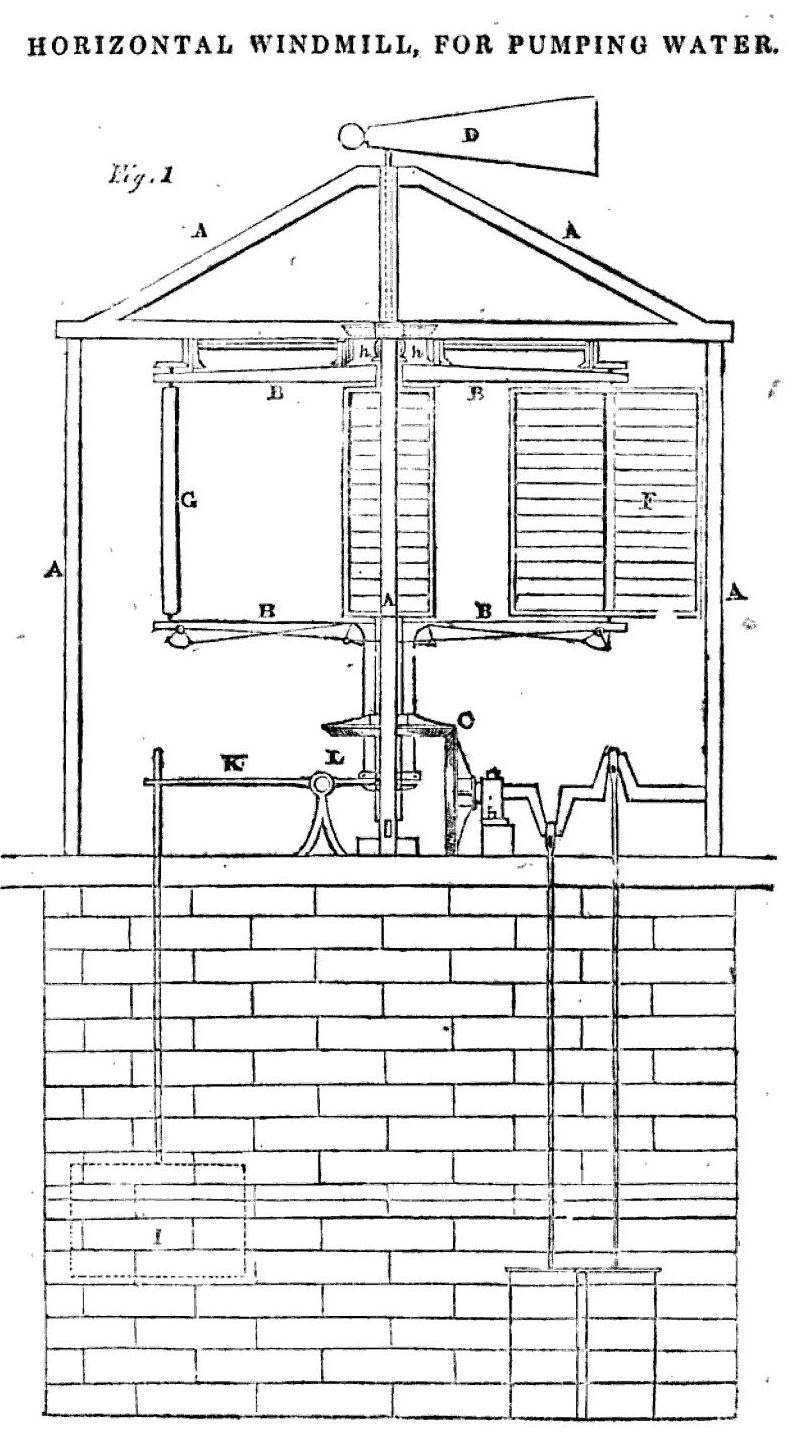
It consists of a windmill sail placed horizontally like that of a smoak-jack, surrounded by an octagon tower; the diverging rays of this tower, a b, a b, may consist of two-inch deals only, if on a small scale, or of brick-work if on a larger one. These upright pillars are connected together by oblique horizontal boards as shewn at A B, by which boards placed horizontally from pillar to pillar, in respect to their length, but at an angle of about 45 degrees in respect to their breadth, so as to form a complete octagon including the horizontal windmill sail near the top of it; the wind as it strikes against any of them, from whatever quarter it comes, is bent upwards and then strikes against the horizontal wind-sail. These horizontal boards, which form the sides of the octagon, may either be fixed in their situations, or be made to turn upon an axis a little below their centres of gravity, so as to close themselves on that side of the octagon tower most distant from the wind.
It may be supposed that the wind thus reflected would lose considerably of its power before it strikes on the wind-sail, but on fixing a model of such a machine on the arm of a long whirling lever, with proper machinery to count the revolution of the wind-sail, when thus included in a tower and moving horizontally; and then when moved vertically as it was whirled on the arm of the lever with the same velocity, it was found on many trials by Mr. Edgeworth of Edgeworth town in Ireland, and by myself, that the wind by being thus reverted upwards by a fixed planed board did not seem to lose any of its power. And as the height of the tower may be made twice as great as the diameter of the sail there is reason to conclude that the power of this horizontal wind-sail may be considerably greater, than if the same sail was placed nearly vertically opposed to the wind in the usual manner.
At the bottom of the shaft of the wind-sail is placed a centrifugal pump with two arms at CD, which has been described in mechanical authors. It consists simply of an upright bored trunk, or cylinder of lead, with two opposite arms with an adapted valve at the bottom to prevent the return of the water, and a valve at the extremity of each arm to prevent any ingress of air above the current of the water as it flows out.
cccc is a circular trough to receive the streams of water from C and D, to convey them where required.
| location | |
| county | |
| date | |
| designer | |
| purpose |
THOMAS WALKER, MACHINE-MAKER. NORWICH,Patents for inventions. Abridgments of specifications, 1873
Has been granted his most excellent Majesty's Royal Letters Patent, for certain IMPROVEMENTS in an HORIZONTAL WIND-MILL, which will be of public utility, particularly in thrashing and grinding of all sorts of corn, or any other sort of machinery that is to be worked by wind. It can be placed before a barn-door without obstructing a loaded waggon, with unthrashed corn, from going into the barn, and is so simply constructed, that there is no more than one wheel and pinion to thrash or cut straw, and will require no more than one man and two boys to thrash, &c. T. W. will engage them to thrash for one third less expence than any machine ever yet offered to the public. They can be made to a one-horse power up to fifty or more, if required. T. W. will have one for inspection, which may be seen in action in one month from this date.
He likewise informs Gentlemen Farmers, that he has made several improvements in his Dressing Machines which are allowed, by all that have seen them in action, to far exceed any others ever offered to the public.
A.D. 1813, May 5 .- N° 3689.Bury and Norwich Post, 18 April 1821
WALKER, THOMAS.- "Horizontal windmill." This consists of an octagonal conical frame or building closed on every side by shutters, which can be opened or shut, and regulated according to the force of the wind by a lever acted on by a weight. Within is a vertical shaft with arms carrying vanes "made of thin boards, the one standing edge upwards, and the other put on the top, leaning towards the wind, forming the eighth angle." "When the windmill is in action, the shutters must be four open and four shut, except the wind blows very strongly, then six shut and two open."
[Printed, 8d. Drawing. See Rolls Chapel Reports, 8th Report, p.99.]
T. WALKER, WIRE WORKER, NORWICH,The patent referred to is
BEGS leave to inform Maltsters, that he has made several Improvements in a Machine for WORKING WIRE for Malt Kilns, which now makes it in such a strong and perfect manner, that no other can exceed it, and being worked by his Patent Horizontal Windmill, he is enabled to sell it at a much lower Price than it has ever before been offered to the Public - Letters post-paid, will be duly attended to.
THOMAS WALKER, Norwich, machine-maker; for various improvements in the construction of a horizontal windmill, that may be applied to all sorts of machinery that is to work by wind. Dated May 5, 1813.
It's possible this invention was a long time in the making - over a decade earlier than the patent, a Thomas Walker had communications with the Royal Society of Arts about horizontal windmill sails: Letter from Thomas Walker about his horizontal windmills sails and Letter from Thomas Walker about his horizontal windmills sails, with drawing.
VERY DESIRABLE FREEHOLD ESTATE IN NORWICH.
To be SOLD by AUCTION,
By Mr. CULLEY,
On Monday, December the 9th, 1822, At the Norfolk Hotel, St. Giles, Norwich, Precisely at Six o'clock in the Evening,
A SMALL and Compact Genteel DWELLING-HOUSE containing an entrance, neat parlour, and sitting room, in front, three sleeping rooms, and convenient offices, with a building adjoining, easily converted into a stable and gig house, and a large piece of land at the back thereof, on which is a neat summer-house, several extensive work rooms, and an horizontal mill, erected at a considerable expence.
The above premises were late in the occupation of Mr. Walker, Machine Maker, deceased, are situated in Cook's Lane, King-street, in the parish of St. Georges Tombland, and are extremely well calculated for a Small Brewery or Manufactory, the Business of a Millwright, Carpenter, or any other in which room is required.
The Estate is moderately assessed to the Land-tax.
| location | |
| county | |
| date | |
| owner | |
| purpose |
Hereford Farmers Club
The quarterly meeting of this club was held at the Green Dragon Hotel, in this city, on Saturday last, M. Newton Esq., in the chair. The members present were Mr. M Lingwood Esq., Mr. J. Jauncey, Mr. Watkin Maddy, Mr. Fowler, Mr. Ronan, Mr. W. Taylor, Mr. Clarke, and the secretary, (Mr. Apperley.)
...
Mr. FOWLER remarked that there was a small engine at Kynastone Court, where everything was fed upon steamed food.
Mr. ROWAN observed that Col. Scudamore had a steaming apparatus, which was also used for the purpose of cutting hay, thrashing, &c. He (Mr. Rowan) had recently erected an improved horizontal windmill which possessed very great power, and might be constructed at a very little expense. It would, he thought, be highly valuable to the farmer, inasmuch as it might be applied to every purpose to which horse power could be used, such as chaff cutting, grinding, thrashing, &c., the motion being the same.
Mr. APPERLEY said that when Mr. Brunel was here a short time since he noticed Mr. Rowan's mill, and remarked that he never saw so much power contained in so small a compass.
Mr. FOWLER said the only objection to windmills was that they would not go when there was no wind.
Mr. ROWAN replied that water-mills would not go in a very dry season when there was no water; but his mill was so constructed that when there was no wind he could throw it out of gear and put a horse to it. The sails also might be regulated according to the wind; if there was but little wind more canvass could be applied, while if the wind was very high a reef could be taken in. Mr. Rowan then proceeded to explain the principle upon which the mill was constructed, stating that, unlike other windmills, it required no turning to the wind, and that three out of four of the sails were always full. He ground charcoal, bones, &c., and had no doubt when completed it would answer admirably. In answer to a question as to whether the mill would answer in the immediate neighbourhood of a farmer's fold-yard and buildings, Mr. Rowan replied in the affirmative, observing that the mast might be raised above the buildings, so that there was no fear of the wind being kept from it. Most of the members present promised to walk down and look at this excellent contrivance at the first opportunity.
The CHAIRMAN said that he very much questioned the advantage of steaming food for horses and cattle at all.
Mr. LINGWOOD replied that it made the food more palatable more digestible, and they would eat more of it.
| location | |
| county | |
| name | |
| date | |
| owner | |
| purpose | |
| building |
OLD "ROUND HOUSE." We have every reason to believe that by the time these lines are before our readers the removal of one of the landmarks of our neighbourhood will have been begun, and the old familiar building known as the "Round House" will be in course of demolition. As far as can be conjectured this structure dates from towards the close of the past century; for the "oldest inhabitant" of Redditch does not seem to remember its erection, while from the fact of Jos. Monk omitting all mention of it in his "Account of the state of the buildings in Redditch in 1776" it is evident that the Round House did not exist at that time. At regards the originator of, at least, the circular part of the building, and the purpose to which it was to be applied, the following extract from the Indicator Christmas Tale, 1889, gives the sum of all that is known from history and tradition respecting these :- "The curious structure so long familiar to Redditch as the Old Round House was built some considerable time before the close of last century by a certain William Sheward, a Quaker. His contemporary Dr. Nash, the historian of Worcestershire, speaks of him as 'an ingenious artist.' Not much is recorded of him, but we find that as early as 1760 he was largely engaged in the needle trade. It would seem that he built the Round House for business purposes: the long narrow slots in the circular walls, of which traces are yet to be plainly seen, were, it is said, for the admission of wind, by which sails were to be turned within, and motive power thus generated. But this, like many of the schemes of 'ingenious artists' was a failure. In spite however of the failure of this scheme. we do not doubt the justice of Dr. Nash's appellation. Mr. Sheward was an inventor and patentee, and proofs of his "ingenuity" may even now, after the lapse of a century, be obtained from the Patent Office for a few pence. There is every reason for believing that the old Round House (an illustration of which we here present to our readers) existed first as a simple circular building, to contain within it the windmill above-mentioned; that when this proved a failure the 16 long slots in its walls were wholly, or partially, bricked up and windows were inserted in lieu of them, whilst floors were laid so as to divide the whole height into three storeys, for the purpose of turning the place into needle-shopping, or a compound of this and dwelling-house for workmen. Whether the partition walls quartering the circular edifice were built at this time is doubtful; since some of the windows in the upper part would in that case appear to have been injudiciously placed. Our reason for believing that the old Round House in its second phase was used as a "domestic factory" in the quarter-circular room visited, the radius of which was not more than 13 feet, there had been three windows, a number useful enough in a needle shop, but quite unnecessary in so small a sleeping room, and which would, if all these upper rooms were similarly lighted, give 12 as the number all round the top storey. In the story below, however, there appear to have been two windows only to each of the four rooms, and in the bottom rooms but one to each The old Round House, as it has existed during the memory of living men, consists of a central circular building, the diameter of which would be, from "out to out" 28 feet, and which is divided into four separate dwellings by brick partition walls extending upward through the three storeys. Where these partition walls meet in the centre is the chimney stack of four flues, one to each dwelling; the fireplaces (on the basement floor only) being therefore in the angles, and the over hanging chimney-breast rests on a short beam, as is usual in old-fashioned dwellings. Upstairs no fire-places were originally provided. These curiously arranged dwellings, four in number, did not however contain room enough on the ground floor, and an apartment was therefore added to each in the form of a little room, the side walls of which converged in the direction of the central chimney stack, and thus caused them to be somewhat fan-shaped in plan. These little rooms were in pairs, and the chimney which was provided for one of the pairs may be seen in the illustration. The two pieces of building fanning out on the left, are separate houses, not influenced materially in shape by being built against the central circular part and making up the number of six dwelling houses clustered together. In spite of the cutting through of the walls of the circular part of the building, to make the various alterations, the old Round House, though exposed to the roughest of weather, has stood well; many times after a severe gale in the night have doubts been expressed as to whether the circular tower-like part would be in status quo in the morning; but still, year after year, it has been there. It has however been found necessary to strengthen the walls, especially on the eastern side, with ironwork. Many might suppose that these six dwellings above described, would be by no means very desirable habitations, but one of the tenants stated that his was the most comfortable house he ever had, and he would like to take it on for 20 years; indeed, there seemed to be a look of regret upon the faces of other tenants who were leaving; and although no doubt but Mr. Huins will erect upon this beautiful site some edifice which will be an ornament to the locality, still many of the present generation will at times bestow a thought upon the old Round House long after it has passed away.
| location | |
| county | |
| date | |
| purpose |
TUESDAY, JULY 6. [1802] We rose at a wholesome hour, and were ready before six, when the coach came up. The morning was fine, and we mounted the roof. The country is uninteresting, hills of neither magnitude nor beauty, and fields intersected by stone walls. We passed through a town called Chipping-Norton, which stands on the side of a hill, and then descended into a marsh, from whence the little town on the hill side became a fine object. A few miles beyond, a pillar has been erected to mark the spot where the four shires of Oxford, Warwick, Worcester, and Gloucester meet; this latter one we now entered. Breakfast was ready for us at Moreton in the Marsh, a place which seems to have little else to support it than its situation on the high road from Worcester to London. Before we entered, the coachman pointed out to us the town of Stow in the Wold, built on a high hill to our left, where he told us there was neither fire, water, nor earth. Water was formerly raised from a deep well by means of a horizontal windmill, but this has fallen to decay.
| location | |
| name | |
| county | |
| date | |
| maker | |
| note |
JOURNAL OF A TOUR IN ENGLAND, IN 1815 AND 1816, From the MS. Notes of their Imperial Highnesses the Archdukes John and Lewis of AUSTRIA.Northampton Mercury - Saturday 30 September 1815
The mansion of the Duke of Bedford at Woburn, where we stopped on the 5th of November [1815], is, with its gardens and park, one of the most superb establishments in England. ...
On leaving Woburn the country is rather uniform though well cultivated; but, as soon as you enter Leicestershire, there is a change both in the aspect of the country and in the cultivation. Its situation is more elevated, and it is evident, from its consisting chiefly of meadows and pasturage, that the keeping of cattle is the principal occupation of the inhabitants.
We were at Leicester on the 6th. The houses are built of brick, of a very lively red, and the roofs slated, which produces a very pleasing effect. Wilson's foundry was the first manufactory that we saw in this town. Here nothing is made but very fine work and machines. The horizontal wind-mills, for which Wilson has obtained a patent, are very beautiful. Kelly's knitting manufactory is considerable. There are fourteen large frames set in motion by a steam-engine. By this method the manufacturer is enabled to furnish for 14s. what formerly cost 40s. The produce of this establishment is very great; it sells from 7 to 8000 dozen pair of braces every week. Great part of these goods is exported to America.
WILSON & NORAWAY.
Iron and Brass Founders, Leicester.
All Sorts of ENGINES, MILLS, and MACHINERY, executed in the best Manner, and on the most reasonable Terms.
Engineers and Millwrights supplied with all Kinds of metal Work, bored or turned with Dispatch, and on liberal Terms, and a great Number of Patterns kept for their Use. - The following Machines are got up in the best Manner for ready Money :-
      Two-horse Power fixed thrashing Machines .. £50  0
      Four horse Ditto Ditto ....................  70  0
      Four-horse portable Ditto, the horse Power
        and thrashing Part being all of Iron and
        standing and working on their own. Wheels  90  0
        Salmon's Patent Hay making Machine . ..... 18 18
Patent horizontal Windmills, horse Movements, for working all Kinds of Machinery.
Palisading and iron Fences of every Description.
Ironmongers furnished with kitchen Work, &c. &c. on the lowest Terms.
| location | |
| county | |
| date | |
| designer | |
| maker | |
| purpose |
... there was a threshing machine to admire, powered by a windmill and erected on the site by Mr Wilson of Leicester. This horizontal windmill, patented by Mr Long, a Leicester surgeon, was reported to have "won a gold medal from this society three years back".Presumably this was an example of the horizontal windmills that Wilson's iron foundry produced.
| location | |
| county | |
| date | |
| designer | |
| purpose |
HUNDON.
WATER SCHEME, - At a meeting of the Clare Rural District Council on Friday afternoon, at the Kedington Workhouse, the Rev. J. R. Little presiding, the Sanitary Inspector (Mr. W. H. Carr) and the Medical Officer, with regard to a water scheme for Hundon, recommended the digging of a well on a site at the upper end of Hundon, abutting on the main road. The depth of the well should be 180 feet, and the diameter 4ft.6in., while the mouth of the well should be 366 feet above the level of the sea. They expected to find the chalk water line about 166 feet below the surface, and the well should contain about fourteen feet of water. Near the bottom would be fixed two 4 in. metal deep pumps, worked by Messrs. Rollason's wind motor. A covered surface reservoir with & capacity of 11,000 gallons should be constructed, from which the water would be gravitated by 3 in. cast iron water mains laid two feet deep along the side of the road. Five standpipes, the level of the reservoir, would allow the water to be gravitated to Babel-green and to Steeple-chase, which latter place was badly off for water. Half an acre of land would be required for the well and the reservoir and to allow of future extension of water storage. The land is the property of the Hon. W.F.D. Smith, M.P., and the estimated cost of the works is £800, which would be covered by a 3d. rate for the first year. Mr. Rollason (Messrs. Rollason, engineers, London) had pronounced that a better site could not have been chosen, and he guaranteed that a 15 ft. motor supplied by his firm would pump water at the rate of 10,000 gallons a day, and would be capable of pumping 20,000. - It was resolved to apply to the Local Government Board for a loan of £1,000, though it was not expected that the cost would be more than £900 at the outside.
WATER SUPPLY AT HUNDON
LOCAL GOVERNMENT BOARD INQUIRY.
Colonel C. H. Luard, R.E., Local Government Board Inspector, attended at the Hundon Schoolroom on Thursday morning to hold an inquiry into an application by the Clare Rural District Council for sanction to borrow £1,400 for works and water supply for the parish of Hundon. There was a large attendance of parishioners, several members of tie Rural District Council being present. Dr. Armistead, Medical Officer of Health, stated that the geological formation in the district was boulder clay, overlying chalk, and it was proposed to take a well through the clay into the chalk, from which a plentiful supply of good water could be obtained. The present supply of water he characterised as very dangerous and unsatisfactory, as the water in the principal well came too near the surface, and as it was near the churchyard, it was liable to be polluted. - Mr. W. H. Carr, Inspector of Nuisances, said that for a number of years there had been complaints made by the inhabitants as to the insufficiency of the water supply. One shallow well had been sunk on the road, and the other well was near the churchyard, but, though 80 feet deep, it probably obtained its supply from near the surface. There were a few better wells attached to the more important houses, which held water of various qualities, though one well was so bad that he was informed the horses refused to drink it. The smaller cottages, however, could not boast of even a shallow well, and necessarily obtained water for drinking purposes from the nearest pond or ditch. From investigations he had made he had found cases of diphtheria in Hundon, where ditch water only was available. During the summer of 1898 many of the shallow wells became dry, and the bed of an adjacent brook was eagerly sought for, but it ran dry and left a few stagnant pools of impure water, which formed the sole water supply for the season. The population of Hundon was 838. and he considered that an efficient supply of water was necessary. The proposal was to construct a deep well to reach the underlying chalk water, some 170 feet to 180 feet below the ground level, at a site immediately above the parish on the Stradishall Road, near the highway, extending 366 feet above the sea level. To raise the water it was proposed to erect a powerful Rollason's wind motor 20 feet in diameter, and fixed 20 feet high to suit the exposed position. With a moderate wind, it would develop five-horse power, and a motor with a 4 inch double-barrel gun-metal force pump, and 3 inch raising main was capable of pumping over 1,000 gallons of water per hour to the required height. An auxiliary horse-gear apparatus would be provided to guard against periods of calm. It was proposed that the water so raised should be stored in a covered service reservoir near the well, strongly constructed of Portland cement, concrete, and clay puddle, covered with a concrete and iron girder root, to hold some 25,000 gallons of water. To gravitate the water from the reservoir to the various parts of the village 3 in. cast-iron water mains would be used.
Mr. A. Boa, of Great Thurlow, produced samples of water drawn from a well at Chipley Abbey, Poslingford, evidently unfit for drinking purposes. - It was stated that Mr. W. H. Smith had given the land for the site free, and had asked to have some of his farms supplied direct; but Mr. Boa said that this could not be managed from the present height of the site. - In reply to Mr. G. W. Goodchild, C.C., of Clare, Mr. A. Bigmore (Deputy-Clerk of the Council) said that the cost of the scheme would be defrayed by a special Sanitary-rate. - Mr. Goodchild objected that the scheme would only benefit about 250 or 300 inhabitants - not one-half. - The Sanitary Inspector said it would supply nearly the whole of the parish. - Mr. Goodchild said they must take into consideration the various farmhouses the water would not reach. He did not oppose the scheme or support it. - After considerable discussion and examining of plans, Mr. Goodchild's suggestion that the connections be extended from Steeple Place to Allen's Farm was adopted, as a proposition by two ratepayers present, to be sent as a recommendation to the Clare Rural District Council. - The inquiry then ended.
| location | |
| county | |
| date | |
| owner | |
| purpose | |
| millid | 13504 |
| location | |
| county | |
| date | |
| designer | |
| purpose |
Referenced in an advertisement in the Hull Advertiser in 1816
To Mill-Wrights, Thrashing-Machine Makers, and Others.
Who are interested in erecting WIND POWERS, particularly at a reasonable rate.
AN opportunity is now offered through the recent erecting of an Horizontal Wind Mill, in Witham, near Hull, upon the Premises of ROBERT DAWSON, the Patentee, who constructed the first Packet that sailed against wind and tide: he has now perfected a Machine upon the most simple and safe principle, as regarding high Winds and attached Buildings, which he can readily apply, from One Horse Power to Twenty: and from his knowledge of the late Improvements in the Machinery of Mills and Manufactories of this country, he is qualified and ready to afford most satisfactory information on this important matter; and is desirous upon a fair consideration as Patentee of the Horizontal Wind Powers, to grant privileges for the contracting of others.
Having an entire Apparatus attached to the other Machinery of the Horizontal Mill, for the distinct object of Grinding PAINT, the Patentee has it in his power to do it on the most reasonable terms.
Hull, Jan. 18, 1816.
| location | |
| county | |
| date | |
| designer | |
| purpose | |
| ngr | |
| gps |
Another photo shows skaters on the Hornsea sea front, and again shows the signal box and horizontal windmill behind. From this picture it's clear that the water tower was further away from the signal box than the loco picture suggests - so it was larger than it perhaps seemed.
A probably 1950's view of Hornsea Station taken from the seaward side of the buildings shows a water tower still existing at that time, now with a more conventional wind engine on it. The water tower also appears in this c1965 image. This undated image provides a great photo of the wind engine (also at flickr).
MOTOR WINDMILLS.
The North-Eastern Railway Company are now making an interesting departure in the mode of pumping water at several of their stations. Arrangements have been concluded for the installations of a number of wind-motor mills, which, it is claimed, will work in any gale, and also in a lighter wind, and are more economical and effective than any other apparatus.
| location | |
| name | |
| county | |
| date | |
| designer | |
| purpose | |
| note |
WHITCHURCH.
BOARD OF GUARDIANS.
THE WIND MOTOR.
At a previous meeting of the Board it was suggested that Messrs. Rollason should be asked if they would take back the superstructure of the wind motor, and what they would allow for doing so. A reply was now read that they would take back the mill provided £50 was sent to them. They had an offer from a gentleman whom they thought would have it. It should be stated that the mill was erected about last October, but has not been paid for, and the question arose as to whether this would settle the affair, as the communication was not clear upon it. The Board approved of the offer providing the lower part is not touched or affected by the removal, as it is their intention to substitute a gas engine for the wind motor.
The Committee had fully considered the tenders received for the supply of an 8-man power Crossley's gas engine, and recommended the acceptance of the tender of the Whitchurch Gas Company, who offered to supply one for £55. This did not include an engine house.
| location | |
| name | |
| county | |
| date | |
| designer | |
| purpose | |
| note |
LYMINGTON.
TOWN COUNCIL. - A special meeting of the Town Council was held on Monday afternoon, to consider the advisability of providing auxiliary pumping power at the low level (Waterford) sewerage station. Mr. Rollason attended with a model of his wind motor - the latest kind of improved windmills-and explained its working in detail. He proposes to erect one at Waterford, together with a huge storage tank, at a cost of £454, and maintain the same for 12 months. The wind motor will work automatically with the present pulsometer pumps, and will ensure continuous pumping day and night. With a 16-mile breeze, the motor will pump 200 gallons a minute; if only an 8-mile breeze only 50 gallons a minute. From experiments made by the borough surveyor with an anemometer during the past week, the wind varied from five to 31 miles, and of the 35 readings it only recorded an 8-mile breeze on nine occasions. In reply to questions, Mr. Rollason said his guarantee was that the motor would do the work if there was sufficient breeze, but not otherwise. It was agreed to obtain further data as to wind power in this district before proceeding further with the subject. Before separating, the Mayor, in the name of the Council, heartily thanked Mr. Rollason for attending, and for the valuable information he had given them.
SEWAGE PUMPING.- The Town Council are considering the advisability of erecting one of Rollason's patent wind motors, at Waterford, to lift the sewage at the low-level section of the sewerage system, and to act automatically in connection with the existing pulsometer pumps. At a special meeting on Monday, Mr. Rollason was present with a model of the windmill, which he guarantees will lift 200 gallons per minute, if there be a 16-mile breeze. No decision will be come to until sufficient data are forth-coming to show the average power of the wind at Waterford. Thanks were passed to Mr. Rollason for attending and giving such interesting information.
| location | |
| name | |
| county | |
| date | |
| designer | |
| sails |
DERBYSHIRE AGRICULTURAL AND HORTICULTURAL SOCIETY.
THIRTY-THIRD ANNUAL SHOW.
...
Messrs. Samuel Evans and Co., hydraulic and sanitary engineers, of Irongate, Derby, exhibited a new design of windmill. The wheel is not constructed upright in the way which has hitherto obtained, but is horizontal and more compact, and has ten sails which are skuttle shape, and made of sheet steel. The invention has been applied to a mill at Morley, and is said to be working well. It is given the name of the "Derby Wind-motor," and can be used for pumping, driving machinery, &c.
| location | |
| county | |
| date | |
| purpose |
Described as being at a mine in one of the most unfrequented parts of Cornwall. Since this is later contrasted with the West of Cornwall, then this presumably means somewhere in the north or east of the county. Most of the best mining geology was in the west of the county. There were almost 100 mines in Cornwall in the 1830s.
"Some time since, in passing through one of the most unfrequented parts of the county of Cornwall, I witnessed the effect of a piece of primitive machinery, worked by that despised and neglected power - the wind. The machine was composed of rough deal boards roughly hung together, upon the principle of the horizontal mill - its situation, a partial eminence - its power connected to a flat rod, which descended into the valley, and was there attached to the pit-work of a shaft, which it cleared of its water - this again, on its arrival at the surface, passed over a wheel which worked some heads of stamps; the water, however, being first received into a pool, and so husbanded as to keep a constant supply, without subjecting the wheel to irregular motion from the varied impetus of the first power."
| location | |
| county | |
| date | |
| purpose | |
| designer |
There were almost 100 mines in Cornwall in the 1830s, but I have not found any reference to which mine Edward Concanan was associated with (or indeed any reference to him other than the clippings below). The attribution to the "Mining Review" as the original resource this was reprinted from is a little loose - the publication was actually the Mining Journal, but I've been unable to find the exact original issue, to see if that carries any more information than this reprint presents. (It may have been in a supplement, which was discarded when issues of the journal were bound into the annual volumes that have been digitized).
Notice of a Wind Machine, applicable to Mining Purposes.
By Mr. EDWARD CONCANEN.
[Extracted from the "Mining Review," with Remarks by the Editor of that Journal.] THERE are few desiderata in mining operations of greater importance than affording effectual trial to shallow mines at the smallest possible cost, and without having recourse to the expensive machinery generally employed for that purpose. In most parts of Great Britain, the working of a mine is impeded, almost in the earliest stage of operations, by a plentiful influx of water, while the face of the country is seldom so mountainous or abrupt as to admit of relief by driving adits, except at a cost and sacrifice of time, which in most cases, far outbalance any ultimate advantage which can be derived from such a course - a truth now so generally admitted, that we are never likely again to see such long and expensive works of this kind executed, as are to be found in almost all our old mining districts. The steam-engine, it is true, offers a most effectual resource on these occasions, but there is one great drawback in its use - the heavy expense which attends its erection - an expense, which in many cases can hardly be warranted by the precarious indications presented at a shallow depth. To avoid this heavy expenditure is evidently most desirable, as a large proportion of all mining adventures of the description we are considering, undoubtedly prove failures, and in this case the costly machinery which may have been erected can only be disposed of on terms which are highly disadvantageous to the adventurers - a truth of which we have had too many examples within the last twelvemonth. For the purpose of unwatering shallow mines without having recourse to the more expensive agency of steam, a machine of a very cheap and simple construction has been proposed by Mr. Edward Concanen, and appears from the subjoined remarks of that gentleman to have been put in execution, and fully succeeded to the extent proposed. The machine is impelled by the wind, and is in fact a horizontal windmill, with a crank attached to the upright shaft, the power being taken from this crank in any manner that may be convenient, as will be seen at a glance by referring to the sketch which accompanies this article. In recommending this machine to public notice, as within certain limits likely to prove of some utility for mining purposes, we must not of course be understood as putting a power so unsteady and irregular in the slightest competition either with the steam-engine or the water-wheel. Considering, however, the precarious nature of the numerous minor trials which are constantly going on in all our great mining districts, we conceive it of the highest importance to proportion the means to the end, and to employ for operations so uncertain in their results, only the most simple and most economical machinery which may be within our reach. The efficacy of the machine in question, appears already to have been put to trial by Mr. Concanen, and to have fully answered his expectations, as will be seen by the following extracts from the communications which we have received from him on the subject. The mode in which his attention was first drawn to the contrivance, and its subsequent application, are thus noticed :- "Some time since, in passing through one of the most unfrequented parts of the county of Cornwall, I witnessed the effect of a piece of primitive machinery, worked by that despised and neglected power - the wind. The machine was composed of rough deal boards roughly hung together, upon the principle of the horizontal mill - its situation, a partial eminence - its power connected to a flat rod, which descended into the valley, and was there attached to the pit-work of a shaft, which it cleared of its water - this again, on its arrival at the surface, passed over a wheel which worked some heads of stamps; the water, however, being first received into a pool, and so husbanded as to keep a constant supply, without subjecting the wheel to irregular motion from the varied impetus of the first power. Struck with its utility, and the great scope for improvement, I returned to our own mine in the west, with a determination to make a trial of a more refined and neater constructed machine upon the same principle. The idea, a new one in that quarter, was at once condemned; I had, however, seen the effect, and being liberally allowed by the gentlemen locally in power to do the best with my project, we soon completed a practicable model, which succeeded to the following effect :- Our set has not the advantage of much water; but by the power of the wind alone, this small machine has proved herself equal to 1 cwt. in each revolution, the number of which vary according to the strength of the wind, from eight to twenty per minute." "The achievement (without cost beyond the first outlay) of even a small power, is an important point gained in mining. The application in the first place enabled us materially to assist the stamp wheel by returning through a small lift some part of the water in continued rotation into the buckets, thus gaining a real, though artificial, supply of water in addition to that which has been so scantily afforded us from natural sources. From another small lift attached to the same machine, we draw water sufficient to supply frames for dressing the leavings, which could not otherwise have been made available during the dry winds so prevailing in the west of the county. The machine requires no attendance (for this duty at least); is proof against a storm, at which time she has been known to make twenty-eight revolutions in one minute. I have had some prejudices to contend with, which have of course given way to the evidence I now produce. "In the words of a respectable engineer, who has encouraged my views, the principle that can command a hundred weight is applicable to a ton. Convinced of this, I have pursued my improvements, and find that a machine of proper dimensions can be erected to draw moderate water at the depth of thirty fathoms from grass or under adit. The first cost is inconsiderable, and the mining cost nothing. There are some objections, of course, to the use of it, which have been obviated by the proper application of simple means; and it has still the grand claim to the notice of those interested in mining, viz., the absence of cost. I have sent you a plan of the power - the mill itself without connexion - both for your own inspection, and for the gratification of those who take an interest in mines. It will, of course, be understood, that competition with steam power is out of the question, but, as a cheap and generally available power in Cornwall, I think it worthy of notice, always understanding that it has been tried and has succeeded. The sixty-inch cylinder mania would have stood much in the way of its adoption some eighteen months since, even for making a small trial of a mine, but in the present state of affairs, I think it no little to be able to state that it is easy to see the bottom of a shaft thirty fathoms deep, without inconvenience to the miner, merely by the power of wind. The principal objection started is, that it will be difficult to keep the water regularly in fork by an uncertain power; this upon inspection of my specifications will be found to be valid. There is another purpose to which it is applicable, viz., whim-drawing; and in this instance alone, in a proper situation, is capable of saving 30l per month. As I have not intruded the subject without a fair trial, I presume it to be worthy of notice beyond a bare project. The accompanying engraving is copied from a drawing sent to us by Mr. Edward Concanen, and represents the "Wind Machine," described in his communication, as having been successfully applied to mining purposes. The construction will easily be understood by reference to the explanation here given; and we may also introduce a subsequent letter, referring to the subject. A power more economical than any now in use, as we have before observed, is evidently a great desideratum in making trial of small and shallow mines; and as likely to effect this object, we are desirous of giving every publicity to this contrivance.REFERENCE TO THE DRAWING OF THE MACHINE. AAAA-Four sails, upon which the wind is acting with full force.
BBBB-Four sails, upon the point of receiving the wind.
CCCC-Four sails, upon which the wind is acting on the back part; here there is nothing to prevent their opening, consequently the wind escapes, and in turn, as they take the situation of the quarter now facing the reader, they will close on the resisting side, and become the acting power, as AAAA.
DDD-The sails of the opposite quarter coming round, they are opening in the same rate at which BBBB are closing.
11111111-An eye in the upper corner of each frame.
22222-The line which, after passing through the hanks which are hung to the spars, enter the eye at 1, and so through on the other side, seen at AAAA, through another hank, and fastened to an iron at 3, which is sufficiently heavy to drop the sail when let go at 4.
33333-Iron slips fastened to the canvass.
4444-The plugs to which the lines are hitched while the sails are up.
5-An iron bar, which drops upon the cleet at 6, as the quarter comes round against the wind; this resists the small bar 7, which turning suddenly, throws off the line at 4, when the sails instantly drop, as is partially shown at A.
8888-The line by which the four upper lines are recovered when it is necessary to hoist up the sails.
9999-The rods that bear the rings upon which the sails run up and down.
10-The crank to which machinery is connected. N.B.- For plain water-drawing, practical sails will not be required, but for whim-drawing, and drawing from a working shaft, it will be necessary to stop by lowering when required. For all purposes requiring proper check and regulated power, the primitive contrivance of the crank is discarded, and the rotary motion applied to cog-wheels and cylinders, upon principles already arranged. Note.- The power of a machine upon this principle, measuring twenty-four feet from the centre of the axle to the end of the arm, placed in a proper situation, is capable of drawing a six-inch box thirty fathoms. "I have omitted to remark, in my references to the drawing of my 'Wind Machine,' a circumstance especially worthy of notice - viz : it requires no adjustment to meet a change of wind, however sudden, as a proper attention to the principles of its movements will show. I shall be willing to meet any observations or objections put forth by your correspondents, because, as I have before stated, having proved its power, I trust I shall be able to do so to their satisfaction. If the principle is good, a fair scrutiny of its merits will tend to the best of all ends, and the point on which the real interest of every shareholder in England depends, 'Economy in Mining.' Be it how it may, I shall be able to prove, that in a fair situation, a machine upon this principle during the approaching months would clear a shaft of water to a good trying depth on the one hand, and draw all the attle from the level on the other; this accomplished, I need not state to you how much more mining work can be done for the money that would otherwise be spent on horses and coals." The nature of the machine and the mode of its application will have been rendered so evident by the drawing, and the description which accompanies it, that but little further remark is needed. As conducive to economy in shallow mining trials, we consider the plan deserving of attention; and we hope, when circumstances are favourable, to see it applied in such cases, instead of the more costly apparatus which has too often of late been lavished upon trivial and unsuccessful mining adventures.
WIND MACHINE.
TO THE EDITOR OF THE MINING JOURNAL.
SIR,-In No. X. of your Supplement I met with a description of a Wind Machine, with a drawing, by E. Concanen, Esq. The writer believes that any person will be able to construct a model from the drawing he has given; but I have found that the person whom I wished to employ does not understand the description sufficiently. Now, Sir, I am about to ask Mr. Concanen, through you, to be kind enough to have a working model constructed for me, of wood, as the least expensive material, and of such dimensions as he thinks proper, and I will gladly repay any expense he may be put to. I am not entitled to ask this of Mr. Concanen, I therefore proceed to state why I do so, hoping that the motive will justify the liberty. I am an Indian officer, and have long wished that I could give the poorer natives of India a cheap method of raising water, and performing some other simple jobs, as expressing oil from the seed, sugar, &c., &c. A windmill has long been the subject of my study, but I have never succeeded in planning such a one as would be within the very limited means of the mass of the Hindoo community - yet a wind machine is the very one of all others for a country where the wind is certain for months together, both as to force and direction. As a military man I can have no personal interest in this, but I would willingly pay some small sum to serve the country where my lot is cast, and I hope Mr. Concanen will consider this a sufficient excuse for my intrusion.
Your obedient servant,
A LIEUT. IN THE MADRAS ARTILLERY.
Grosvenor-place, Aug. 4. [Being doubtful of Mr. Concanen's present address, and therefore unable to forward the above letter to him, we insert it here, as the surest mode of meeting his eye, and thus forwarding our correspondent's wishes. Perhaps Mr. Concanen may now be able to furnish us with further information either regarding the machine in question or on other subjects of interest to the mining world .- ED. M. J.] ... NOTICES TO CORRESPONDENTS.
Our correspondent, a "Lieut. in the Madras Artillery," will no doubt hear from Mr. Concanen in reply to his letter, inserted in our present Number. By calling at our office he may at any time see the original drawing on a large scale of the "Wind Machine" in question.
NOVEL WIND ENGINE .- We have been much gratified this week in examining a wind engine for fen drainage upon a very improved construction. The object of the inventor (Thomas Brighty, Esq., of Ramsey) seems to have been to produce a machine that shall not be affected by the head thrown against it, to render the least motion of the air available to raise a corresponding weight of water, which may be increased exactly in proportion to the strength of the wind, and (what is entirely a new feature in the above machine) it may safely be left "to take care of itself," requiring only occasional attendance; it clothes itself when the water is high, and when low, unclothes and stops; and let the wind be ever so strong, it cannot stir until the water has again risen to a certain pitch; then, if the wind is sufficiently strong, it clothes and sets itself in motion, and continues going until the water is reduced to a certain level, when it at once unclothes and stops. The machinery is extremely simple, and not subject soon to get out of repair .- Cambridge Independent- [We believe there is nothing novel in the application of the Windmill or wind engine, whether as regards Cornwall or North Wales, having seen them applied to the purposes of drainage in both. In the neighbourhood of Holywell is one erected, if we mistake not, by Messrs. Rigby, at a lead mine, which is most perfect and simple in its construction, requiring little or no attention; it turns with the wind, shuts up shop, and does all that is necessary to render it serviceable; it is of great power, and used for working crushers or grinders. Mr. Concanen also gave a description, with an illustration, in the Mining Journal, some time since, of an improved wind machine.- ED. M. J.]
NEW SYSTEM OF LOCOMOTION .- M. Parkin, of Nanterre, in France, has just put forth a pamphlet, descriptive of some inventions connected with railways ... The motive power is to be the wind acting on horizontal windmills at proper distances; ... He also proposes to take advantage of all the water which can be found at proper heights, and thus combine all the powers which nature presents, and which may be applied at little cost. M. Parkin does not, however, inform us how, either the wind or water is to act on the trains, ... the horizontal windmill has long been used in Cornwall for drawing and pumping; and his water-power is anticipated by Shuttleworth's hydraulic railway. The whole pamphlet appears to contain a jumble of crude, undigested ideas of mechanical arrangements, very far behind the age in which we live.
| location | |
| name | |
| county | |
| date | |
| designer | |
| purpose |
A NEW INVENTION, - A horizontal windmill has been the dream of many inventors, and the subject of many patents, but hitherto all have practically failed to produce a machine equal in power to the ordinary vertical mill, or the rosette mill. Mr J. Griffiths, of the Alun Tool Works - Caergwrle, has almost completed a moter on this principle, which bids fair to be a success. The power developed exceeds expectations. It will work in a light breeze, and safely in the heaviest gale, and can be perfectly controlled either by hand or automatically. It has the advantage of being under a roof, but the wind has free and direct access to the wheel. It has not to be swung from one point of the compass to another with every change in the course of the wind. It is claimed that it will prove a cheap moter for generating electricity with the use of storage batteries, also for pumping, and many other purposes for which large farmers and others find it necessary to provide steam engines.
| location | |
| county | |
| date | |
| designer | |
| sails | |
| building | |
| purpose |
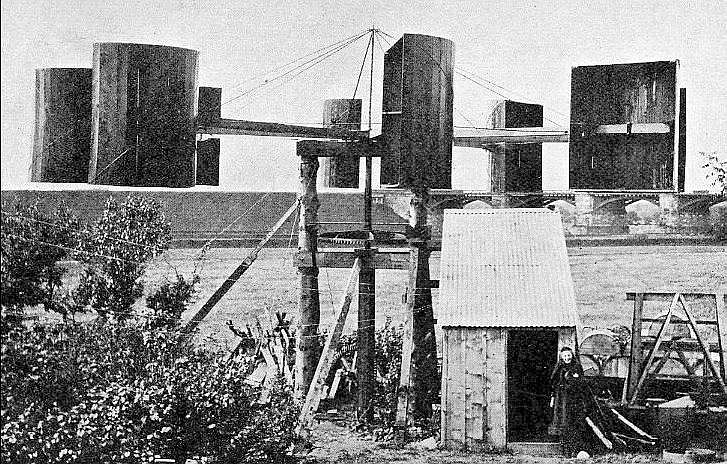
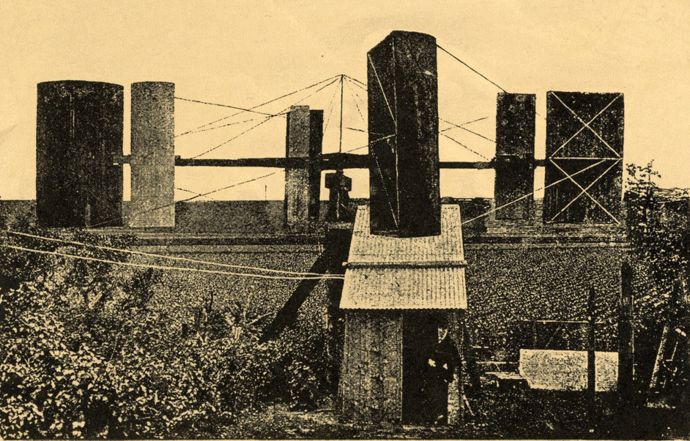
N° 19,401 A.D. 1891
Date of Application, 10th Nov., 1891 - Accepted, 12th Dec., 1891
COMPLETE SPECIFICATION.
Improvements in Wind Engines.
I, JAMES BLYTH, Professor of Natural Philosophy, Anderson's College, in the City of Glasgow, do hereby declare the nature of this invention and in what manner the same is to be performed, to be particularly described and ascertained in and by the following statement : -
This invention relates to a simple form of wind engine that will be acted upon by all winds, independently of their direction, and which shall be capable of running in high winds or gales, without attaining too high a speed for practical purposes.
The improved wind engine which is shown in outline perspective at Figure 1 and in part plan at Figure 2, of the accompanying drawings comprises a vertical shaft A carried in bearings in a suitable framing B and provided with gearing as C for transmitting the power of the engine. Upon the shaft A are mounted a number of projecting arms D on each of which is rigidly secured a hollow semi-cylinder E having closed ends.
These are so placed that as the arms revolve the hollow faces of the semi- cylinders shall be all in the same direction.
The engine rotates by the action of the wind being much greater on the concave faces of the semi-cylinders than on the convex faces of the semi-cylinders at the opposite ends of the arms.
By this construction the speed of the engine in high winds will reach a terminal value i.e., will not race even when the working load is removed, and the use of devices such as are required in ordinary windmills for bringing the vanes into the wind or throwing them out of action is entirely avoided.
Having now particularly described and ascertained the nature of the said invention and in what manner the same is to be performed, I declare that what I claim is :-
A wind engine composed of a rotating shaft having arms fitted with semi- cylinders, acted on by the wind substantially as described.
Dated this Ninth day of November 1891.
CRUIKSHANK & FAIRWEATHER,
62, St. Vincent Street, Glasgow, Agents.
| location | |
| name | |
| county | |
| date | |
| designer | |
| builder | |
| purpose |
Said to have operated for 30 years.
| location | |
| county | |
| date | |
| designer | |
| purpose |
ROLLASON'S Patent Wind Motor successfully driving electric, pumping, and other plant, at work in Glasgow. - Doddrell Bros., 11 Bothwell Street.Doddrell Brothers, Arthur Richard Doddrell, and Edward Ernest Doddrell were "commission agents", who also acted for other firms such as Easton's Lifts. Later ads are more specific on uses, but no better clues as to locations Glasgow Herald, 28 October 1896
ROLLASON'S WIND MOTOR. Cheapest power extant. From 1/4 to 23 H.P. Is being used for Electric Lighting, Grinding, Pumping. Flushing Sewers, &c. - Doddrell, 11 Bothwell Street, Glasgow.I don't think that there was a full-sized Rollason installed at Bothwell Street, though there is mention of a model being demonstrated there.
| location | |
| county | |
| date | |
| designer | |
| purpose |
PUBLIC HEALTH COMMITTEE.
HOPEMAN WATER SUPPLY.
A report was submitted by Messrs Milne and Hogg with reference to the Hopeman water supply. Is stated that they had prepared plans, specifications, and schedules of quantities, and had advertised and obtained offers to execute the work. There are two contracts- (1) the wind motors, pumps, and mechanical part; (2) reservoir and distribution of piping. Messrs Milne and Hogg went to the south of Scotland to obtain additional information concerning the various kinds of windmills. They did not find cases in every respect parallel to this one, but it was the unanimous experience that with a reservoir to hold a week's water a windmill would give an unfailing supply. They recommended the "Rollason's patent" wind motor, which turns on the principle of a revolving ventilator. The lowest offer for the reservoir and distributor was by Mr J. Hunter Clark, Elgin- £607 12s. The wind motor recommended was the Rollason's Patent, by Messrs Doddrell Bros., Glasgow, costing £312. This was not the cheapest offer, but they considered it would be the best. This, with the expense already incurred by Messrs Milne and Hogg, and the price of the company pump, brings up the total cost to £1106 19s 8d, being £56 19s 8d over their estimate, which, however, had been more than caused by the extra cost of the wind motor recommended by them.
The Clerk read a letter from Mr Wink, solicitor, factor to Mr Gordon Duff, stating that Mr Duff was willing to give the ground required for the well, windmill, and a site for the reservoir, for the annual feu-duty of £2, with 20s extra for way-leave. He also stipuiated for a pipe to take a supply to the Parsonage.
Mr George Mackessack of Ardgye asked what extra expense supplying Hopeman Lodge would cost.
Mr Hogg said it would mean £60 at any rate.
Some discussion took place over the recommendation of Messrs Milne and Hogg that ten pumps should be erected through the village. Dr Black of Sheriffston suggested that they should leave it to Messrs Milne and Hogg to arrange them in the way they thought best.
Mr J. Mackessack, Kinlose, ssid more water would be wasted with ten pumps than with seven.
Mr Hogg said that the pumps were so made that a tub could not be put below them, and they also shut automatically.
Mr Smith, Grantown, asked if Mr Hogg thought seven wells would be sufficient for Hopeman.
Mr Hogg said that Mr Milne and he had carefully considered the matter, and they put down ten as what they considered would be suitable, but if the council wished is they would carry out any alteration.
Mr George Mackessack asked Mr Hogg if he thought there was plenty of water for the whole ten taps.
Mr Hogg said that as a matter of fact it would make no difference whether there were seven or ten taps. All the people had to be supplied, and they would be supplied whether it was from seven or ten taps.
Mr Walker, Altyre, said there was one important feature in the discussion which they were overlooking. By the decision of the Court of Session they were not obliged to give the full supply in water fit for dietic purposes. He held is was an experiment supplying such a village or such a community with a wind pump. There was a certain amount of uncertainty about it, both as to motive power and water supply. They had got very little assistance from those locally interested, still they might help Mr Hogg so far as the number of taps was concerned.
Captain Brown, Miltonhill, moved that Messrs Milne and Hogg's report be adopted.
Mr J. Y. Cumming, Cardow, seconded, and the motion was unanimously agreed to.
It was also agreed to accept Mr Gordon Duff's offer, with the exception that they are to ask him to forego the condition that a supply of water be brought to the parsonage, as it would only be laying an additional burdon on his own feuars, who were being given a good supply of water.
[Essentially the same report as above, down to this point] ... the motion was unanimously agreed to.
Dr BLACK suggested that they should make a remonstrance with Mr Gordon Duff as to the condition of bringing a supply of water to the Parsonage.
Mr HARVEY, Grantown, asked if the Parsonage was within the water district.
The CLERK said that it was.
Mr WALKER-There is another parson who will be wanting water.
Dr BLACK thought Mr Duff would withdraw that condition if he was asked.
Mr GEO. MACKESSACK said they should write that they were agreeable to all the conditions except that one.
Dr BLACK suggested that they should point out that this additional expense was simply adding to the burden of his feuars, the people of Hopeman. He was quite sure that Me Duff would consider the matter very favourably when he saw the effect the condition would have.
The CHAIRMAN said they should point out that the benefit was greatly to Mr Duff's profit.
Mr HARVEY asked if they expected Mr Gordon Duff to bring in the water at his own expense.
The CHAIRMAN-If he wants it.
Mr SMITH-Cannot the Parsonage demand it?
Dr BLACK said there was a regulation in burghs, and he supposed it applied in the present case, that the main must be brought within 100 feet. They could only remonstrate with Mr Duff, but he was quite sure Mr Duff would agree to their request.
Mr HARVEY said that if Mr Duff agreed to their request to forego his claim, they could not ask him to pay taxes.
Mr SMITH said that in one village he was acquainted with they felt that as a matter of equity they must bring the pipe within a certain distance of every house in the district, and in consequence had entailed a considerable expense on the general community. He did not know whether they were bound to do it, but as a matter of equity they felt they must. The expense entailed was perhaps not to the extent of what Mr Duff was asking, but the principle was the same, and he thought it was only fair to bring the pipe within a reasonable distance corresponding to the average of the village.
Mr WALKER said that Mr Smith referred to a village being supplied by gravitation, and from a large source, but they were forgetting that they were dealing with one well, and, further, that they were depending upon doubtful powers for their supply. He held that they should realise what they were compelled to do by law before they did anything. It was all very well to speak of equity, but they knew how the Hopeman people felt, and, if they incurred any illegal expanse, they would find themselves in trouble.
Mr YOOL, Leuchars House, said that when water was introduced to Lossiemouth the pipes were in many cases more than 100 yards from the houses, and assessments had to be paid on all the farms within the water district.
The CLERK said that, according to the Act, the mains must be brought within a reasonable distance. A reasonable distance depended on circumstances, and, in the event of a dispute, it had to be settled in court.
The CHAIRMAN-The distance in this case is 500 yards.
After some further discussion, it was agreed to accept Mr Duff's conditions, with the exception of bringing a supply to the Parsonage, and the Clerk was instructed to write, asking him to withdraw this one.
Mr Monro MacBey's account of £29 11s 9d in connection with the Hopeman water supply was remitted to the Finance Committee for payment.
HOPEMAN WATER SUPPLY.
HISTORY AND COMPLETION OF THE SCHEME.
The question of providing a water supply for the fishing village of Hopeman has at intervals for about a quarter of a century agitated the various local authorities in power during that long period, and the problem has presented some very knotty points, all of which have now been swept away and, it is hoped, forgotten, in what promises to be the successful introduction of a supply of water and the completion of a system whereby to distribute it to the very doors of the inhabitants. The final struggle and ultimate victory have lain with the Elgin County Council, materially assisted by the practical advice and research of their able officials, Mr Milne, sanitary inspector, and Mr Hogg, road surveyor, whose services in the matter have been very valuable.
A brief resume of the history and progress of the scheme might be of some interest at this stage. The matter, as indicated, had its origin about twenty-five years ago, when the district local authority discussed it and experimented in many ways, so that large sums of money were spent in obtaining professional advice from eminent engineers and in carrying out recommendations for improving the water supply, but all without practical result. Then, on the Local Government Act coming into force in 1889, the question was revived in the County Council, and since then it has passed through many and varied phases.
When the old local authority of the neighbouring village of Burghead introduced a supply of water, now nearly twenty years ago, they offered to allow Hopeman to join with them on terms which at the time were considered very reasonable. Hopeman, however, declined to join in such a scheme, and the matter was accordingly dropped. Again, a few years ago, a motion was brought up in the Public Health Committee of the County Council with the view of rearranging the districts in such a way that Hopeman and Burghead and the area between would be formed into one special water supply district. The Burghead people, however, interdicted the Council, and immediately formed the town into a police burgh, which prevented the County Council from taking any further steps in the matter. The controversy in the County Council hinged on the point whether the water should be introduced by a scheme of gravitation from the Lossie, the Lennoch Burn, and other distant sources, or from the existing wells and other supplies near at hand. The schemes by gravitation, which were mostly favoured locally, were all found to be too expensive, as they would exceed the half-crown limit, and thus entail a tax being imposed over all the county, which it ultimately transpired could not legally be done. Every means was adopted to secure a supply, the cost of which would not exceed the limit of assessment of the special water district, and in all about a dozen reports by engineers and analysts were submitted. A crisis in the history of the proceedings was brought about, it will be remembered, by the Local Government Board raising an action about a year and a half ago in the Court of Session against the County Council, as local authority, to compel them to introduce a supply of water. The Council defended the action, and won the case with expenses. As a last resort, the County Council instructed Mr Milne and Mr Hogg to improve the existing supply by preventing the pollution of the public wells, and to see whether in the immediate locality a supply of water could be found adequate to the requirements of the village. These officials proceeded at once to carry out the remit. They took steps to prevent the pollution of the Company's well, not the least important source of water supply to Hopeman at the time, which, by the way, was purchased by the County Council for the sum of £20. The officials selected a site for digging a well some 150 yards distant from the public road at the east end of the village. They had only gone down some 24 feet when water appeared and increased to such an extent that two force pumps were required take it down. Upon further sinking, the supply of water increased to such a volume that a centrifugal pump, driven by steam, had to be fitted up. This enabled the workmen to proceed with cutting through the bar of rock, and they were at last rewarded by a large inflow of water, which was found by measurement to be more than ample for the present requirements of the special district. The officials, by authority of the County Council, went south to examine a variety of motor powers for pumping the well. Ultimately they decided upon putting in one of Rollason's wind-mills, and this met with the approval of the County Council, and the work was proceeded with accordingly. The advantages, so far at least as expense is concerned, of a wind power over other kinds of mechanical power are quite apparent, and it would appear that the utmost expectations of the officials in the one that has been erected are to be realised. It may be mentioned that several mansion houses and private buildings are supplied with water by wind power, but in no community in the country of the size of Hopeman has a system of this kind been introduced, so that great care and judgment had to be exercised in fixing it up. Description of the Wind Motor. The Rollason wind motor is a departure from the ordinary construction of windmills. The sails are of a horizontal design, erected on an iron tower within a skeleton turret. The tower is about 30 feet across the base and about 20 feet high. On the top of this is the turret, constructed to contain the wind wheel. The wheel itself is 20 feet in diameter by 20 feet high, and consists of five concave sails which revolve round a centre shaft. One of the most important parts of the design is the immense reduction of friction. This is attained at the base of the wheel by a system of roller bearings running on a polished face, the whole of which is enclosed in an oil bath. The next, if not the most important, part of the invention is a concave shield which shelters the side of the wheel which revolves against the wind, thus giving the open side of the wheel the full advantage of the wind force. This shield is also set on roller bearings, and is actuated to the varying directions of the wind by a large vane or rudder on the top of the turret. The motive power is conveyed by the continuation of the centre shaft to the surface of the ground. This shaft has also roller bearings and thrust blocks after the same principle, thus reducing friction in such a way that a force of four or five pounds on the edge of one of the sails will turn the wheel. From the bottom of the tower to the top of the well the power is conveyed by a strong wire rope acting on grooved pulleys, which by a set of gearing considerably reduces the speed and increases the power on the crank shaft of the pump. The pumps are of the double-action type, with gunmetal barrels six inches internal diameter, and with a stroke of nine inches. The motion of the pumps even in a gale of, say, forty miles an hour, will not exceed 27 strokes per minute; and in that case an automatic arrangement, the invention of Mr Hogg, has been fitted on the supply pipe to prevent the well being reduced below the lower end of the suction pipe. From the well the water is pumped into a 3-inch pipe, which takes it to a large reservoir situated on a higher level. The reservoir is a large cement tank, measuring 80 feet long, 28 feet broad, and 10 feet deep, and is capable of holding about 521 [should read 122,000] gallons - sufficient in itself to maintain a supply to the village for an extended period of calm weather. It is about 50 feet above the level of the well, and, the well being 38 feet deep, the water has to be pumped up a distance of 88 feet and through about 350 yards of piping. From the reservoir the water is distributed through the village by gravitation.
On Tuesday Mr Milne, Mr Hogg, and Mr Hunter Clark, plumber, Elgin, along with Mr Rollason, who has superintended the work of fitting up the wind motor, turned on the supply to test the pipes. The windmill has been working constantly for twenty-four hours, part of the time in a light breeze of about six miles an hour, and in that time there was pumped into the tank about 56,000 gallons, or 39 gallons per day per head of the population. With an eight-mile wind the motor was pumping about 20 gallons per minute. Even when all that quantity was pumped, there seamed to be no depreciation in the supply of water coming into the well. With even the very light wind that was blowing on Tuesday morning, the wind motor was going steadily, and could with ease pump sufficient water to supply the village. The water came with a steady rush, and advantage was taken of the time it was turned on to have pails filled, there being especially among the young ladies rivalry as to who should get the first pailful.
The wind motor and pump cost about £300 odds, and other works about £900. This expenditure, including an allowance for a person in charge, is not likely to exceed an assessment of 1s 6d in the £1. The contractors were - for reservoir, distribution, street fountains, &c., Mr J. Hunter, plumber, Elgin; and for the wind motor and mechanical part, the Rollason Wind Motor Company, Limited, Berners Street, London. The makers of the wind motor maintain that, in addition to the power required for pumping, the motor is sufficient to drive a dynamo which, having sufficient accumulators, could be utilised for lighting the village. It is not, however, likely that this will be considered until it is fully shown that the motor is sufficient for the work for which it is intended. We understand that the Public Health Committee are to visit Hopeman on Saturday, 15th inst., to inspect the works.
WATER SUPPLY FOR HOPEMAN.- For some time considerable difficulty has existed about how to provide an adequate supply of water for the village of Hopeman, but the problem has now been successfully solved by the adoption of a rather novel contrivance. The sanitary authorities resolved to sink a well at a place where it would be impossible for the water to be contaminated by sewage from the village or surface drainage. Having chosen the site, the work of sinking was commenced. The operation, however, was not free from difficulties, as the first twelve feet of depth proved to be a soft, spouty clay, and the sides of the well had to be securely sheeted with wood. After piercing through the clay, a dry, hard, sandy formation was struck, which increased in hardness till, at the depth of about twenty-four feet, solid sandstone rock was encountered, and had, to be blasted. Water shortly after appeared, and a pump had to be fitted up. The water increased in volume to such an extent as the sinking progressed that two force pumps were required to keep it down. The work of still further sinking by blasting out the rock was proceeded with till the inflow of water overpowered both pumps, and the workmen had to leave the well. A centrifugal pump was then fitted up and driven by steam power. This enabled them to proceed with their operations till they had practically cut through the bar of rock, and they were rewarded by a large inflow of water, which, when measured, was found to be considerably more than sufficient for all domestic purposes within the special district. Having been successful in obtaining a supply, they next set about pumping the water to a reservoir on a higher level, by wind power, and distributing it through the village by gravitation. But the motor for the pumping was a main point in the work. In Glasgow, at Doddrell Brothers' in Bothwell Street, the authorities saw a model of Rollason's patent wind motor, which, although rather more expensive. than the common disc wheel, was, they thought, capable of great possibilities. This pattern was approved by the County Council, and the work of its erection proceeded with. The well is situated about fifty-yards south of the public road, and about 150 yards south-east from the company's pump, and is 38 feet deep. The wind motor is placed about fifty yards south of the well, and the pumps are driven by a wire rope. The Rollason Wind Motor is quite a departure from the ordinary construction of wind-mills. It is of a horizontal design, erected on an iron tower within a skeleton turret. The tower in this case is about 30 feet across the base and about 20 feet high. On the top of this is the turret, constructed to contain the wind wheel. The wheel itself is 20 feet in diameter by 20 feet high, and consists of five concave sails which revolve round a centre shaft. One of the most important parts of the design is the immense reduction of friction. This is attained at the base of the wheel by a system of roller bearings running on a polished race, the whole of which is enclosed in an oil bath. The next, if not the most important, part of the invention is a concave shield which shelters the side of the wheel that revolves against the wind, thus giving the open side of the wheel the full advantage of the wind force. The motive power is conveyed by the continuation of the centre shaft to the surface of the ground. The shaft has also roller bearings and thrust blocks, thus reducing friction in such a way that a force of four or five pounds on the edge of one of the sails will turn the wheel. The motion on the pumps even in a gale of, say, forty miles an hour, will not exceed 27 strokes per minute. From the well the water is pumped into a 3-inch pipe, which takes it to a large reservoir situated on a higher level. From the reservoir the water is distributed through the village by gravitation. At the first trial the windmill had been working constantly for twenty four hours, part of the time in a light breeze of about six miles an hour, and in that time there was pumped into the tank about 55,000 gallons, or 39 gallons per day per head of the population. With an eight-mile wind the motor was pumping about 20 gallons per minute. Thus the vexed question of a water supply for Hopeman has been, satisfactorily and cheaply settled.
THE HOPEMAN WINDMILL.
TO THE EDITOR.
SIR,-I was down at Hopeman the other day, and went to see the windmill that is to pump up water for the village. It is a rather pretty structure, and looks well from a distance. It has the appearance of lightness and strength, and, but for the revolving sails, might be taken for an abortive Eiffel Tower. The Hopeman windmill, or, to give it its proper name, the Rollason Wind Motor, is not a bit like the traditional windmill of the pictures. The sails of the motor - there are five of them - are made of wood, and look like doors slightly curved so as to catch the wind. They are fixed upright on a circular iron framework, and, with the slightest breeze, sails and framework together revolve on a vertical axis. The axis is itself the shaft that drives the machinery at the foot. I was told that the shaft is carried both at the top and bottom on well-oiled ball bearings, "just like the bicycle." I will confess that I used to have a difficulty about windmills, though I never cared to mention it to any one. I could never see how the breeze which drove one arm forward did not at the same time drive its opposite neighbour backwards. I dare-say there are other unpractical folks in the same predicament. To all such I say, "Go to Hopeman and see Rollason's Wind Motor." Your difficulty will vanish in a twinkling. One of the first things to catch your eye will be a huge vane - they call it a rudder - streaming like a wooden Union Jack over the whole apparatus. This vane is rigidly connected with a wooden "shield," which partially surrounds the sails, and revolves apparently on the same axle, but is in no way fixed to the shaft. So long as the wind blew from the same quarter, the vane and shield remain stationary. On the slightest change of wind, however, the vane turns, and with it the shield. Two of the sails are always hid by the shield, and so protected from the wind. Thus the full force of the blast is expended on the other three sails. There is no back current. The arrangement is most ingenious, and I am not sure but the vane and shield are the characteristic features of this kind of motor.
There is nothing peculiar about the accessory machinery. The motion is carried from the foot of the windmill by a strong wire rope to the top of the well, a distance of about fifty yards. The water is driven by force pumps up the hill to a reservoir. It is said that the supply of water is abundant for all the needs of the village, in which case we must bid good bye to our old newspaper friend, the Hopeman water supply.
I stood for some time watching the action of the windmill in a very light breeze. From the ease with which it did its work, I am inclined to think there is a great reserve of power in it that may yet be utilised. I was told that, if the motor succeeds at its present business, it will be set to drive a dynamo to supply the village with electric light. That is a possibility very likely to be realised.- I am, Sir, yours, &c., B.
AN INTERESTING WATER SUPPLY .- For the past 20 years the village of Hopeman has been without a satisfactory water supply, and the question has caused great trouble and expense, the matter at one time reaching the Court of Session. The new supply, which is to be inspected on Monday by Elgin County Council, seems likely to meet the requirements of the district. A well has been sunk, and a copious supply of exceedingly pure water has been found. In order to provide a gravitation supply, a large cement tank, to hold 122,000 gallons, has been formed, and the water pumped a distance of 88 feet by means of Rollason's Patent Wind Motor, an ingenious contrivance, of which Messrs Doddrell Brothers, 11 Bothwell Street, Glasgow are the agents. The motor has, so far, done its work exceedingly well, pumping in a very light breeze during 24 hours about 56,000 gallons.That pumping rate seems high, but possible averaging under a gallon per second. The figure also appears in this secondary report, but I suspect that it is just quoting from the first report. Clutha Leader, Volume XXIV, Issue 1247, 20 May 1898, Page 3
The problem of supplying the village of Hopeman, near Elgin, with water has been solved by means of the Rollason Wind Motor, which in twenty-four hours had pumped 56,000 gallons of water into the water-tank to supply the village.
ELGIN COUNTY COUNCIL.
PUBLIC HEALTH COMMITTEE.
Hopeman Water Works.
The CONVENER asked Mr Hogg if he had anything to report regarding the water works at Hopeman.
Mr HOGG said that the laying down of the pipes and distributing the water through the village were completed, while the reservoir, pumps, and wind-motor were practically finished. The fencing of the ground was scarcely completed, but it would soon be. It would be necessary to have some local person, a mechanic if possible, to look after the works, all that would be required being to look up once a day and see that the oiling was all right.
The CONVENER stated that he went over the whole of the works the other day, and they seemed to him very well carried out, and in every way efficient for throwing up the water. There was a very large reservoir, one of the largest in Scotland, he believed, and it could hold water sufficient to last Hopeman for five or six weeks without pumping.
In answer to Mr Black, the SURVEYOR said the windmill had been going all right for the past three weeks. The makers were responsible for any accident caused by wind for two years, and for one year they took the responsibility of anything going wrong with the machinery.
Mr WALKER asked if Mr Hogg or Mr Milne had any one to suggest to look after the works, for the sooner that man was appointed the better, seeing the windmill was going.
Mr HOGG said that Mr Sandison, blacksmith, was a very suitable man for the position, and he was willing wo do it for £10 per annum. They had appointed him ad interim on these terms.
Rev. Mr CASSIE, Hopeman, questioned the surveyor's statement that Mr Sandison would do it for £10 a year, and he did not think that he had said so to the surveyor.
Mr HOGG (firmly)-He did. (Laughter.)
It was then agreed to appoint Mr Sandison, whom failing, some one else at the discretion of Messrs Milne and Hogg, at the salary stated, subject to the approval of the Rollason Wind Motor Company.
| location | |
| county | |
| date | |
| designer |
The mill erected at the Wellington is the third which the Rollason's Wind Motor Company have erected in Scotland, the others having been working successfully for some time at the village of Hopeman, Elgin, and in Ayrshire.
| location | |
| name | |
| county | |
| date | |
| designer | |
| purpose |
The Wellington Farm School was a residential reform school for boys. [History
PENICUIK.
NEW WATER SUPPLY AT THE WELLINGTON.
For some years back the question of an increased supply of water at the Wellington Farm School has been before the directors, and at the annual meeting held at the Wellington, the Chairman, Sir John Cowan of Beeslack, intimated a donation of £100 from a friend towards the expenses entailed in securing an additional supply of water. Water was found about 300 yards from the farm in a field adjoining the public road, and during the last few weeks a wind mill to be used for pumping the water to the school has been in course of erection, and the somewhat strange sight has attracted a considerable number of people to the locality. The mill erected at the Wellington is the third which the Rollason's Wind Motor Company have erected in Scotland, the others having been working successfully for some time at the village of Hopeman, Elgin, and in Ayrshire.
Early this week the mill was successfully started, and a brief description of it may be of interest. It is a twelve-foot motor with five sails, and is distinct from the old class of wind mill in that the sails work on a vertical shaft at the top of a tower 28 feet high. The sails revolve inside a cage in a vertical position, and the slightent breeze sets the mill in motion. By the aid of a screen, which is worked by a weather cock on the top of the cage, there is practically no resistance to the wind as the sails are coming up to receive the wind, so that the full benefit of the slightest breeze is got. By this arrangement also the mill works as successfully in a hurricane. The shaft extends through a saucer-shaped plate at the top of the tower, where the whole weight of the sails is borne, and there is little friction as a considerable quantity of oil is used at this part of the motor. The bottom of the shaft is attached to a bracket which is bolted to the top of the tower, and here the crank for working the pump is attached. A clutch is provided so as to put the pump out of gear when not required, but the wind mill can go on whether the pump is working or not. The force pump is a four-inch one of gun metal, and draws the water from a bore 34 inches wide and 80 feet deep. The water is forced through a 2-inch pipe, a distance of about 300 yards to a tank at the back of the Reformatory, capable of holding 1000 gallons, which is equal to three days' supply. It is estimated that the tank could be filled by means of the motor quite easily in 24 hours in a wind of say five miles an hour. The mill is built on the cantilever system, and all the strain is in the top cage, and it is claimed that there is no chance of the mill being thrown over in sudden gusts of wind, and that there is no strain on the bottom foundation.
| location | |
| county | |
| date | |
| purpose |
The correspondent has provided good information on this mill, and it seems reasonable to assume that they had good first hand knowledge of it. Gladstone is a surname with Scottish roots, and Leman Street is an area of the present Tower Hamlets that has Scottish connections.Sir, - This Mill was erected in the south of Scotland, about the year 1810, for pumping water off a low piece of ground, which in rainy weather was mostly covered with water, and being a considerable distance from any house, it was so constructed that it would act itself, with the exception of a person giving it oil daily.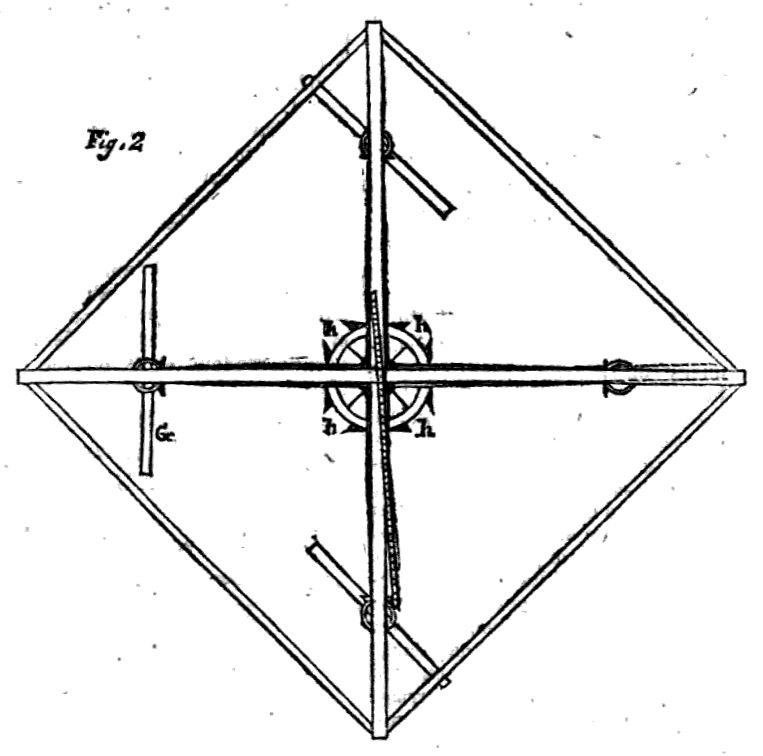
Description.
Fig. 1 represents an elevation of the mill; fig. 2 a ground plan.
AAAAA, wood framing, bound together at the corners with iron knees, made fast to the stone-work.
BBBB, arms fixed to the shaft with iron flanches; at their extremities, are bushes to receive the wings.
C, two wheels, for conveying the motion to the cranks.
D, a large vane, to turn pound with the wind; it is made fast to an iron shaft, and at the bottom of the shaft is a bevel wheel, which only turns when the wind changes, along with the vane.
The wing F being set fair to the wind, is carried round along with the other three; and by the time it arrives at G, goes edgeway against it: the wings turn half round their axis for once of the shaft. This motion is derived from the pinion, hhhh, working into the wheel E.
The wings are composed of a number of thin pieces of deal, turning upon centres (the same as window-blinds), which open and shut by a rod passing through the centre of the wing gudgeon. This rod is moved up and down by a piece of wood, I, floating in the water to be pumped; when the water is all raised, it falls to the bottom, and pulls down the lever, K, lifts the sliding-box, L, which the rod is fixed to, and so opens the shutter, when the mill will stop.
From whatever point the wind blows, the vane will always turn the wings fair for it, and the shutter will always shut when there is water to pump.
This mill answered the purpose that it was erected for, and seldom went wrong, though exposed to all weathers, and raised a deal of water.
Mills made on this principle would be very serviceable in many situations, where other powers cannot be had without considerable expense.
I remain, Sir, Yours respectfully, J. GLADSTONE. Leman-street,
| location | |
| county | |
| date | |
| building | |
| purpose | |
| condition | |
| millid | scot58 |
| location | |
| name | |
| date | |
| county | |
| designer | |
| purpose |
GOOD NEWS for the Growers of these Islands.
SAVE TIME AND MONEY BY PURCHASING
ROLLASON'S
PATENT WIND MOTOR
Which will pump 2,000 gallons of water
a day. Will work day or night in the slightest
breeze and run before the strongest gale like a
spinning top. The sails are braced to form a
wheel, which rotates on rollers running in a
bath of oil sufficient for a year, and requires no
attention during that time.
==} One of these Machines may be seen
working at the Gouffre, Guernsey. {==
All particulars may be obtained from the SOLE
AGENT FOR THE CHANNEL ISLANDS,
A. RAKE, F.R.H.S.,
GOUFFRE HOTEL, GUERNSEY.
ROLLASON'S PATENT WIND MOTOR.
The special attention of fruit growers in the Island is directed to an advertisement which appears in this issue and which gives details of Rollason's Patent Wind Motor. This mechanical contrivance will, it is guaranteed, pump 2,000 gallons of water per diem, and is constructed so as to work equally well in the faintest breeze or in a full gale of wind. Thus it is claimed the motor will prove a valuable economiser, both of time and money. Full particulars may be obtained of Mr. A. Rake, F.R.H.S., of the Gouffre Hotel. Guernsey, on whose premises may be seen one of the machines at work.
| location | |
| name | |
| county | |
| date | |
| designer | |
| purpose |
THE CASTLETOWN GOLF LINKS HOTEL AND FORT ISLAND ESTATE, LIMITED.
...
The Hotel, which is fully licensed, is a very handsome, modern, and substantially-built structure, erected by and under the personal supervision of the Vendor during the last winter, and was opened for business in last Whit-week.
From the extent of its business during the short time the Hotel has been open, the Vendor is confident that, even during the first year of the Company, it will, in addition to the dividend on the preference shares, pay a substantial dividend on the ordinary shares.
At present the Hotel has accommodation for 50 guests. On the ground floor there is a magnificently furnished entrance hall, a handsome dining room to accommodate 70 to 80 people, drawing room, writing-room. billiard-room, bar, offices, smoke-room, lavatories, and kitchens. On the upper floors are private sitting-rooms, bedrooms, dressing and bath-rooms.
...
There is an ample supply of pure spring water, which is pumped to the Hotel by one of Rollason's patent Wind Motor Pumps.
| location | |
| country | |
| name |
| location | |
| name | |
| country | |
| purpose | |
| condition |
| location | |
| country | |
| date | |
| purpose | |
| designer |
De toutes les forces naturelles celle qui est la moins coûteuse et la plus également répartie, la force du vent, est aussi la plus négligée. En effet en dehors de la Hollande, on n’en trouve que des applications assez rares. Pourquoi cette force est-elle si peu employée? Ne serait-il pas possible et avantageux de l’asservir dans un grand nombre de cas? Telles sont les deux questions que nous nous sommes posées et que nous avons cherché à résoudre en nous inspirant à la fois de la théorie, de l’examen attentif des types existants, et des observations du praticien. A la première question nous répondrons: 1° les anciens types classiques, avec maison sur pivot, seraient à présent d’une construction inabordable à cause du prix des énormes pièces de bois qui les composent; 2° ces moteurs absorbent par frottement beaucoup de force; des arbres de couche, en bois de 0,50m, 0,60m et plus de diamètre, roulant sur des coussinets de même nature, sous une forte charge, sont de véritables freins; 3° l’orientation est pénible et réclame souvent la force d’un cheval; 4° en cas de tempête ; replier la toile est une opération des plus périlleuses; 5° le mode de réception du vent est vicieux, car la force est décomposée en deux forces dont une fait tourner le moulin et l’autre tend à le renverser. Tous les moulins à arbre horizontal reposent sur les mêmes principes et présentent à des degrés divers les inconvénients signalés ci-dessus. Quant aux moulins à axe vertical, ils sont si rares et produisent si peu de force, en général, que nous n’y insisterons pas. Telles sont suivant nous les causes du peu d’emploi d’une force aussi répandue que celle du vent, de l’air en mouvement. La description d’un nouveau type de moulin que nous avons construit à Grand-Quevilly près Rouen, nous a paru devoir intéresser les lecteurs de La Nature. Ce type n’a rien d’analogue avec les moulins connus. Il présente les avantages suivants: 1° l’axe est vertical et repose sur une pointe, ce qui nous assure du même coup un minimum de frottement et le bénéfice d’une orientation permanente; 2° il utilise toute sa surface à produire du travail sans fatigue pour aucune partie de l’appareil; 3° il peut produire une force quelconque, sans que les conditions de solidité et de facilité de construction soient compromises; 4° il se gare automatiquement de la tempête. Voici en quoi consiste l’appareil: Une cage cylindrique, pouvant tourner sur son axe verticale, porte trente ailes en bois léger de 2m X 0,40m; ces ailes peuvent pivoter sur leurs axes respectifs, qui forment comme les barreaux de cette cage; chaque aile est d’ailleurs partagée par son axe en deux rectangles inégaux en largeur, dans le rapport de 1 à 2. A l’état de repos ces ailes présentent au vent leur épaisseur et par suite une surface presque nulle. Chaque aile MN (fig. 1) peut prendre en pivotant sur son axe A deux positions MN, M’N’, qui font entre elles un angle de 700 à droite et à gauche de la tangente TT’ d’une circonférence cc’ dont le centre coïnciderait avec le centre du moulin et qui passerait au point A. L’aile peut être maintenue en MN et M’N’ par les deux ressorts RR’ quand ils viennent au contact de l’arrêt B. ff’ est un fil de fer reliant cet arrêt à l’appareil de déclenchement (fig. 3). La figure 2 présente un groupe horizontale du Panémone montrant la disposition respective de chaque aile à un moment donné, Soit xy la direction du vent, vz le sens de la rotation, M une aile; en la suivant pendant un tour complet, nous verrons quelles sont maintenant les deux positions qu’elle prend alternativement et sans choc pendant la rotation, recevant ce vent tantôt sur une face de 1 en 13; tantôt sur l’autre de 14 en 25; car l’aile n’est inactive que de 26 à 30, La projection de la surface exposée au vent et produisant un effet utile est alors représentée, pour un observateur regardant de loin l’appareil, le dos au vent, par le produit de la hauteur des ailes par les 9/10 du diamètre du Panémone, cette surface considérable tient à ce que les ailes produisent un effet utile même en revenant contre le vent de 14 en 25 et de 1 en 6. C’est le principe qu’on applique dans la direction de la voile d’un navire. Celle-ci fait avec la direction du vent un angle variable, qui peut devenir très petit, quand on marche, comme disent les marins, « au plus près du vent ». Nous avons dit que l’aile changeait de position dé 13 en 14 (fig. 2) sans choc; il est utile d’insister sur ce point; en effet à l’instant où chaque aile occupe la position 13, elle est dans sa partie ab soustraite à l’impulsion du vent par l’aile qui Occupe la 12e position; le vent la frappant seulement en bc, elle s’ouvre, mais aussitôt emportée par la rotation du Panémone, elle arrive à sa position nouvelle à l’instant précis où elle est complètement masquée et par suite sans choc. Quant aux arrêts ils sont commandés par des fils de fer aboutissant au centre du moulin où est disposé l’appareil qui dérobe automatiquement les ailes aux coups de la tempête. Voici en quelques mots la disposition de cet organe (fig. 3). Une girouette AB, libre de tourner sur l’arbre du moulin et que le vent maintient dans une direction fixe, porte un plateau C articulé en D toujours opposé au vent. Vienne la tempête, le plateau C sous la pression du vent s’abaisse, les deux galets EE’ qu’il porte (dont un seul est visible sur la fig, 3), appuient sur la douille F libre de descendre le long de l’arbre, le déclenchement se fait par l’intermédiaire des fils de fer ff, et les ailes ne présentent plus au vent flue leur tranche. Que le vent se calme, un mouvement inverse se produit et bientôt le moulin se remet en marche. Cet appareil répond aux objections que l’on fait d’ordinaire à ces moteurs. Reste une objection inhérente à la force elle-même. C’est l’inconstance: l’industriel veut mettre en route, mais le vent chôme; l’agriculteur ou le maraicher ont plus de vent qu’ils n’en veulent avant ou pendant les pluies; mais quand la mare est à sec, quand les céréales et les légumes brûlent sur pied, pas de vent, pas d’eau. L’argument est aussi fort qu’il est net et ne souffre guère de réplique, On a essayé de réservoirs placés en hauteur qui seront en temps utile des magasins de force ou des sources fécondes; mais une seconde objection s’est présentée: le moteur produit trop peu, pour que l’on puisse par l’emmagasinage obtenir une force régulière ou une réserve suffisante pour l’alimentation. Le peu de puissance, c’est là qu’est la difficulté. Il faudrait pouvoir obtenir une force considérable pour une vitesse moyenne du vent. La pratique a montré que les moulins gigantesques ne sont pas avantageux. Ne peut-on pas cependant trouver une disposition d’organes qui permettra de proportionner dans tous les cas la surface du moteur aux effets à produire, exactement ce que fait le mécanicien qui proportionne la surface de chauffe à la quantité de vapeur qu’il veut obtenir dans l’unité de temps? Ne peut-on pas construire un moulin multiple, de force et de puissance illimitées, comme on construit une pile d’un nombre quelconque d’éléments et totaliser sur un même arbre de couche leur force individuelle; comme on recueille sur une même pile un courant puissant issu des différents éléments de a pile? La solution de ce problème, qui à première vue parait assez simple, présenterait de grandes difficultés avec les moulins généralement employés, tant pour les transmissions de force de l’un à l’autre qu’à cause de la nécessité de les disposer entre eux de manière à ne pas les masquer les uns par les autres, quelle que soit la direction du vent. Mais ces deux difficultés tombent comme d’elles-mêmes, en prenant pour élément le Panémone décrit plus haut et en donnant au moulin multiple la disposition suivante: Soit ABCD (fig. 4), une vaste charpente circulaire analogue à celle qui constitue le support de gazomètres et dans chacun des intervalles abcd formés par les colonnes verticales un panémone-élément, il est évident que l’on peut facilement totaliser au centre du système la force de tous les éléments qui le constituent, on peut même établir plusieurs étages de systèmes semblables ou des groupes de systèmes et les réunir entre eux. Nous remarquerons que l’ensemble de ce moulin multiple est toujours orienté comme un élément et que le vent faisant, comme on sait, avec l’horizon un angle d’environ 15 degrés, agit même sur les éléments qui sont au second plan, en passant par-dessus ceux qui sont au premier plan. Il nous parait donc aujourd’hui possible de construire des moteurs à vent d’une force illimitée, de dessécher de vastes marais, de submerger des vignes, d’élever dans d’immenses réservoirs, sur nos collines, l’eau des fleuves, de distribuer régulièrement à nos campagnes la fécondité, à nos villes l’eau, la force et la lumière.
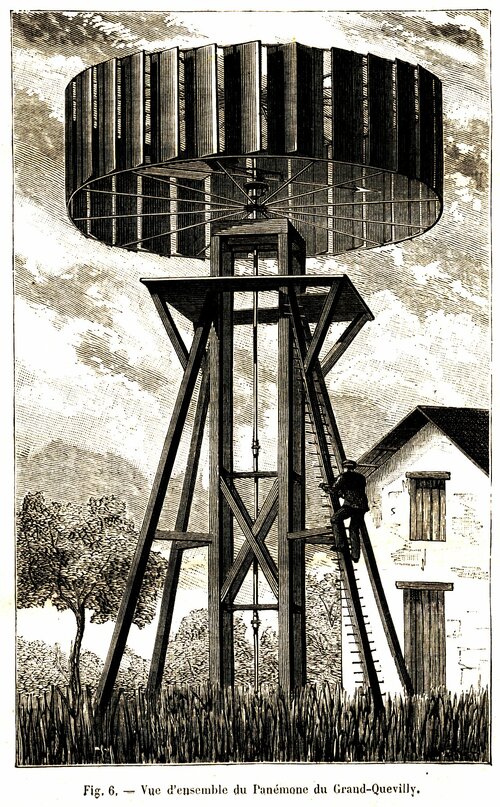
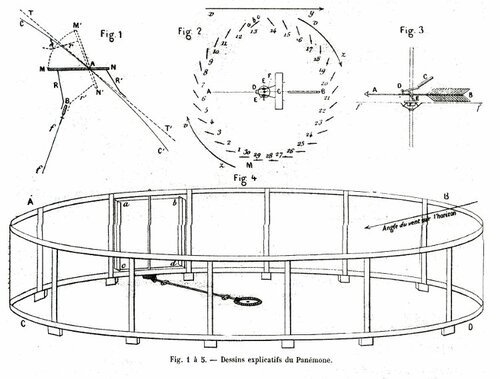
| location | |
| country | |
| date | |
| sails | |
| building | |
| architect | |
| owner |
| location | |
| country | |
| date | |
| purpose |
| location | |
| province | |
| country | |
| date | |
| designer | |
| owner | |
| purpose |
HORIZONTAL WINDMILL.- The invention of Mr. Thomas Robson, of Sackville, N. B., has lately been most successfully carried out into full effect by Mr. Benjamin Mitchell, Cabinet Maker and Upholsterer, of that place, and also by Mr. Ayres, a Tanner, whose Bark mill bears testimony to the practical success of this mode of applying wind power. At Mr. Mitchell's the Mill is employed to work a Turning Lathe, Circular Saw, Boring Machine, &c., all of which are kept in full operation. Mr. Mitchell will kindly answer any inquiries on the subject, and we have no doubt but those of our readers who may have occasion for cheap motive power will do well to give it their attention.- Nova Scotian.
| location | |
| province | |
| country | |
| date | |
| designer | |
| owner | |
| purpose |
HORIZONTAL WINDMILL.- The invention of Mr. Thomas Robson, of Sackville, N. B., has lately been most successfully carried out ... by Mr. Ayres, a Tanner, whose Bark mill bears testimony to the practical success of this mode of applying wind power.
| location | |
| name | |
| province | |
| country | |
| date | |
| note |
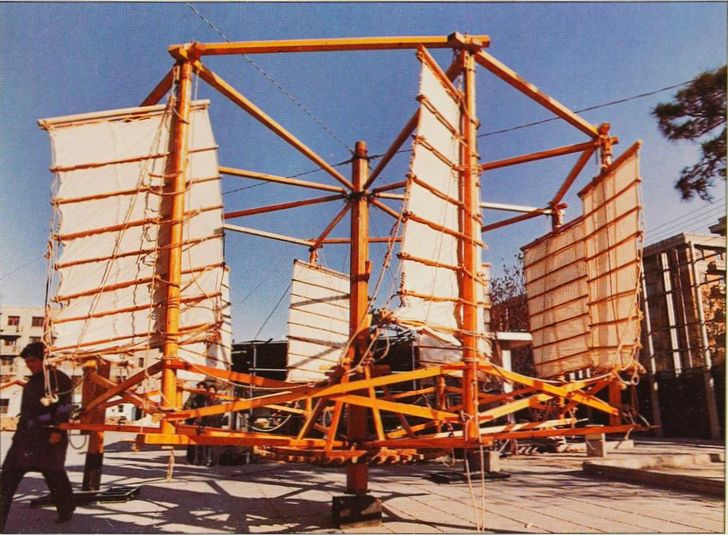
| location | |
| country | |
| date |
From the Freemantle Observer, August 20.
Mr. Shenton has recently erected an horizontal Wind-mill which appears to work well. We hope to be enabled to lay the particulars of this first Wind-mill constructed in the Colony before our readers. They will all we feel satisfied agree with us that Mr. Shenton's enterprise and application are deserving of every support.
| location | |
| country | |
| date | |
| designer | |
| purpose |
Horizontal Windmill.The windmill was mentioned as under construction, in a long list of Hobart mills, quoting from an old almanac for 1829. The Mercury, 25 Jan 1910, Page 3
THE undersigned begs to inform the Public that he has invented a horizontal Windmill, apon an entirely new principle, which may be extended from 40 to 100 feet in diameter, and of which he has already constructed a model, with the machinery complete, at Bagdad, where it may be viewed. It is calculated for the most extensive premises, with the same power as common post mills, and is so constructed as to turn itself by its own power to face the wind. and if it should blow harder then is necessary it is made so as to regulate itself to the power of the wind. The whole of the machinery is contained under one roof, and is extremely simple, the same sort of wheels being employed as in a post mill, and totally out of sight.
T. HAYS, Sen. Miller. Bagdad. August 5, 1828.
Old Tasmanian Almanacs.
...
In 1829 ... on New Year's Day of that year, another almanac made its appearance. It was compiled and published by Dr. James Ross, who ran the "Hobart Town Courier," and was very well got up. It was about an inch in thickness, and was neatly bound in boards.
...
Dr. Ross gives some interesting information ...
Two excellent sawmills, driven by the town rivulet, chiefly supply the wants of Hobart Town in its daily increasing and numerous new buildings. The same stream also drives Mr. Bruford's flour mill. Mr. Manningion's do., the Government mill rented by Mr. Walker, Mr. Dean's upper mill, and Mr. Rayner's Cascade mill. Below Launceston, at the very extensive supply mills, is [a] windmill, and at Perth Mr. Fergusson's mill. On the Isis is Mr. Gatenby's long-established mill, Mr. Lackey's on the Blackman's River, Mr. Axford's and Mr. Nicholas's on the Clyde. Mr. Terry's mill at New Norfolk, Mr. Roadknights at Lower Clyde, and Mr. Hay's at Bag-dad, who is also constructing a horizontal windmill, the Richmond or Coal River mill, and Mr. Downwards at Sorell, besides the numerous hand and cattle mills in different parts of the island.Dr. Ross's Almanac was a great improvement on anything that had been published in Australia up to that date. It cost 10s. a copy.
| location | |
| country | |
| date | |
| owner | |
| purpose |
We are sorry to observe that Mr. Mann's horizontal wind-mill has not answered the purpose of its spirited proprietor and is about to be converted into a store. Mr. Mann. however, we learn, is about to erect a mill on the common principle so that we shall still have the advantage of that power in addition to our other mills to supply us with the necessary article of flour.
| location | |
| country | |
| date | |
| designer | |
| millid | oz9 |
| purpose | |
| condition |
| location | |
| name | |
| country | |
| date | |
| model | |
| designer | |
| sails |
| location | |
| country | |
| date |
It is generally conceded that the harbour of Port Jackson is one of the most spacious and secure in the world. — Its entrance is unobstructed by any bar, and is formed by a narrow canal, cut through solid rock. You enter it at once from the deep-blue ocean, and on each side rises a steep rocky wall, hundreds of feet in height. Steering west, and hugging the north shore of this wonderful canal, you soon turn to the south, passing to the west of a rocky reef, upon which is a signal. Two horizontal windmills soon heave in sight, together with the house of Captain Piper, and several gentlemen's villas. Soon you turn to the west, and before you opens the noble harbour, with its tortuous windings, its outspread arms, its coves and indentations. Passing Garden and Pinch Gut Islands, you see the city of Sydney, upon a hilly peninsula that lies between Sydney Cove and Darling Harbour. Upon either side of the entrance to the latter cove is situated a fort. The country round about is rocky, clayey, and sterile; there is nothing here to recommend the place except the harbour.
| location | |
| name | |
| country | |
| builder | |
| date | |
| purpose |
Mr. Thomas Forsaith, of Waymouth-street, has just erected to order a horizontal windmill, for the purpose of raising water. This is an improvement upon the vertical windmill, not a few of which have been put up on farms and runs, and in gardens. Mr. Forsaith states that the advantages of his mill over the horizontal mill are - 1st. That it is much cheaper. 2nd. That it can be easily managed, and is completely under control. And 3rd. That it is almost self-acting, which renders it next to impossible for any high winds to materially injure it. The mill which we inspected has been built for a gentleman at Finniss Flat, and is made after a model which was exhibited at the Agricultural Show, in February, 1864. It will work a double pump, and has an ordinary water-drawing power of about 1,100 or 1,200 gallons per hour. The frames revolve horizontally, but the sails are perpendicular. They are constructed so as to give way before any high winds, and the power of the machine is in this way equalised. When thrown out of gear the same advantage of immunity from injury by high winds is secured. The mill is certainly very simple in construction, and will no doubt be largely used.
| location | |
| country | |
| date | |
| designer | |
| purpose |
Local News.
ANOTHER IMPORTANT INVENTION BY MR RIDLEY.- After about three years' thought and experiment, Mr Ridley has at last succeeded in making a discovery which yields to man a prodigious accession of power. It is well known to mechanics that the horizontal motion of windmill fans would be by far the most powerful, if that point was overcome where the wind on the one side counteracts its force on the other. This Mr Ridley has effected by exposing, by a peculiar process, a less surface of the fan to the wind on the side going against it at the moment of opposition than on the other. Several scientific men, among whom we may mention Captain Start, have inspected the model, and have declared the success of the invention to be triumphant. Mr Ridley will in the meantime enter a caveat, and apply as soon as possible for a patent. He intends to apply the new power to assist his steam-engine, and he can easily, by it, drive five or six pairs of stones, the power by the horizontal motion being so much greater than that by vertical fans. A mill on this principle can be very easily and cheaply erected, and of course the power will in time be extensively applied to raising water for irrigation.
Since writing the local paragraph respecting Mr Ridley's invention of a horizontal windmill, we have received a latter from that gentleman, in which he explains that although new to him, one similar in principle had been previously invented. We are sorry that Mr Ridley's letter came too late for insertion in our present number, but it shall appear in our next.Southern Australian, 22 Mar 1844, Page 2
TO THE EDITOR OF THE SOUTHERN AUSTRALIAN.Adelaide Observer, 23 Mar 1844, Page 5
Sir - Presuming you may notice in your peper the plan of a wind power I had the pleasure of showing you on Saturday last, I beg the favor of qualifying the statement I have made, that it was an entirely now invention: this I find was a mistake, as I have since met with a description of one similar in principle in the 6th volume of the Mechanic's Magazine. "It was erected in the south of Scotland, about the year 1810, for pumping water. It answered the purpose for which it was erected; it seldom went wrong, though exposed to all weathers, and raised a deal of water." It is added, that "It might be very serviceable in many situations where other power could not be had." In none of the descriptions of horizontal windmills I have consulted is there any notice of this, and the old mill is given in all its original inefficiency. As far as I am concerned, it is my own invention, and I have no recollection of ever seeing any account of it before. I hope those to whom I have stated that it was a new invention, will acquit me of any intention to misrepresent the matter, and I hope the resuscitation will be of more importance than the original invention, as I shall not be deterred by the comparatively disparaging notice of the Mechanic's Magazine, and the apparent neglect of it, from carrying my own ideas into effect. Horizontal windmills, as hitherto generally constructed, have been very inefficient; indeed, their power being, according to Smeaton, only one-eighth of vertical mills of the same extent of vane. This arises from only one vane acting fully at once, and the resistance of back stroke. In the new construction, the vane is propelled against the wind with greater speed than with it, when the machine is unloaded, the oblique action of the wind giving greater speed than the direct: speed and power are different things, but this proves there is no resistance in the back motion, but through the greatest part actual propulsion. When the comparative facility of construction of horizontal mills is considered, the value of the improvement will be seen, as I trust experiment will shortly determine, and it will appear that in this instance, as in many others, the most important inventions have been suffered to lie dormant for many years.
Yours respectfully, JOHN RIDLEY.
Hindmarsh Flour Mill, March 18th, 1844.
Mr Ridley (whese harvest machine has placed him in our first rank of useful inventors) has again been applying his inventive faculties to the resuscitation of an ancient!y-known but almost obsolete application of wind power. The principle of the horizontal windmill of which Mr Ridley has discovered a novel mode of application, is likely to do important service amongst our mechanical aids. As a means of raising water for irrigation and other purposes, it is stated to be highly efficient; and one great feature of Mr Ridley's method is, its extraordinary simplicity. Only one sail is employed. but the rotary motion is equal and perfect from whatever point the wind may blow.Another inventor of a capilliary based method of raising water gets a mention, with a suggestion that it might be powered by a horizontal windmill. Southern Australian, 26 Apr 1844, Page 2
On Saturday we had the pleasure of seeing. at Mr Mildred's farm, on the south-east bank of the Torrene, an ingenious and simple plan for raising water, which may be applied with great advantage where pumps cannot be got, or even to supersede them altogether. The plan is, to fix a small drum-wheel above a well, around which is placed an endless band of canvas, covered with blanketing, of sufficient length to go to a considerable depth into the water. By simply turning the wheel, about sixty gallons of water per minute may be raised. The whole expense of this apparatus is about 40s. Mr Mildred has it in constant operation, and Mr Crawford has also applied it to a well, forty-five feet deep, at his brewery at Hindmarsh, and finds it to act admirably. Mr Mildred intends to apply to his wheel the power of the horizontal windmill, which latter he has had in consideration for the last eighteen months, and feels satisfied that, by the adaptation of the two powers, he will be able to raise sufficient water for all the purposes of an extensive farm and cattle establishment. Mr Mildred has expressed to us his willingness to give every information in reference to the above to any respectable person who may apply to him, his wish being to make the invention as generally beneficial to the colonists as possible.The two inventors' ideas are combined together: Southern Australian, 30 Apr 1844, Page 2
IRRIGATION.After a while, a real instance of the windmill is built Southern Australian, 26 Jul 1844, Page 2
FROM conversation with country settlers, we are glad to understand that a sense of the great importance of irrigation is now becoming general, and that there is an increasing desire to know the best modes of applying it. ...
In these circumstances we congratulate the settlers on the increasing desire to apply ingenious mechanical powers to the purposes of raising water. The contrivance mentioned in our last we find to be better known than we were aware of at the time. We have since seen a model at Mr Ridley's mill, which was constructed some time ago, under the direction of the Surveyor General. In this model there are several wheels, and the motion communicated to the wheel which turns the endless band is more rapid than in the ordinary way. Mr Ridley recommends the use of a fly-wheel as giving greater and more uniform power. He constructed that which is in operation at Messrs Crawford and Tinline's brewery, and which we have seen acting. Mr Ridley intends to apply the same apparatus along with the horizontal windmill for the purposes of irrigation.
NR RIDLEY'S HORIZONTAL WINDMILL. - IRRIGATION .- On Tuesday last we had an opportunity of seeing in motion the horizontal windmill which Mr Ridley bas erected, on his section close to the Port Adelside road and we are happy to report, that it has fully answered the anticipations that were formed of its action and power. The action of this machine is regulated by a very simple principle. A large vane is erected in the centre, which the wind keeps of course constantly in one direction. Around the pole of the vane is fixed, on cog wheels, a chain, which also embraces the sail, and the vane thus becomes the regulator of the sail to the effect of turning its edge to the wind when going against it, and at all the other points the full surface of the sail is exposed. There are two sails upon the present machine opposite one another, so that not only does the one sail, at the moment of opposition to the wind, place the least point of resistance, but the other sail goes, at the same moment, with its full front before the wind, and the velocity is maintained equal all round. The power thus acquired is prodigious. Mr Ridley intends immediately to erect a mill for driving several pairs of stones, for grinding flour. The present machine is to be applied solely to raising water for the purpose of irrigation, and it is calculated that on enlarging the well which has been sunk beside it by a horizontal excavation, sufficient water will be got to irrigate 1000 acres. The results of this new power are perfectly incalculable. The first, of course, must be, that the plains will be rendered equally fertile with any portion of the province. On them we shall have a perennial spring, and the vegetation of the tropics during our hot season. We are glad to hear that several other parties besides Mr Ridley are making trenches, and otherwise preparing to apply irrigation to their fields during the ensuing season. If, as is also supposed, irrigation should prove to be a preventive of blight, then the crops upon the plains will be rendered as certain and abundant as in any part of the colony, or of the world.Clearly a local attraction - it gets a visit from The Governor. Southern Australian, 2 Aug 1844, Page 2
AUSTRALIAN AGRICULTURAL SOCIETY'S PLOUGHING MATCH.A friend and business partner, writing later, states that the windmill was never completed (for some definition of complete - clearly people had seen in in action, but perhaps it was never "perfected"). South Australian Register, 31 May 1886, Page 7
As previously announced, the above Ploughing Match took place yesterday, at Mr Cook's farm, Hindmarsh, on a fine alluvial flat near the Torrens. ... About half past two the field was visited by his excellency the Governor, accompanied by Captain O Halloran, the Private Secretary. The Governor rode round the lands attended by Mr Wotherspoon, the Secretary, and inspected the ploughing. He shortly afterwards rode off to inspect Mr Ridley's new horizontal windmill, and returned to witness the close of the contest.
Mr. Ridley lived in a very atmosphere of machinery and invention. The first thing which caused me to wonder, on my arrival here on a beautiful September evening, as I came up from the Port, was the purpose of an unfinished wooden structure upon a section near the Port-road. It remained for many years afterwards. It was an attempt by Mr. R. to raise water for the irrigation of the Adelaide Plains by means of a kind of horizontal windmill, the plan of which he had found in a book. Old colonists will remember it. It was never completed, owing, no doubt, to the subsequent absorbing attention necessary to perfect the reaping machine; to purchase and reap the crops necessary to try the machines and keep them fully employed during the harvest season. At the time I speak of Mr. Ridiey's workshop was full of mechanics, and his yard full of patterns and cast-off machinery, such as Mr. Umpherstone describes.A little more info on the windmill and Thomas Magarey is given many years later. The Register, 24 Dec 1919, Page 9
...
I have condensed these historical records very much, because I understand that a well-known gentleman is working them up in a more important historical record, ...
The name of the Last Anglo-Saxon inventor is John Ridley. To him be the credit.
I am, Sir, &c., THOMAS MAGAREY.
JOHN RIDLEY'S HORIZONTAL WINDMILL.
From A. T. SAUNDERS:- In The Register of December 16 Ridley's horizontal windmill is mentioned. The Southern Australian, July 26, 1844, has a description of this. A great deal of Ridley's mechanical success was due to Mr. Langman, his foreman blacksmith, father of Mrs. Benett Johns, now of Firle. On Tuesday, November 14, 1845, a trial of Ridley's machine took place on Mr. Langman's farm near Bowden. The wooden spikes or fingers originally tried failed, and iron was substituted. (See Southern Australian, November and December, 1843). Mr. Mildred invented a machine for raising water from wells, and the description and drawing of it are in The South Australian of May 28, June 4, and November 9, 1844. Your correspondent says that Mr. Thomas Magarey came out from England, and no doubt Mr. Magarey did originally; but on September 4, 1846, The Register records the arrival of the Palmyra from New Zealand, bringing as a passenger Mr. Thomas Magarey. There were two brothens (Thomas and J. B. Magares), and evidently both worked for Mr. Ridiey at his Hindmarsh Mill. Mr. J. B. Magarey wa drowned in the Admelia in August, 1839. He was father of Mr. W. J. Magarey and grandfatber of Mr. W. A. Magarey. The Hon. Thomas Magarey long survived his brother, but was an invalid for some years. I used often to see him come to lunch at Beach's, heavily wrapped up with a woollen comforter round his throat: and Judge Bundey had the same habit. That good man, legisiator, democrat, and physician (Dr. S. J. Magarey) was a son of the Hon. Thomas Magarey, of Enfeld.
| location | |
| country | |
| designer | |
| date |
FOR SALE, Horizontal WINDMILL, entirely self-regulating : also Patent for same. Schinnerling, 21 Capel-street, Hotham.A. Schinnerling was an inventor and trader operating in Hotham, North Melbourne in the 1870s and 80s. Leader, 12 Jun 1875, Page 5
PATENTS. APPLICATIONS DEALT WITH.
1982. FREDK. AUG. SCHINNERLING, "An Invention for Schinerling's Wind Engine. "A modification of the horizontal windmill." A number of flat vanes turning on a vertical axis near the centre are arranged round a hexagonal frame. These vanes are made to present a flat surface to the wind during one part of their revolution, and their edges towards the current as they pass through the circle of their revolutions on the opposite side. This arrangement is effected by using a large directing vane, which acts upon a series of levers attached to the vanes through communicating rods. The area of the surface of the vanes exposed to the wind at any given time is regulated by balance-weights. 31st October, 1874.
| location | |
| name | |
| country | |
| date | |
| purpose |
DIGGING LIFE AND REMINISCENCES.Another, probably totally unrelated horizontal windmill for Australian goldminers is The Murchison Times and Day Dawn Gazette, 15 May 1895, Page 2
No. II.
It is naturally to be supposed that in such heterogeneous communities or rather centres of population as constituted the goldfields of Victoria - men of every country, creed. color and condition, the man of ordinary observation met with much to interest, amuse and even instruct him.
...
If one now goes on our gold fields grand steam engines of vast power with all the latest improvements meet the eye, crashing and tearing away at the quartz matrix of the precious metal, while it is fresh in my memory of seeing what was known as a "jumper" at work, which was a simply a short pile shod with iron, lifted by a stringy sapling, from which it was suspended, the quartz being put into a hollow tree stump with an iron grating, and thus the stone was rudely pulverised. To disintegrate the gold from it, an ingenious sailorman rigged up an apparatus, a sort of horizontal windmill having four sails, three of which were always "full," while the fourth was "shivering in the wind." A considerable power could be got out of this, but the wind in the gullies was hardly steady enough to make it readily available, and these and other labor-saving contrivances died out before the great motor - steam; and now hundreds of tall chimney-stacks meet the eye for miles along the several lines of quartz reef, and by their smoke toll of thousands working below to provide the stone for them to crush.
Amongst the many inventions that have been made within recent date in connection with gold mining machinery, alluvial miners have by no means been forgotten. Steve Lordon came to their aid with the dryblower, which has already proved to be a great favourite. Another invention has now been made, the object of which is to save the exertion of working the dryblower by hand, the motive power being a horizontal windmill, made of galvanized iron, by Mr. Wilden, Austin street, Cue.
| location | |
| country | |
| date | |
| designer | |
| purpose | |
| millid | nz61 |
| location | |
| name | |
| country | |
| date | |
| purpose |
ROYAL ZOOLOGICAL SOCIETY OF IRELAND.
The annual general meeting of this valuable society was held yesterday, in Dr. Ball's rooms, Trinity College. At two o'clock (College time) the chair was taken by
Dr. WOODROFFE.
Dr. Ball (Hon. Sec.) read the following report :
REPORT OF COUNCIL, 1854.
The council, in presenting the twenty-second annual report, have to congratulate the society on the progress made during the past year.
In common with many other institutions, your society shared in the advantages arising from the influx of strangers brought hither by that enterprise of Mr. Dargan, the Great Exhibition. The accession of funds thus acquired enabled the council to effect many improvements and works much wanted. They have permanently rebuilt the stables, sheds, and offices, originally temporary structures, but long since in a state of decay. They have built a house for the display of aquatic animals, and have had a forcing pump, tanks, pipes, &c., fitted for a due supply of water to this interesting addition, as well as for supplying water to the two other principal houses. They have also erected a horizontal windmill, with the view of aerating the water in the several fish tanks, fifteen of which, it is hoped, will be in action within the next few days.
| location | |
| name | |
| country | |
| date | |
| owner | |
| note |
Class 2. Machinery, Carriages, &c. &c.It's not clear if that catalog entry is the same as the model that this description applies to, when describing a "gallery" Cork Examiner, 6 September 1852
...
7 Bury, Robt. Cork. — Horizontal windmill.
...
16 Graham, Benjm. Waterford. — Mill machinery for three pair of stones. ...
21 Harrison, Lee & Son, Limerick. — Beam engine and boiler (to drive a coffee mill.)
...
42 Steel, John, Cork. — A steam engine of three-horse power, with boiler complete; a silk dressing machine for flour; a cleaning (or smut) machine for wheat; screw and lifting jack.
...
Class 4. Agricultural Implements, &c.
...
4 Bury, Robert, Rev. Cork.— Churns for milk and butter.
5 Chapman, William, Clonmel. — A corn-crusher for flour mills, &c
...
Class 20. Irish Curiosities, Antiquities, Natural History, and Music
...
85 Windele, John, Cork. — An Irish harp constructed on the ancient model; an Irish quern or handmill; two cards of ring money, and other bronze antiquities.
NATIONAL EXHIBITION.Although some of the other milling related exhibits get a mention in the exhibition writeup published soon after exhibition closed, the windmill is unfortunately not one of them: The Industrial Movement in Ireland, as Illustrated by the National Exhibition of 1852, John Francis Maguire, 1853
We presume our notices of the contents of the gallery, in which so many articles of merit and curiosity attract the eyes and engage the attention of visitors.
...
Captain POWELL exhibits a model of a fish-pass, and the Commissioners of Fisheries exhibit another. These models are deserving of attention, and should be inspected by those interested in the preservation of salmon, whose numbers, from some as yet unexplained cause, are annually diminishing in our rivers.
Adjoining these models, is one of a horizontal wind-mill, of sufficient power to put any machinery in motion. We apprehend that the days of wind-mills have been long since numbered, and that those of them surviving, no matter how ingenious may be the improvement introduced into them, will speedily sink beneath the power of steam.
I was glad to perceive that a local millwright, John Kennedy, had received several orders for an improved "Furze, Straw, and Hay Cutter", the invention of Mr. Thomas Jennings; and that Mr. Steele, also of this city, had sold his admirable machine for sifting flour according to the French system.
MACHINERY.
I come next to the Machinery Department, at which I shall but briefly glance, as so many other objects of the very deepest interest challenge my attention. ... Several exhibitors have already got orders for machinery; Mr. M'Swiney, for a high-pressure steam engine, from Mr. Edwards, the contractor for building the Pier at Queenstown; Mr. Steele, for a silk-dressing machine, for preparing flour on the French principle; and Mr. Perrott, for machines for the preparation of flax - besides others to whom it is impossible I could allude.
More on the exhibition can be found at
Nine years earlier, in the same city of Cork, there is a possible reference to the same horizontal windmill Morning Post, 22 August 1843
BRITISH ASSOCIATION FOR THE ADVANCEMENT OF SCIENCE.
(From our Correspondent.)
CORK, Wednesday, Aug. 16.
The thirteenth meeting of the British Association for the Advancement of Science commenced operations this afternoon, at three o'clock, in the College-buildings, when the general committee assembled to receive the report of the Council, and to agree to the programme of proceedings during this anniversary scientific festival. The experiment of holding the meeting in this distant region of the British empire does not, as yet, promise to be very successful. The number of scientific men from England is small; and, though the attraction of an after-excursion to Killarney Lakes might hold out much temptation to those who desire to combine science and scenery, the passenger-boats from Bristol to Cork, the direct communication with London, were but scantily laden.
...
The following is a list of the papers appointed to be read in the different sections this day :-
...
SECTION G .- MECHANICAL SCIENCE.
Bury, Mr .- On a Horizontal Windmill
| location | |
| country | |
| inventor | |
| date |
[Approximate translation]Anton Bohlken was an engineer/inventor with a number of German patents to his name, including for a ground anchor (6430), an auger (3231), and a butter making machine (193, 3434, 12054). On finding that the butter machine was also useful for mixing other things, he also patented it for those uses (3149). It's possible that the horizontal windmill arose from his development of the butter mixer machine, which also employed horizontal rotation.
A few years ago, Anton Bohlken in Varel on the Jahde devised a construction of a so-called horizontal wind wheel, in which four rectangular wind vanes, exposed to the wind, each revolve around its vertical axis, in such a way that they all attempt to turn the entire wheel in the same direction.
| location | |
| country | |
| date | |
| purpose | |
| inventor | |
| sails |
[Approximate translation]A tourbillon is a circular cage like mechanism generally used in a watch - thus the horizontal windmill here is being compared to that watch part.
At the exhibition in Frankfurt am Main in 1882, a tourbillon wind motor by Purger was on display, which powered a pump, a threshing machine, and a small grinding mill. This motor had eight blades or wind screens, 5 meters high and 4 meters wide, which, arranged vertically in the direction of the radii of an octagon, imparted a rotating motion to the vertical axle to which they were connected.
| location | |
| name | |
| country | |
| purpose | |
| date | |
| designer | |
| gps |
| location | |
| name | |
| country | |
| purpose | |
| date | |
| designer | |
| gps |
| location | |
| country | |
| date | |
| sails | |
| building | |
| millid | gr100 |
| location | |
| name | |
| country | |
| purpose | |
| condition | |
| imd | International Mill Database |
| location | |
| name | |
| country | |
| date | |
| purpose | |
| condition | |
| imd | International Mill Database |
| location | |
| name | |
| country | |
| purpose | |
| condition | |
| imd | International Mill Database |
| location | |
| name | |
| country | |
| purpose | |
| condition | |
| imd | International Mill Database |
| location | |
| name | |
| country | |
| purpose | |
| condition | |
| imd | International Mill Database |
| location | |
| name | |
| country | |
| sails | |
| building | |
| purpose | |
| condition |
In 1977, Michael Harverson visited the Tristomos remains, noting in 1995 private correspondence with Louis Blom "Only the lower section, walls only, no windwheel or other machinery".
| location | |
| country | |
| owner | |
| sails | |
| building | |
| purpose | |
| condition |
| location | |
| country | |
| date | |
| sails | |
| building | |
| purpose | |
| condition |
After the rain had ceased we set off for another point on the island, and on our way visited the long line of windmills which stretches up the hillside behind the town. Two of these are draught mills, circular ones, with an upper storey without a roof. There are two openings, one to the north, another to the south, and inside are six flaps, which catch the wind and turn this upper storey round and round, and in so doing the corn in the lower storey is ground. These draught mills are much thought of in this windy isle, and reckoned superior to, though not so picturesque as, those with sails.See brief mention in L. H. Blom, BM14 Windmills of the Greek Islands.
| location | |
| country | |
| date |
| location | |
| name | |
| country | |
| purpose | |
| note | |
| imd | International Mill Database |
| condition |
| location | |
| country | |
| date | |
| purpose |
WINDMILLS FOR PUMPING. In your issue of 30th August last, which has been forwarded to me by a casual visitor at Brisbane, there is an enquiry from J. T. Carver for a detailed description of a horizontal windmill for fencing purposes. In The Field newspaper (London) of January 2, 1875, is described and figured a horizontal wind-engine,many of which are used on the Kansas Pacific Railroad, U.S.A., for raising water from wells along the line into tanks, for the supply of the engines. The engine is driven by the action of the wind on a horizontal drum 15 feet in diameter, fitted with wooden floats, placed vertically, about 6 feet long and about 1 foot in breadth, which can be opened or closed.It rotates horizontally on a circular frame which is supported by the house, &c. The great advantage of this wind-engine is that there are no sails, and no shifting of position to catch the wind.
I also send you a description of a windmill, sail-wheel, used in South Africa for pumping water from a large river on to a hill 800 feet above its level, on which was built an observatory, and by which means it was quickly sheltered by a growth of umbrageous trees - a costless structure.- Yours, &c.,
ALEX. HAY BORTHWICK. St. Dunstan's, Melrose, N.B., November 25, 1875.
A windmill for pumping water from a lower to a higher altitude was used in South Africa, from the bed of a river to an altitude of 300 feet. The sails were eight in number, in the shape of the foresails of a boat, nailing one side along one of the arms, and extending the opposite angle by a 'sheet' rope to the end of the next arm. By a simple alteration of the sheet rope each sail fell back from the plane of the wheel at the proper angle to give the greatest propelling force in the rotatory direction. This method gave a very simple plan of regulation for the varying strength of the wind; for by making the sail rope elastic, the sail would fall back farther and farther from the plane of revolution, and not only present a less surface to the wind. By way of trial, the wheel went round slower in a storm of wind, with all eight sails set, than with long slack sheet ropes in the same wind with only one sail set, and that close-hauled. Its stand was a three-legged stool sunk 3 feet, and 5 feet above. The sail-wheel was (say) 9 feet in diameter. The horizontal axis of the sail-wheel was made of 11 inch thick round bar-iron; and to have some means of changing its direction by hand to suit a change of wind, its bearing was fixed on an intermediate triangle, that revolved on the top of the stool, by means of an intermediate ring, and could be fastened down firmly in any position by screw bolts through holes in the two wooden frames. A small brake-wheel was placed on the other end of the axis to counterpoise the weight of the sail arms. It pumped 400 gallons per hour.Mechanics' Journal.
| location | |
| country | |
| date | |
| purpose |
DES MOULINS A SUCRE. Il y a trois sortes de Moulins, dont on se sert pour moudre, & pour briser les Cannes, afin d'en exprimer le suc. Les uns tournent par le moyen de l'eau, les autres sont tirez par des Boeufs ou par des Chevaux, & les troisiémes sont meûs par le moyen du vent. Ces derniers sont rares. Je n'en ai vu que deux, quoiqu'on en puisse faire très-commodément dans toutes les Cabesterres, où l'on est assuré que les vents de Terre & de Mer se succedent immanquablement, & où les calmes sont presque aussi rares que les Eclipses du Soleil. L'un de ceux que j'ai vus, étoit à Saint-Christophle, dans la partie Angloise, auprès du grand Fort. Je n'entrai point dans ce Moulin, & je me contentai de l'examiner par dehors, pouvant le faire tres-facilement, parce que la cage étoit toute à jour. L'autre appartenoit à un Habitant du quartier du Fort-Royal de la Martinique.Approximate translation
On m'a assuré que depuis la prise de l'Isle de Saint-Christophle les Angloisen ont fait faire à la maniere des Moulins à Bled de Portugal, sur les desseins que le Comte de Gennes en avoit donnez au Colonel Codrington General des Isles Angloises sous le vent.
Les deux Moulins à vent que j'ai vûs, ne differoient presque en rien de ceux que l'on voit en Europe, & a l'entour de Paris, pour moudre le Bled, excepté qu'il y avoit un Tambour revetu de fer, au lieu de la Meule. Il y en a d'une autre maniere à la Barbade: comme je ne les ai point vûs, je n'en peux rien dire.
Les Moulins que l'on fait a la maniere a de ceux dont on se sert en Portugal pour moudre le Grain, ont les aîles horizontales, au lieu que les autres Moulins les ont verticales ou perpendiculaires. L'Essieu ou l'Arbre, comme on voudra l'appeller, à l'extrêmité duquel la Meule ou le Tambour est enchasse est pose perpendiculairement sur un Pivot qui tourne sur sa Platine. Il est retenu dans cette situation par deux demi-Collets de Bronze, enchassez dans deux traverses de bois, qui se meuvent dans les coulisses du chassis pour serrer l'Arbre, & pour le tenir droit, & pour le laisser libre, quand il y a quelques reparations à y faire. Cet Arbre est assez long pour sortir au-dessus de la plateforme, qui sert de couverture à toute la Machine. Cette partie est longue d'environ neuf pieds; elle est percee de huit mortoises par-haut, & autant par bas, dans lesquelles on fait passer huit traverses, qui excedent l'Arbre ou l'Essieu de quatre à cinq pieds de chaque côté, & qui forment ainsi huit bras, sur lesquels ou cloue des planches minces & legeres, qui composent les huit aîles de ce Moulin. Elles ont, comme on voit, hui: pieds de haut sur quatre à cinq pieds de large. L'Essieu, ou le reste de la longueur de l'Arbre qui excede la hauteur desaîles, est diminue dans sa grosseur, & reduit à trois ou quatre pouces de diametre, pour être emboeté plus facilement dans une ouvertureronde, pratiquée dans l'une des traverses qui se croisent, & qui sont soûtenuës par les porteaux arc boutez sur la plateforme, afin de soutenir l'Arbre & pour le tenir droit. Mais comme il arriveroit que le vent frappant dans l'entre-deux de deux aîles, rendroit le Moulin immobile, & qu'il est necessaire, pour le faire tourner, que le vent frape les aîles de cote, on l'a determine a produire cet effet, en faisant de petites cloisons de planches au devant de l'ouverture, que forme chaque entre-deux d'aîles, qui soient paralleles à la troisieme aîle qui précede celle, dont on couvre l'ouverture; & comme il y a huit ailes, & huit ouvertures, ce sont aussi huit cloisons qu'il y a a faire, qui sont éloignces de trois ou quatre pouces de la circonference du cercle, que les aîles décrivent en tournant. Ces cloisont sont aussi hautes que les aîles, & leur largeur egale la distance qu'il y a d'une aîle a une autre. Elles empechent le vent de fraper à plomb entre-deux aîles, & le determinent à suivre le biais qu'elles lui presentent, & a fraper avec violence l'aile qui lui est opposee, & a la faire tourner, & imprimer le meme mouvement successivement à toutes les autres, a mesure qu'en tournant elles se presentent devant la même ouverture. Or y aïant huit ouvertures, il est aisé de comprendre que de quelque Rhumb qu'il souffle, il trouve toujours une entrée pour fraper quelqu'une des huit aîles, & pour faire agir le Moulin.
La difficulté d'arrêter le mouvement du Moulin, quand la necessite le requiert, ou quand on n'a plus besoin qu'il tourne, est plus considerable: car la violence de son mouvement est très-grande, & il ne faut pas esperer de la pouvoir surmonter avec quelque cheville de fer, ou avec un autre arrêt, parce qu'on se mettroit en danger de voir briser les ailes, de sorte qu'il faudroit attendre, ou que le vent cessat, ou qu'il changeat de Rhumb, mais on a trouve une espece de porte en maniere de coulisse, de la hauteur de la cloison, & un peu plus large qu'il ne faut, pour fermer toute l'ouverture. On la pousse devant celle ou le vent souffle, & le vent ne pouvant plus agir fur les aîles, il est facile d'arreter le reste du mouvement qu'il y avoit imprime.
La maniere de porte qui me plairoit davantage, seroit celle qui seroit attachee à chaque cloison avec des gonds & des pentures, qui s'ouvriroit en dehors, & qui se plaqueroit contre la cloison, parce qu'on n'auroit qu'à pousser la porte pour empêcher le paffage du vent, & pour arreter ainsi le mouvement des ailes.
On voit assez qu'un Moulin de cette façon doit aller tres-vite, & qu'il n'est pas d'une dépense considerable, ni pour la fabrique, ni pour l'entretien. Le reste de la construction de ces Moulins est semblable à ceux que je vais décrire: ainsi j'y renvoye le Lecteur.
SUGAR MILLS. There are three kinds of mills used for grinding and crushing sugarcane to extract its juice. Some are powered by water, others by oxen or horses, and the third are powered by wind. These last are rare. I have only seen two, although they could easily be built in all the Cabesterres, where one is assured that land and sea winds follow one another without fail, and where calms are almost as rare as solar eclipses. One of those I saw was at Saint-Christophle, in the English part, near the large fort. I did not enter this mill, and I contented myself with examining it from the outside, which I could do very easily because the frame was completely open. The other belonged to a resident of the Fort-Royal district of Martinique.
I was assured that since the capture of the island of Saint-Christophle, the English have had mills built in the style of the grain mills of Portugal, based on the designs that the Count of Genoa had given to Colonel Codrington, General of the Leeward Islands.
The two windmills I saw differed almost nothing from those seen in Europe and around Paris for grinding grain, except that they had an iron-covered drum instead of a millstone. There are some of a different type in Barbados; as I have not seen them, I cannot say anything about them.
Mills made in the style of those used in Portugal for grinding grain have horizontal sails, whereas other mills have vertical or perpendicular ones. The axle, or shaft, as one may call it, at the end of which the millstone or drum is mounted, is set perpendicularly on a pivot that rotates on its plate. It is held in this position by two bronze half-collars, set into two wooden crossbeams, which move in the slides of the frame to clamp the shaft, to keep it straight, and to allow it to move freely when repairs are needed. This shaft is long enough to extend above the platform, which serves as a cover for the entire machine. This section is about nine feet long. It is pierced with eight mortises at the top and as many at the bottom, through which eight crossbeams are passed, extending four to five feet beyond the shaft or axle on each side, thus forming eight arms. Thin, light planks are nailed to these arms, forming the eight sails of this mill. As can be seen, they are eight feet high and four to five feet wide. The axle, or the remaining length of the shaft that exceeds the height of the sails, is reduced in diameter to three or four inches so that it can be more easily fitted into a round opening made in one of the crossbeams, which are supported by arched gates on the platform to support the shaft and keep it upright. But since it would happen that the wind, striking between two sails, would render the mill motionless, and since it is necessary, in order to make it turn, for the wind to strike the sails sideways, it was designed to produce this effect by making small partitions of planks in front of the opening formed between each sail, parallel to the third sail preceding the one whose opening is covered; and since there are eight sails and eight openings, there are also eight partitions to be made, which are three or four inches from the circumference of the circle that the sails describe as they turn. These partitions are as high as the sails, and their width equals the distance between one sail and another. They prevent the wind from striking directly between two sails, and instead force it to follow the angle they present, striking the opposite sail violently and causing it to rotate, thus imparting the same movement successively to all the others as they turn and present themselves before the same opening. Now, with eight openings, it is easy to understand that no matter how strong the wind blows, it will always find an opening to strike one of the eight sails and set the mill in motion.
The difficulty of stopping the mill's movement, when necessity requires it, or when it is no longer needed to turn, is considerable: for the force of its movement is very great, and one should not hope to overcome it with some iron pin, or with any other stop, because one would risk having the sails broken, so one would have to wait either for the wind to cease, or for it to change direction. But a kind of sliding door has been found, the same height as the partition, and a little wider than necessary, to close the entire opening. It is pushed in front of the opening where the wind blows, and since the wind can no longer act on the sails, it is easy to stop the remaining movement it had imparted. The type of door that would please me most would be one attached to each partition with hinges, opening outwards and fitting flush against the partition, so that one would only have to push the door open to prevent the wind from blowing through and thus stop the movement of the sails. It is quite clear that a mill of this kind must operate very quickly and is not a considerable expense, either in its construction or its maintenance. The rest of the construction of these mills is similar to those I am about to describe; therefore, I refer the reader to them.
| location | |
| country | |
| builder | |
| date | |
| purpose | |
| note |
From Temple Henry Crokersecond letter
Honour'd Sir
Philadelphia June 11. 87.
The very great advantages that would have accrued to the Sugar Islands from the Horizontal Windmill I lately constructed at St. Christopher had it's power been greater, and the probability that the improvement Your Excellency so benevolently suggested may encrease that power sufficiently to answer the purpose of grinding Canes, both confirm me in the opinion of the expedience of some Magazine of mechanic Knowledge to which a beginner in the Science might resort and there see ready done to his hand, what otherwise he might employ years to bring to perfection. Nothing has put a greater stop to mechanic and indeed all Philosophical improvements than even the adepts being frequently oblig'd actum agere, to labour at experiments that have been made, but are lost for Want of having been recorded. Benefits will result from commemorating attempts, that have been unsuccessful; fruitless labour sav'd is no small advantage, and the time that would be thrown away might be employ'd in what might be of real use, and perhaps considerable emolument to the Community. Permit me therefore to suggest to that Philosophical Society of which you are President, their establishing and acquainting the World, when they have such a Magazine, open to the inspection of those, whose Genius leads them to attempt any (to them) new improvements. Your Excellency's distinguish'd abilities may direct the Members to contribute, each in their several ways, plans necessary for the compleating so useful a Work; and, as bound in duty and gratitude for your genteel Attention, when the Experiments of the Horizontal Mill are compleated, I will remit a faithful Account of them with explanatory drawings to Your Philosophical Society.
From Temple Henry Crokerthird letter
Honoured Sir
St. Christopher 16 Aug—87.
... After the hurricane months I propose trying Your Excellency's improvement on my Horizontal Windmill and will then acquaint you with the result. I have the honour to be with the truest esteem Your Excellency's most obliged Most humble Servant
Temple Henry Croker
From Temple Henry CrokerGiven the unsuccessful nature of the experiments, I suspect that the promised full account of the mill once it was completed was not produced, though Croker had been suggesting that writing up unsuccessful experiments was still beneficial.
Honoured Sir
St. Kitts Novr. 25. 1787.
It is with no small Concern that I acquaint you, that your improved Plan of the Horizontal Windmill is little, if anything, found on trial, superior to the Plans already laid down and like them, does not exceed the power of a strong Mule. Therefore, tho' it may grind Corn or raise water, it never can overcome the resistance of Canes, so as to do any essential Service. Next to that Service is the knowledge of its real powers, which I, as proposed, beg you to lay before that Philosophical Society, which has the happiness of having so worthy a President.
| location | |
| country | |
| date | |
| purpose | |
| sails |
| location | |
| region | |
| date |
1819 Sixth Month 12th. - We set off this morning on our return to Simferopol, intending to take the remaining German colonies in our way. The Governor kindly ordered two horsemen, one a Greek, the other a Tartar, to accompany us and show us the road. He came himself to take leave of us, and we parted affectionately.
In passing along we came to a neat little village, which is very rare in this country. Here is a horizontal windmill, and they have two or three such at Theodosia. About two o'clock we arrived at the first colony Heilbrunn, consisting of thirty-six families from the neighbourhood of Stuttgard, who settled here about fifteen years ago.
| location | |
| region | |
| date | |
| building | |
| sails | |
| purpose |
Around the town of Eupatoria, in the Crimea, there appeared to be nearly two hundred windmills, chiefly employed in grinding corn; and all which were in a workable state were of the vertical construction, and only one horizontal mill, which seemed to have been out of use for at least a quarter of a century. The tower of this mill was built of brickwork, about twenty feet diameter at the base, and about seventeen feet at the top, and twenty feet high. The revolving wings, which consisted of six sets of arms, appeared to be about twenty feet diameter and about six feet broad, fitted with vertical shutters which were movable on pivots passing through the arms, the shutters being about twelve inches wide by five or six feet high; and the pivots were fixed at about one-third of the breadth from the edge of the shutters, in order that the wind might open and shut them at the proper time during the revolution of the wings. About one third of the circumference of the wings was surrounded by a segmental screen, to shelter the arms and shutters, while moving up against the wind; and the screen seemed to have been hauled round with ropes, in order to suit the direction of the wind.
| location | |
| country | |
| date | |
| purpose | |
| millid | ro100 |
| location | |
| country | |
| date | |
| sails | |
| building | |
| builder |
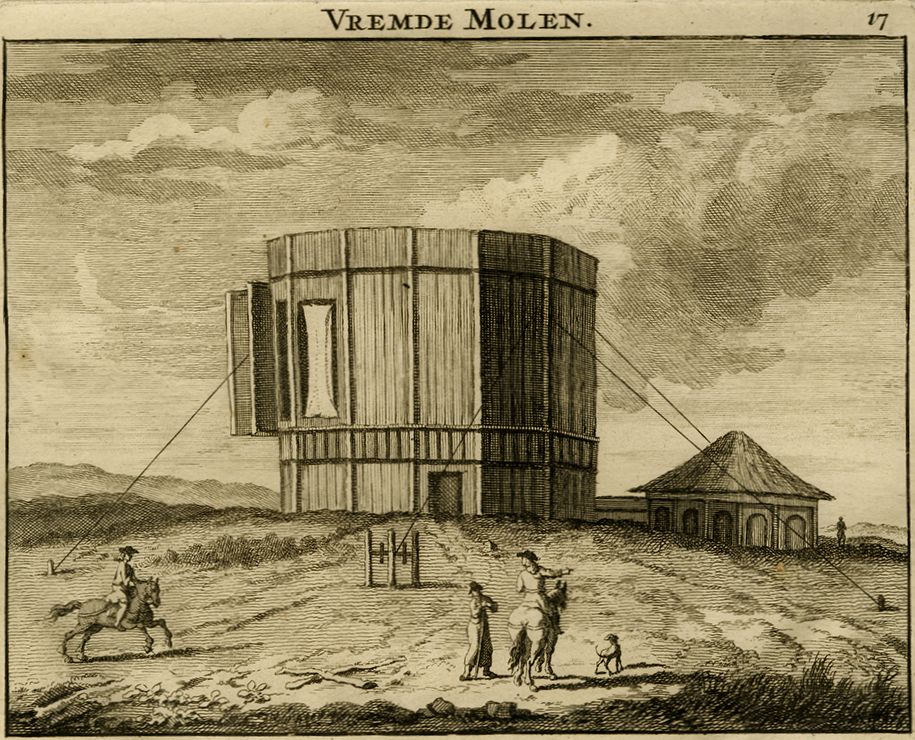
1703
I found his Majesty at his liquor, and understood he was the next day, being the fourteenth, to go with all his train to the Don or Tanais, about 12 wersts from Veronis, to take a survey of the shipping there.
Journey to Tanis
We set out at three in the afternoon, most of us on horseback, and the rest in waggons or coaches, and when we had got a little way from the town, his Majesty stopped at a small church,
An Extraordinary mill
and we went a little aside to see a mill of an extraordinary contrivance by a Circassian, and of an octogon form. Within it are four mills which work together, without sails or ought else for the wind to take hold on outwardly; but within there are seven sails, like those of a vessel, and shut up without by great windows or doors; when there is wind stirring they open two or three of the windows on the side next to it, so that rushing upon the sails, it sets the machine a going with great violence. You have this represented in number 17.
| location | |
| country | |
| date | |
| purpose | |
| note |
Photo: Sail windmill used in pumping brine, Taku Government salt fields, near Tientsin
The following appears to be a standard filler piece of text, that was included in a number of newspapers without much context. In the first example I found, there is no mention of location. Greenock Telegraph and Clyde Shipping Gazette, 25 April 1901From time immemorial horizontal windmills have been employed by the Chinese to pump sea water into higher basins, where wind and sun evaporate the fluid, leaving the salt. Such salt contains a great deal of bitter matter, which gives it a very disagreeable taste; but it appears to satisty the Chinese.A later reworking supplies the location in China where these windmill can be found, and includes a simple illustration, but the rest of the text is very similar. Pearsons Weekly, 14 July 1904
WINDMILLS TO MAKE SALT.A very similar "random fact" on the subject appears in Scott's Scrapbook Henderson Daily Dispatch, Sep. 25 1935
At Taku, in China, an immense number of horizontal windmills are to be seen along the sea-shore. From time immemorial such windmills have been employed to pump sea water up into reservoirs on the land level where the wind and sun evaporate the fluid, leaving the salt. This salt contains a large quantity of bitter matter, giving it a most disagreeable taste to the European, but the Chinaman apparently does not object to it. From Taku the salt is carried in blocks resembling loaves of bread to Tien-Tsin, whence it is distributed all over the country.
The Chinese build horizontal windmills. This one is at Kwantun for pumping sea water into salt vats.
| location | |
| country | |
| building | |
| purpose | |
| millid | af1 |
| location | |
| country | |
| building | |
| purpose | |
| millid | af2 |
| location | |
| country | |
| building | |
| purpose | |
| millid | af3 |
| location | |
| country | |
| date | |
| purpose |
FOR SALE CHEAP!!
In Antigua, at "Lower Freeman's" Estate,
A FIRST CLASS HORIZONTAL WINDMILL, COMPLETE.
CONSISTING of a superior Mill, (Rollers 4 ft. x 2 ft.) Iron Spindle, Crown Wheel and Shaft: Arms and Points nearly new.
To he sold as Steam Works are being erected.
For terms and further particulars apply to C. A. SHAND, Esqr., Pitches Creek, Antigua.
Or to Messrs. G. W. BENNETT & CO., St. John's, Antigua. October 2nd, 1883.
| location | |
| name | |
| country | |
| date | |
| owner | |
| purpose |
Notice.
The Subscriber has received instructions to offer for Sale
Millars Estate
in the Parish of St. George in this Island.
THIS property consisting of 405 acres or thereabouts, is in full Sugar and Provision cultivation, and has a ten horse power Engine with Multi-tubular Boiler, both lately erected, also a spare Cornish Boiler in working order, and a powerful horizontal Wind Mill all capable of reaping a large crop.
The crop on the ground is promising and will shortly be fit for reaping.
For further particulars apply to Sir Oliver Nugent on the spot, or to Alfred Turner, Esq., 6, Dale Street, Liverpool.
OLIVER NUGENT.
Antigua. January 3rd. 1884.
| location | |
| name | |
| country | |
| date | |
| designer | |
| purpose |
-: NOTICE. :-The estates were offered for sale again 2 years later, where the mill was still described as "recently imported" Antigua Standard, 27 May 1899
In the Supreme Court OF THE LEEWARD ISLANDS PRESIDENCY OF ANTIGUA
TITLE BY REGISTRATION ACTS 1886. 89.
In the matter of Lands - OF - ANNE MARIE THÉRSÉ ODDY (formally GUFFROY)
Registered Proprietor as Trustee of all those Plantations or Estates called
"ORANGE VALLEY, FFRYES AND SANDY VALLEY" "HARTS AND ROYALS" AND "CARLISLES."
- AND -
In the matter of a Mortgage of the said Lands in favour of ERIC CARRINGTON SMITH AND EDWIN FRESHFIELD.
PURSUANT to the order of His Honour OLIVER SMITH Acting Chief Justice of the Leeward Islands dated the 14th day of JULY 1897 there will be sold at the COURT HOUSE in the City of St. John, on Thursday the 7th day of October 1897, AT 2 O'CLOCK IN THE AFTERNOON, IN 3 LOTS, -:
All, that Plantation or Stock Farm called :- 'Orange Valley, Ffryes & Sandy Valley' AND ALL THOSE SUGAR ESTATES OR PLANTATIONS CALLED "Harts & Royals" & "Carlisles"
-: LOT NO. 1. :-
Orange Valley Efryes and Sandy Valley;
- SITUATE IN THE PARISH OF ST. MARY, -
Containing 1319 Acres of Land, an excellent Stock Farm with a large quantity of valuable wood.
LOT No. 2. - HARTS AND ROYALS, -
situate in the Parish of St. John containing 219 acres of land, of which 128 acres are Cane land. The crop for 1898 consists of 25 acres of plant Cane, 25 acres of 1st. Ratoons 59 acres of 2nd 3rd and 4th Ratoons. There is a Manager's House, and an Overseer's House, and the usual sugar buildings, a very superior horizontal WIND MILL (by FLETCHER), recently imported, a plentiful supply of water is obtainable from a Spring near to the Sugar buildings.
THE LIVE STOCK CONSISTS OF 2 PONIES, I MARE & FOAL, 5 MULES, & 22 OXEN
LOT No. 3. CARLISLES.
Situate in the Parish of St. George, consisting of 388 acres of Land, of which 220 are Cane land. The Crop for 1898 consists of 62 acres of Plant Canes, 40 acres of 1st Ratoon, 63 acres of 2nd and 3rd Ratoons. There is a good Dwelling House, and an Overseer's House and, Large Sugar Buildings. The Machinery consists of an 8 horse power steam plant (by Fletcher) 2 Aspinal pans, 3 four hundred gallons steam Clarifiers, and a patent scumpress &c.
The Live stock consists of 2 PONIES, 8 MULES AND 20 OXEN.
THE purchaser will have an indefeasible title under the Title by Registration Acts 1886.
FURTHER particulars can be obtained at this Office, or on application to MR. ROBERT W. McDONALD, of 54 Church Street, St. Johns Antigua, the Solicitor having the carriage of the Sale.
O. HUMPHRYS, Chief Registrar Supreme Court.
REGISTRAR'S OFFICE, 16 July 1897.
PURSUANT to the order of His Honour Sir Henry Thomas Wrenfordsley, Knight Chief Justice of the Leeward Islands dated the 18th day of May 1899, there will be Sold by Public Auction at the Court House in the City of St John in the Presidency aforesaid on Tuesday the 1st day of August 1899 at 2 o'clock in the after noon in three Lots, all that Plantation or Stock Farm called "Orange Valley Ffryes and Sandy Valley" and all those sugar plantations or Estates called "Harts and Royals" and "Carlisles."
Lot No 1 :- Orange Valley Ffryes and Sandy Valley situate in the Parish of St Mary, containing 1,319 acres; an excellent Stock Farm with a large quantity of valuable wood.
Lot No 2 :- Harts and Royale situate in the Parish of St John, containing 219 acres of which 128 acres are cane land. The crop for 1900 consists of 22 acres of plant Cane, 79 acres of 1st 2nd 3rd and 4th ratoons. There is a manager's house and an overseer's house and the usual sugar buildings, a very superior horizontal windmill (by Fletcher) recently imported; a plentiful supply of water is obtainable from a spring near to the sugar buildings. The live stock consists of four ponies, tour mules, and 15 oxen.
Lot No 3 :- Carlisles, situate in the Parish of St George, consisting of 388 acres of which 220 are cane land. The crop for 1900 consists of 42 acres of plant cane and 114 acres of 1st 2nd and 3rd ratoons. There is a good dwelling house and overseer's house and large sugar buildings. The machinery consists of an 8 horse-power steam plant (by Fletcher) two Aspinal pans, three four hundred gallon steam clarifiers, and a patent scum press &c. The live stock consists of 3 ponies, 8 mules 16 oxen and 1 ass.
The purchaser will have an indefeasible title under the Title by Registration Acts 1886.
Further particulars can be obtained at this office or on application to Mr Robert W. McDonald of Temple Street St John's Antigua, the Solicitor having the carriage of the Sale.
O. HUMPHRYS, Chief Registrar Supreme Court.
Registrar's Office 23rd May '99.
| location | |
| name | |
| country | |
| date | |
| purpose |
The Hon'ble Mr Parris.
There is one thing which we cannot refrain from saying of the Hon'ble J. W. PARRIS, and it is that however we may differ from his political views, it is impossible not to admire him for the indomitable perseverence, and the care with which he approaches experimental matters of this sort. On the passing of the second reading of the Bill, this hon. gentleman rose from his seat and gave the members of the Council the benefit of certain experiments which he had personally undertaken in order to satisfy himself that a Central Factory would not be the success wbich was claimed for it. It was a noteworthy illustration of the Barbadian pluck which characterizes some of our old planters, a race of men who have formed the back-bone of this country from its early settlement. The following experiment was made at Ayshford Plantation, St. Thomas, with an ordinary horizontal wind mill, the rollers being 24 in (diameter) by 36 inches (width). A quantity of canes weighing 8.914 lbs was ground, and produced 650 wine gallons of juice with a density of 10 deg. Reaume and 2,790 lbs of Megass. The 650 gallons of juice were then boiled and gave 1,016 lbs of sugar and molasses together and filled 22 barrels of sugar. After allowing the molasses to drip for 13 days the result was 796 lbs sugar and 20 gallons of molasses weighing 240 lbs or 1,016 lbs of sugar and molasses. Thence he argued that if 8,914 lbs cane gave 1,046 lbs of sugar and molasses, the result from 1 ton of canes would be 163.338 gallons of juice and 262.849 lbs of sugar and molasses together. Also 100 tons of canes would yield 16,333 gallons of juice from which there would be obtained 26,284 lbs of sugar and molasses or 11 tons 14 cwts, 2 qrs and 20 lbs or 11.733 tons. As stated by Mr PARRIS the the basis upon which the Committees' calculations were made was 9.87 tons and that therefore the common prooess of manufacture must be credited with 1.66 tons more. We are of course quite prepared to admit the accuracy of these figures, but we would point out that some of this difference is accounted for by the fact that Mr PARRIS has calculated at 12 lbs to the gallon of molasses while the Committee have calculated at 11 lbs to the gallon. The products of a Central Factory being more a matter of scientific calculation are likely to be as accurate as possible: and if after such a careful experiment as Mr PARRIS has carried through, to his great credit be it said, only a difference of 1.66 tons of total products more is to be credited per 100 tons of canes it is all the more evident that Central Factories will pay.
| location | |
| country | |
| date | |
| purpose |
Agricultural Report and Packet Summary. Although the fortnight, like it as predecessor, has been somewhat too shifty for windmills yet substantial progress is being steadily made, and field after field of the ripened crop is rapidly disappearing. ...
There have been too some very remarkable yields recorded, perhaps the most noteworthy from "variety" ratoons, for indeed the value of varieties is in their ratooning power. It is a fact that a spot of third ratoons on the ridge of Christ Church, where once ratooning was thought impossible, has during the present season yielded more sugar, on the average, than first crop grown in the same locality; and it is worthy of record that within the past few weeks a spot of second White Transparent, grown on the northern slope of the valley of St. George, and crushed by a horizontal windmill, yielded 600 gallons juice, from each gallon of which 1 1/2 lb. sugar was obtained. The exact figures are: 600 gals juice, 910 lbs. sugar gross in bags - undoubtedly a fine expression for the much maligned windmill, and a splendid quality of juice from canes grown only with stake manure as we make it in Barbados.
| Last generated 20/10/2026 | Text and images © Mark Berry, 1997-2026 - |