Other coverage of horizontal windmills:
18 Feb., 1744-5. A gentleman called on me to show me the drawing of a new invented mill with horizontal sails which goes day and night without attendances, regulates itself according to all winds, and all degree of wind. He has got a patent for it. It is useful in draining lands, mines and grinding.Essays in the earlier history of American corporations, Joseph Stancliffe Davis, 1917
CF. the invention announced in March, 1793, of a horizontal windmill, in Independent Gazetteer, March 31, 1793, and Columbian Centinel, April 10, 1793.A descriptive and historical account of hydraulic and other machines for raising water, Thomas Ewbank, 1850
A horizontal and a vertical windmill are figured at folio 49 of Rivius' translation of Vitruvius, A.D. 1548.I think this must be the Mitcham Common horizontal windmill, but I've not seen anything to specifically locate it on a particular part of the common Merton Historical Society, no. 168, Dec 2008
One survival in Commonside West is the late Victorian Windmill pub, named probably for the unusual horizontal windmill, which once overlooked Three Kings Piece.NRHE also labels a record on The Isle of Man as horizontal air mill
A documentary reference to a medieval mill. It is uncertain if there are any visible remains.This isn't a record of a horizontal windmill, rather of an editorial comment suggesting a vertical windmill should be replaced with a horizontal one. The story came from The Times newspaper, but I assume the editorial comment originated with the Mechanics Magazine. Mechanics Magazine, no. 656, March 6, 1836
The Mechanics Magazine editors could sometimes be more scathing about inventions, such as the following account of a windmill driven ship. This description makes no mention as to whether this is a horizontal windmill or not, but most so called designs for marrying windmills to ship propulsion used horizontal mills, to get the advantage of using wind power from any direction, to even be propelled upwind. Mechanics Magazine, no. 664, April 30, 1836Fall of a Windmill. - Yesterday afternoon, shortly after five o'clock, the inhabitants of Mill-street, Lambeth-walk, were greatly alarmed in consequence of the sails of Mr. Saxby's flower-mill, weighing upwards of five tons, falling with a tremendous crash. A number of houses are very much injured, and the damage is estimated at upwards of 300l. The proprietor and three of his men were in the mill at the time of the accident, and a number of persons were passing, but we are happy to state that no one met with the slightest injury. The high wind was the cause of the mischief- Times, 2nd March - [We hope that when Mr. Saxby proceeds to reconstruct his mill, he will have the good sense to do it on the horizontal and not on the vertical plan - which last was the sole cause of the alarming accident - which has, for the present, put an entire stop to his business. We say "the sole cause" - and considerately; for high as any wind may be, as long as you can master that wind, and do not, the fault is not in nature, but in your neglect of the means which art has furnished you of controlling the powers and freaks of nature.]
Rev. F. H. MABERLY, of Bourn, Cambridge ; new method of Propelling Vessels. - Sealed July 13, 1835, specification inrolled January 13, 1836.Another mix of windmills and boats, this time for pumping. Here the windmill is mentioned as circular, which would appear to mean a horizontal windmill. Mechanics Magazine, no. 644, December 12, 1835
Our readers will hardly believe that the learned clerical patentee now under our notice, has been at the expense of patenting a Windmill ship ! - not of any peculiar construction - not with any contrivance to do away with the objections over and over again advanced - but a mere transposition of a common windmill from land to ship-board, and the substitution of paddle-wheels for millstones! This is not the first by some score, of such plans - not a few of them have been noticed too in our own pages - and there was one described in vol. xvi. p. 35, far more worthy of a patent than the reverend gentleman's. We now turn to the paddles which are to be set in motion by the windmill. The float boards are affixed to an endless chain which works round two wheels placed a little distance apart from each other, along the side of the vessel. We hardly recollect, amidst the confusion of words in the specification, whether both the upper and under parts of the chain are to be continually under water, but we imagine it must be so, because after the paddles opposing their surface to the water, in passing with the chain under the two wheels, they are "struck," (as the patentee terms it) by entering a groove, which carries them along the upper side in a horizontal direction. We beg again to refer our reverend friend to our 5th volume, page 137, where he will find this part of his invention described.
We fear our patentee has been seized with a species of monomania, as we observe that he has since taken out another patent, for a Street-sweeping machine! That he is under a delusion, and believes himself that the inventions are really worth something, we can easily imagine; the very fact of his throwing away a few "cool hundreds" on patents is a proof of this. The inventor, as well as the poet, should know what ideas have been made public before his time, so that he may avoid republishing antiquities. Mr. M's. windmill has brought "grist to the mills" of the different offices through which a patent has to pass; but will bring none to his own.
After what we have said, it would be absurd to criticise the drawing of the specification; - we will just observe that the word "new" in the title, should be altered to "old and useless." Both the description and the drawings are evidently the productions of the reverend gentleman himself, with a bad pen, and without rule or compass. If he cannot preach a sermon better than he can draw a specification, we pity the unfortunate congregation of Bourn.
FREEING LEAKY VESSELS FROM WATER.A small snippet via Google Books of an in copyright book, but clearly quoting from some earlier out of copyright material: Journal of the Society of Arts, and of the Institutions in Union, and Official Record of Annual International Exhibitions, Volume 83, 1935
Sir, - In your valuable Magazine for the 21st of November, a correspondent, signing himself N. G., says, "that he has often thought the screw of Archimedes offered an easy means of freeing a leaky vessel of water"; but he does not state how he would work the screw. Now, sir, it appears to me that the screw might be very well turned by the shaft of a circular windmill placed on deck; in which case, of course, the quantity of water worked out would depend on the force of the wind. The mill might be of moderate dimensions, constructed of materials light but strong, and so as to take to pieces, and be put together with little trouble, and in a short time. There need be no complicated machinery to create expense and cause confusion. I know not whether this plan has been suggested before, but I think it would answer. Nor am I skilful enough to decide whether an Archimedes' screw would be the best kind of engine to work by such a power; but a clever mechanic would soon form a judgment on that point.
I remain, Sir, Your humble servant, J. E.
PAGE 860Something has gone very awry here - as well as mispelling the name with an "l" instead of a "t", the actual patent issued to this inventor on that day was for a toy train!. Somehow they confused the patent 589530 issued to another inventor on the same day. The San Francisco call, August 17, 1898
... models, which have been lately brought before them. It is, a perfect construction of an horizontal wind-mill. Many constructions of such mills have been produced: but none of them, which are publickly known, are free from those defects and inconveniencies, that render them inferior to the vertical wind-mills. It is certain, however, from the tried fact itself, that a well constructed horizontal wind-mill is preferable to the best vertical. There is now in Sussex such a mill ; which has been continually in use near thirty years : and the proprietor, who has great skill ...
WASHINGTON, Aug. 16.— Pacific Coast patents were issued to-day as follows: California: - ... John A. Weilzel [Weitzel], Redlands, horizontal windmillAlthough many horizontal windmill patents were issued in various countries, many of the ideas people came up with were not original. Scientific American 1855-04-14: Vol 10 Iss 31
To correspondents: ...The practical sugar planter, Leonard Wray, 1848
M. W. J., of Mass .- Your Horizontal windmill is not patentable. Mineing knives of malleable cast iron, hardened as you propose, would last some time - not equal to steel of course.
There are many other forms in which windmills could be advantageously made use of: as, for instance, that of Vallance's Horizontal Windmill, or Biddle's Patent Eolian Engine, which is also horizontal; and as the upper districts of India have a very great power in the winds prevailing during the hot months, so no doubt the planters will see the positive necessity of using some of these various descriptions of windmillOracle and the Daily Advertiser, 20 October 1801
The French Government has erased from the list of emigrants and rewarded FLEURY, a French Priest, for some years a refugee in England, for his new discovery of a horizontal windmill, which retains its force whatever may be the inequality of the wind. BONAPARTE is not supposed to be any great admirer of Priests, but shows that he is not Quixotic enough to pick a quarrel with a windmill.Newcastle Courant, 25 August 1843
BRITISH ASSOCIATION FOR THE ADVANCEMENT OF SCIENCE.Essex Standard, 16 July 1856
CORK, WEDNESDAY EVENING.
...
THURSDAY EVENING
...
The meetings of the different sections commenced in the morning at eleven o'clock, when, as usual on the first day of meeting, the proceedings were neither numerous nor varied.
...
SECTION G .- MECHANICAL, SCIENCE .- Professor Macneill, President, in the chair. 1. Mr Henry Dircks, on the proper construction of gasburners. 2. Mr Burt described a horizontal windmill. 3. Mr J. Scott Rusell read some observations on the application of some laws of sound in the construction of buildings.
ROYAL AGRICULTURAL SOCIETY AT CHELMSFORD.Daily News, 23 April 1851
The meeting of this great national Society in the county town of Essex is an event of considerable importance, both as regards the impetus which it can hardly fail to give to the agriculture of the county - already far in advance of very many districts of England; and also on account of the honour accruing therefrom as well to the county as to the town selected as the immediate scene of the gathering. ...
The Implement Stands.
These stands, which cover some ten acres of ground, embrace almost every kind of implement known in farming, besides a vast number of articles of general use, which cannot properly be included in that category. To attempt an enumeration would occupy much more time and space than we could conveniently devote to a single department; and would moreover be a work of supererogation, as the Society's catalogue, with which the majority of visitors will supply themselves before starting on a round of inspection, is not a mere list of names, but gives a description of the uses and principal features of each implement, the latest improvements made in them, and the prizes or honours obtained at former shows. In noticing therefore the different stands (in numerical order) we shall merely mention the leading features of each :-
...
No. 92. H. PHILLIPS, Leamington; reaping-machine and horizontal windmill.
LIST OF EXHIBITORS IN THE CRYSTAL PALACE.Mentions horizontal windmills - but I think at this time this meant (vertical) windmill driving a horizontal roller mill Barbados Herald, 29 April 1889
(Continued from the Daily News of yesterday.)
The following List does not profess to be a complete catalogue of exhibitors at the approaching Great Show, but is offered only as the most perfect statement at present obtainable. It has been prepared from information sent by exhibitors themselves; from lists supplied by the representatives of various foreign states; from descriptions in local journals; and from facts obtained through inquiries by our own reporters.
...
Terrett, Richard, 2, Homer-street, Lambeth. Working models of a new patent feathering paddle wheel, and horizontal windmill, on entirely new principles. The paddle wheel is so constructed as to occupy much smaller space than any wheel now in use. It creates no back water whatever, is perfectly silent, and if even entirely immersed in water by the tolling of the ship, would continue its work without any strain on the engines, or danger of damage to the side frames, as all the paddles, after performing their pull, feather edgeways out of the water. The paddles are deep and narrow, and at sea, with a fair wind might be instantly thrown out of gear, so as to form lee boards, and to keep the vessel in the wind when under sail. The sails of the windmill work horizontally. It is suitable to put to work on the top of a warehouse or store, and is likely to be of utility, either for sugar mills in the West India plantations, for home manufactories, of for emigrants' saw, corn, or other mills.
In the meantime we must be content to confine our improvements principally to points which are comparatively inexpensive and, in a measure, within the reach of all; viz., the improvement of our crushing power, and the prevention of waste. The vertical mills on small estates must give way to horizontal works; the horizontal wind mills, at present overtaxed, must give way to steam works, or at least have the hydraulic brace attached to them. It is quite surprising that this invention has never been applied to a wind mill, as it appears even better adapted to wind mill power than to steam. Whilst we hail with delight the erection of 7 new plants of steam machinery this year, we believe that powerful wind mills have never had a fair chance; if sufficient steam pans and discs were set up on the estates possessing powerful horizontal windmills a great save in the reaping would follow. When the wind did not blow, little or no sugar would, of coarse, be made, but when it did, 6 or 7 tons would be the result of the day's work. As it is, in a fine day the mill is often "pulled out" every 2 or 3 hours, because there is no room for the liquor in the boiling house.Hampshire Advertiser, 26 May 1897
THE AGRICULTURAL SHOW ON THE SOUTHAMPTON COMMON.The Agricultural show held at Darlington, County Durham had a number of wind motors shown: Nottinghamshire Guardian, 29 June 1895
SUCCESSFUL INAUGURATION.
For some time past the inhabitants of Southampton have been watching with interest the enclosure of a portion of the Common, and the erection of wooden houses and sheds for the accommodation of the exhibits at the annual show of the old established Bath and West and Southern Counties Society, which was opened on Monday morning by the Mayor (Mr. E. Gayton), attended by members of the Corporation, officials, and representatives of other public bodies. ... IMPLEMENTS AND MACHINERY.
There is a very extensive exhibition of implements, machinery, etc .- in fact, it has nearly trebled in size since the Society's last visit to Southampton, and this, in spite of the fact that the rate of charges for space for non-agricultural exhibits is higher now than it was then, and that more stringent regulations are in force with regard to the admission of such exhibits. There are two long lines of shedding with machinery in motion, the length of the shedding being something like 750ft. The machinery in motion is arranged to form an avenue from the entrance to the show yard in about the middle of the eastern boundary. All the heavy goods were taken into the ground by this entrance, and to avoid the turf being injured as much as possible a temporary roadway composed of bulky railway sleepers was laid down. As considerable interest is always evinced in the machinery in motion, it would perhaps be most desirable, in taking a glance at the exhibits, to make a beginning here, and afterwards to deal with the multitudinous exhibits of implements adapted to the various requirements of the farm, the road, and the homestead gathered together under an extensive range of shedding. Commencing with the right hand row from the entrance, round which are the offices of the various railway companies, the first thing to strike the view is a large windmill engaged in the operation of pumping water, this being exhibited by Mr. J. W. Titt, of Warminster, who also shows an elevator and other machinery. Messrs. E. H. Bentall and Co., of Heybridge, Maldon, have in operation some grinding mills and shafting, while in another quarter they make an extensive display of agricultural implements, such as mowing machines, turnip and chaff cutters, and grinding mills. Returning to the machinery in motion, Mr. S. Howes, of Mark-lane, London, a neighbourhood so much associated with the corn trade, showed screening machines and grain separators at work, and in another direction was represented with a waggonette and light cart. Messrs. Blackstone and Co., of Stamford, had chaff cutters, grinding mills, and haymakers at work, the driving power being furnished by oil engines. ... Windmills of different types tower to a good height, and were exhibited by Messrs. Duke and Ockenden, Littlehampton, Messrs. E. and H. Roberts, Stony Stratford, and the Rollason's Wind Motor Company, London.
ROYAL AGRICULTURAL SHOW.A suggestion to install horizontal windmills in Inverness Inverness Courier - Thursday 02 April 1818
BY PROFESSOR W. J. MALDEN.
The implement section of the Royal Agricultural Show, which opened on Saturday, is, as usual, one of the most attractive portions of the great exhibition. No matter where the show is held, there implements of all classes must go, at any rate all that are best and newest must do so.
...
Wind motors increase in number yearly, and the type associated with Mr. Titt are shown in large numbers. These have proved very valuable additions to farms for pumping, grinding, and many similar operations. A new style of motor. however, is shown by Rollason's Wind Motor Company, which appears likely to be very useful for generating power for electric lighting, and similar work, where a more constant motion is required. The feature of this engine is that the sails are placed horizontally. They are concave in shape, and have no openings or perforations; the wind therefore catches them fully, and with no loss of force. The concave shape occasions less waste of power when backing to the wind, and as a revolving shield actuated by a vane prevents the wind from being brought to bear on them in that direction, the resistance is very slight. The full force of the direct wind is secured, and a powerful motion is obtained. The whole of the weight of the sails and frame carrying the shield is thrown to the centre bearing on the bottom of the turret. On the top of the sail shaft is fixed a cup containing a quantity of oil, within which are carried rollers by which the shaft actuates the shield. Sufficient oil to last for several months is contained in the cup, so that frequent oiling is rendered unnecessary.
HIGHLAND SOCIETY.- On Saturday last was held the anniversary Meeting of the Corporation of the Highland Society; the Duke of Argyle in the Chair. ...The Expedition for the Survey of the Rivers Euphrates and Tigris, carried on by order of the British Government, in the years 1835, 1836, and 1837; preceded by Geographical and Historical Notices of the Regions situated between the Rivers Nile and Indus. By Lieut. Colonel CHESNEY, R.A., F.R.S., F.R.G.S., Colonel in Asia, Commander of the Expedition. London: Longman, Brown, Green, & Longman., as reviewed and quoted in Newry Telegraph, 26 September 1850
Last year Government sent down corn to the distressed Highlanders of Inverness and its neighbourhood, but being entirely destitute of mills for grinding it, they were under the necessity of returning the corn. A few horizontal wind-mills will soon pay for themselves, and their singular and extensive usefulness will be speedily and powerfully experienced. They would cost from £100 to €200 each, according to the size.
No people are more diligent husbandmen than the Afghans, and their efforts are not confined to the manual labors of the field, nor the ingenious excavation of a kanat; for, in addition to the portable hand-mill of the tent population, much mechanical ingenuity is displayed in the construction of water-mills, Persian wheels, and, especially, horizontal windmills.Dundee, Perth, and Cupar Advertiser, 14 April 1863
At the ninth meeting of the session of the Royal Scottish Academy of Arts, held in Edinburgh on Monday evening, Mr Edward Sang communicated a description of a new horizontal windmill, invented by Mr James Laird, caum maker, Forfar. Mr Sang also gave a description of two new gravity escapements, invented by Mr Henry Kerr, clock aud watchmaker, Dundee. Both papers were remitted to Committees.The committee reported back a while later: The Scotsman, 14 July 1863
ROYAL SCOTTISH SOCIETY OF ARTS.
LAST night, an extraordinary meeting of this Society was held in their hall, 117 George Street. - Dr Stevenson Macadam, President of the Society, in the chair.
...
MR LAIRD'S HORIZONTAL WINDMILL.
The committee on Mr J. Laird's horizontal windmill reported that the invention was not new, but that the same object was attained several years ago by Mr George Buchanan.
The following Mills Archive records have been tagged with Horizontal Windmill, but are unclear if this is correct
A VICTIM TO MODERN INVENTION.A series of letters and queries appearing in the Field, and in the English Mechanic, that seem to be more opinion than fact. Field, 02 May 1874
Since quite a child Harry Gradient had been noted for his ingenuity in devising various mechanical oddities. When not engaged in graver pursuits he was sure to be ankle deep in some hydraulic scheme, or head over ears in some other of the mechanical sciences. His knack of invention was truly wonderful, though as yet—at the time I write Harry was twenty-five—my friend had had few opportunities of turning it to a practical purpose. He and I were both engaged in some engineering works on the continent, undertaken by an English firm. After we had been there some months, Harry received the welcome news that a relative had died, leaving him a nice little property and a comfortable house, some miles out of London.
Prior to leaving me to return to England - for there was much to be done in the way of setting the property and house in order - my friend said, with his usual enthusiasm: "Mark, my boy (my name is Mark Mildmay), I shall expect you to come and see me when you come back. I suppose you are booked here for another eighteen months or so, and that will just give me time to set my house in order. Such a house my boy! You've never seen such a one as it shall be. I mean to give up engineering for the public, and to exercise my talents in that way for my own benefit and comfort my house shall be full of ingenious and curious contrivances, such as have never been seen before."
Time passed on, and the business I had been engaged in was completed, and I had returned home. I had written to Harry occasionally, and as soon as he heard I had arrived in England, he sent me a pressing invitation to come and visit him. ...
After a time we joined the ladies in the drawing-room, and had some music and singing, as Miss Denbigh had a very fine voice she and Harry sang some duets'together, and appeared so much accustomed to it that they must have had a great deal of practice. In the room was a nice little organ, on which Harry gave a very creditable performance. He explained to me that it was blown by water-power. He had fixed a horizontal wind-mill on top of the house, which pumped up the water and from the height to which it was raised he got sufficient power to work a small water-engine to blow his organ. ...
WIND ENGINES FOR FARM PURPOSES.- AS you devoted several columns of The Field to some very excellent and valuable observations on steam power as applied to farming purposes, you will perhaps allow me to name an invention which I have lately completed where wind is the agent. Looking to the expense and difficulty of construction of the vertical wind engine, I have for a considerable time devoted my inventive faculties to devising a horizontal one, which shall possess the advantage of cheapness in manufacture, easiness in management, and great comparative power; and the model just completed appears to combine these desiderata. I started with the conviction that in a horizontal wind engine the wind must be taken on so as to exert its utmost influence: and when that object is gained, the sail must "feather" itself by an automatic arrangement until it arrives into position for receiving the impulse, at which instant it must again present a flat surface to the wind. Another sine qua non is evident in the fact that, should the wind shift, it must be practicable to alter the automatic action without difficulty and in a few seconds of time, so that the taking on and cutting off shall continue uninterruptedly; and this I believe I have also rather successfully accomplished in the model. I have constructed it with sails 2ft. 10in. long by 1ft. 6in. wide, on an arm about 4ft. long. This gives an extreme width of 8ft. from end to end, and there are four sails. The upright shaft is about 2ft. long, and l 1/4in. thick, I had no idea that so small an affair possessed so much power as it does. In a brisk pleasant breeze, and when I was grasping the shaft as hard as I could, it ran through my hand without the least possibility of my stopping it; and it would, I feel sure, drive a lathe easily enough if made only half as large again as I have made it. For a farm engine, I would suggest one with sails about 10ft. long by 4ft. wide, and I foresee that such as engine would make very light of a straw cutter, or in fact of a small thrashing machine. There are thousands of moderate-sized farms where steam power cannot be afforded, and where that splendid power, water, is not available; but wind is prevalent everywhere, and usually at a time of the year when farm machines aro wanted. A vertical wind engine requires to be elevated very high, aud requires a "line" shaft (usually called the "wind shaft,") to the upright one, which involves friction; and, besides all this, they are not very easy to keep in the wind. In the horizontal engine the sails are on the upright shaft itself, doing away with the wind shaft altogether, and the engine need not be constructed more than 7ft. from the ground; and should the wind be very high, any one or more of the sails can be bolted up in half a minute, and be carried round in a position edgeways to the wind, instead of falling into their driving form, as they would do if at liberty; and. what is more, the engine cannot by this arrangement be made heavy-sided.- DEALFALL.Field, 5 December 1874
WIND ENGINES FOR FARM PURPOSES .- My attention has just been directed to this subject, and to the suggestions made by "Deadfall" in your issue of May 2, 1874. They may appear at first sight very attractive, but before I begin the experiment with one as suggested by him, and of the dimensions he gives to drive my chaff machine, I should like to be sure that the sails will not be too heavy at the end of the poles or arms, and to be satisfied that there will be the objectionable concussion overcome, the concussion so generally prevalent in horizontal mills when they feather the wind. I and some of my friends have tried experiments with models and full-sized horizontal windmills, and the results have been that in models there is an apparent success but of full working size a total failure, and the old trials verified that horizontal are not so powerful as vertical, and the whole surfaces carried are not utilised to the extent of vertical; if some come edge to wind in a revolution, when so placed they are a dead weight.English Mechanic and World of Science, Nov 6, 1874
-ALPHA BETA.
WINDMILLS AS DOMESTIC MOTORS.English Mechanic and World of Science, Nov 20, 1874
[8315]-The subject of employing the power of the wind for driving lathes, and working numerous other machines where steam is out of the question and water not available, has so frequently occupied the attention of your readers that I venture to request the insertion of the following, with the view of obtaining further information and suggestions from many of your mechanical readers. The remarks I am about to quote appeared in the Field, over the signature "Deadfall." The writer says :-
"Looking to the expense and difficulty of construction of the vertical wind engine, I have for a considerable time devoted my inventive faculties to devising a horizontal one, which shall possess the advantage of cheapness in manufacture, easiness in management, and great comparative power; and the model just completed appears to combine these desiderata. I started with the conviction that in a horizontal wind-engine the wind must be taken on so as to exert its utmost influence: and when that object is gained, the sail must "feather" itself by an automatic arrangement until it arrives into position for receiving the impulse, at which instant it must again present a flat surface to the wind. Another sine qua non is evident in the fact that, should the wind shifts, it must he practicable to alter the automatic action without difficulty and in a few seconds of time, so that the taking on and cutting off shall continue uninterruptedly; and this I believe, I have also rather successfully accomplished in the model. I have constructed it with sails 2ft. 10in. long by 1ft. 6in. wide, on an arm about 4ft. long. This gives an extreme width of 8ft. from end to end, and there are four sails. The upright shaft is about 2ft. long, and about [unreadable]in, thick. I had no idea that so small an affair possessed so much power as it does. In a brisk pleasant breeze, and when I was grasping the shaft as hard as I could, it ran through my hand without the least possibility of my stopping it; and it would, I feel sure, drive a lathe easily enough if made only half as large again as I have made it. For a farm-engine, I would suggest one with sails about 10ft. long by 4ft. wide, and I foresee that such an engine would make very light work of a straw cutter, or, in fact, of a small thrashing-machine. There are thousands of moderate-sized farms where steam power cannot be afforded, and where that splendid power, water, is not available; but wind is prevalent everywhere, and usually at a time of the year when farm-machines are wanted. A vertical wind-engine requires to be elevated very high, and requires a "line" shaft (usually called the "wind-shaft") to the upright one, which involves friction; and, besides all this they are not very easy to keep in the wind. In the horizontal engine the sails are on the upright shaft itself, doing away with the wind shaft altogether, and the engine need not be constructed more than 7ft. from the ground; and should the wind be very high, any one or more of the sails can be bolted up in half a minute, and can be carried round in a position edgeways to the wind, instead of falling into their driving form, as they would do if at liberty: and, what is more, the engine cannot, by this arrangement, be made heavy-sided.This is all very satisfactory, so far as it goes; but the writer does not say how he constructs his horizontal windmill. What is wanted is a detailed account of the arrangement, and this, I imagine, some of your readers ean supply.
J. Kingham. Hornchurch.
WINDMILLS AS DOMESTIC MOTORS.
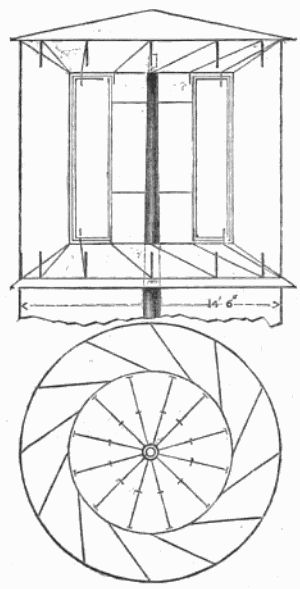
[8380] The horizontal windmill which Mr. J. Kingham (let. 8316), would wish to construct with reefing-sails has never yet succeeded, but I inclose a very rough diagram of one with fixed sails and fixed windprints, which will give a respectable performance.It is very simple, requires no attendance, and takes the wind from any quarter. The model is supposed to be 8ft. 6in. diameter and 9ft. high; each sail is 2ft. by 8ft. 6in. giving 18ft. super, or for four sails 72ft. super, for the wind acts on four at once; but the aggregate of the four windgate is 184ft. super, and reckoning the wind's force at 1lb. per foot super, the pressure on the sails will approach 180lb., or about a four-man power.
Henry W. Reveley.
[20715] Horizontal Wind-engine. - Would some of "ours" kindly give me a little information upon the above object, as I want to erect one to work a small pump, say, 3in, barrel. How are the sails made so as to feather? How so as to return and present a flat surface again to the wind? A sketch of the sails would greatly oblige.English Mechanic and World of Science, Nov 27, 1874
A. E. O.
WINDMILLS AS DOMESTIC MOTORS.English Mechanic and World of Science, Dec 11, 1874
[8413] About ten years ago, then employed in the great city (London), I remember assisting a rather ingenious young shopmate to construct such a machine as described by Mr. Kingham (letter 8315, p.196), and will give details to the best of my recollection. Suppose an upright shaft, 10ft. or 12ft. high, and 1 3/4in. in diameter; on top of this vertical shaft a round cast-iron disc 10in. in diameter made fast to main shaft by a boss or socket, and taper cross-pin; on this round plate is bolted four plummer blocks, with their usual caps and screws, and gun-metal bushes; now two of these plummer blocks should be nearly half as high again as the other pair; because in those journals are laid the two arms, crossing each other at right angles, and horizontal with the main shaft, so that one of the arms will be unavoidably its diameter above the other, sufficient clearance to allow them to revolve, or rather oscillate; these arms are 8ft. long, and taper towards their extremities from 7/8in. to 1/2in. in diameter. Now comes the wrinkle; at the ends of these four horizontal arms are bolted or riveted four light Iron frames 3ft. by 1 1/2; these frames carry the sails of canvas, fastened to inner rods by slip or curtain rings, ready for reefing; now take one of the four frames, and make it fast to one of the four arms, so that it will be across the arm at right angles: this arm will have now the appearance of a huge T square; now turn round the same arm in its bearings, till the frame-sail lies horizontally; now fix on another frame, vertically this time, at the opposite end of the same arm; repeat the dose to the remaining arm. There were four stays or stops, preventing the arms being blown right round, so that each arm described alternately a quarter of a revolution; thus, each sail rose and fell alternately to the wind, or, in other words, kept feathering themselves up and down, up and down, the four horizontal arms flying round, and carrying the vertical shaft with them, no matter which way the wind blew. My friend had a small wooden one at work in his garden. Before this one was completed, he went to America, and I have lost all trace of him since.
J. B. Parvis.
WINDMILLS AS DOMESTIC MOTORS.English Mechanic and World of Science, Dec 18, 1874
[8470.]-I beg to be allowed to make a few remarks on the letter (8310), of Mr. J. Kingham (page 196, Nov. 6). He very naturally wishes for details of the construction of my recently invented wind-engine. I believe the invention to be strictly original, for I cannot in any mechanical book or in the Encyclopaedias find the movement which I have carried out. I am now constructing a wind-engine rather larger than the one he alludes to, and am finishing it more carefully and adding governors to it so as to control the speed in high and variable winds. I found that the first I made was so powerful in a gale that it actually shifted its position more than a foot one windy night. I should state in explanation that it stood on a wooden tripod about six feet high, and not fixed to the ground. I have had a great many mechanics, both amateur and professional, to look at it, and they have been astonished at its capabilities, and to no one of them had the feathering and self-winding movement occurred previously, although pronounced simplicity itself, when shown in action. By every one I have been strongly urged to patent the invention; and this was the reason why I did not go into details of construction in the Field.
I have not, however. made up my mind about this point yet; and cannot well do so until I see how the governors act.
I hope to have the new wind-engine finished in about a fortnight. A former correspondent, I observe, makes mention of a horizontal wind-engine, about eight feet high. It is, in fact, the American engine, of which, under the name of "Strunks's Wind Engine," you gave a drawing in June, 1861, or 1871, I forget which. My engine, if for driving lathes or farm machinery, need not be more than about four feet high, as the power is got with the lengthened arm. This being the case, it could be erected on the top of a flat building, and need be no eyesore. Should I not patent it, I intend to have it photographed, and publicity of the machine can then be readily afforded.
Deadfall.
WINDMILLS AS DOMESTIC MOTORS.
[8489.] - If "Deadfall," 8470, p.326, has done what he says, and allowed a number of people to see and inspect his device, he can no longer obtain a valid patent. That admirable institution-the Patent Office will take his money, and give him in return a sheet of parchment with a few pounds of sealing-wax of very inferior quality attached to it; but that document will be absolutely worthless, as any one is at liberty to make any apparatus which has been publicly exposed, in spite of any patent afterwards taken out. A valid patent can be obtained only, if the effect alone has been visible, but the mode or apparatus by which it is produced has been kept secret.
Sigma,
[8490] J. W. PURVIS (letter 2413, p. 277) mentions a windmill as domestic motor. There are some points in it that I do not understand. Will "J. W. P." or some other reader, enlighten me? The frames or sails are said to be 3ft. by 1 1/2. Are they put crosswise to the arms, or longwise? Why are they not put the whole length of the arm? what causes them to turn broadside to the wind? are they fixed to the arms just at the middle of sail or, higher up, so that the bottom part is heavier than top? I want to erect a windmill for working a pump, or driving a grindstone, or other light machinery, and should be glad with information on the subject. R. R. Smith could doubtless give advice if he felt inclined, and I have a question to ask him about his stone-dresser.English Mechanic and World of Science, Dec 25, 1874
G. T. B.
[21072] - Windmills as Domestic Motors - I have read with interest the letter by "Deadfall." Will he kindly reply whether his windmill would be sufficient to drive a centrifugal pump, having a 3in, delivery and suction pipe, now worked by high-pressure engine? What would be the probable cost and approximate horse-power?English Mechanic and World of Science, Jan 8, 1875
QUARRYMAN.
WINDMILLS AS DOMESTIC MOTORS.English Mechanic and World of Science, Jan 8, 1875
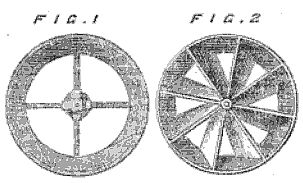
[8379] - "G. T. B.," 8490, asks advice, and appears to intend to make use of advice tendered. The annexed engravings, I believe, would yield very satisfactory results, and in a fair wind would transmit about a one-horse power for 100 square superficial feet exposed to the wind; and all irregularity in the motion could be rectified by attaching a force-pump to the mill and regulating the flow of water from the receiver, so that if the pump attempted to run too fast, the pressure of air in the air-vessel would soon react and reduce the speed to that required. Of course I am aware what I am now recommending is an hydraulic press, and I have no doubt could be made to punch a 1/2in. hole through a 1/8in. boiler plate; so that some strength is required in the various parts.
No. 1 shows the two main cross timbers put through the shaft, just the same as is usual in a common wind-mill with four sweeps, around which is a conical rim to concentrate the wind upon the sails and prevent any being thrown off by centrifugal motion or sliding off, and it is very possible that 30 per cent. can thus be added to the pressure upon the sails. No. 2 shows the sails fixed complete; only eight sails are shown, but in practice more will be required, as it is intended to utilise all the surface exposed to the wind. If "G. T. B." really intends to make a mill, and will submit his drawings to me by post, I will advise with him, and should anything worth notice result, it could be afterwards published to benefit others. With regard to his question about the millstone dresser, see my advertisement.
R. R. Smith.
[21072]-Wind-Engine. - My model wind engine is about completed, but the snow lies on the standard of it four inches thick, and, as far as one may judge, seems likely to remain. Until the weather permit, I do not like to put the machine together, although I am most anxious to prove what the result will be when the governors are attached. If "Quarryman" will kindly wait a while, I hope to say something practical on the question at a comparatively early date. As to the power and adaptability of my horizontal wind-engine, I have, with every reason, the most favourable opinion. I am no mathematician, but I am sure some correspondent who possesses that knowledge could kindly calculate the power from the dimensions I gave.
DEADFALL.
About Sugar Cane.
(BY LEONARD WRAY, ESQ)
No. 39.
THE first cost of a water-wheel in Jamaica, is considerable; but if well made and properly erected, its working is most simple, economical, and enduring, as well as uniform and efficient. I am of opinion that where an overshot water-wheel cannot conveniently be erected, the horizontal wheel of Whitlaw and Stirratt, may be availed of.
The wind furnishes another very great power, which planters have from time to time been eager to avail themselves of: thus, in Jamaica and many of the other West India islands, numerous windmills are to be seen, either in present working order, or in that state of dilapidation which has but too generally fallen on many of the finest estates of the West. Where the towers are still in good substantial order, mills could be readily fitted to them, in order either to work them in conjunction with cattle or steam-mills, or separately as a spell to those mills. No estate can rely on a windmill alone; therefore, wherever there is one erected, there is also either a steam or a cattle mill beside. The expense of constructing a windmill is in general so great, and its work so very uncertain, that few planters ever think in these days of recurring to its use: but it happens that the only kind which has hitherto been tried in the Colonies is the vertical mill, the erection and general cost of which is very expensive. Lately, however, there have been patented more than one form of horizontal windmill, which seem to hold out a promise of better things for the planter. Of these, that of Stace and Vallance appears to be the best: and, next to that, Biddle's Eolian Engine, either of which may be purchased at L25, the four horse power mill. I am unable to speak correctly as to the price of those of greater power; but I have now before me a letter from one of the patentees (Mr. Stace), wherein he writes, that they can supply those windmills which are considered of four horse power with a moderate wind, at L25 each. I therefore have little doubt that the cost of one which would be rated at sixteen horse power in a moderate wind, would not exceed L100. Now if an honestly constructed and practically efficient windmill, of sixteen horse power, can be purchased for L100, I think every estate favourably situated with regard to wind, should have one, whether the other motive power be cattle or steam. I consider that it would be found a very valuable auxiliary; one that would very frequently spell the cattle and mules, wherever they are still used: or would save a considerable amount of fuel where steam-engines are employed. I have myself lived for a long time on an estate which had a windmill, and I have, in numerous cases, known it to be in full work from daylight until dark. In Jamaica, however, the sea-breeze usually sets in at about nine or ten o'clock in the morning, and lasts until four or five o'clock in the afternoon; affording, therefore, from six to seven hours working wind. This sea breeze is on the whole very constant, and very frequently is very powerful, as every planter knows. I therefore perceive that great economy of fuel would result, as well as other advantages so important, that I think the subject merits the serious consideration of the planter.
Let us look at the matter practically and dispassionately: take, for instance, an estate having a ten or fourteen horse power steam engine and mill, and suppose this estate to be in Jamaica or any other colony where fuel is expensive, and a good steady wind very frequently available. Now in working off a large crop, occupying perhaps five or six months, if every third or fourth day the steam-engine can be spelled by the auxiliary windmill, there will be, out of the five or six, upwards of one full month during which the fuel necessary to work the engine has been saved; and that time is afforded the engineer or negro attendant to examine, clean, or may-be repair, the various parts of the engine. It is no uncommon thing, in many localities in Jamaica, to have a strong sea-breeze almost every day, for a month or more at a time: there are times when the breeze is so very moderate that little power could be obtained from it in mill-work; but it is also equally certain that a very strong breeze frequently prevails, even for many days in succession. It therefore follows that every day which brings with it a good stiff breeze during crop-time, causes a considerable saving to that estate which has, besides its steam-engine, an auxiliary windmill. There cannot be the least difficulty in fixing a horizontal windmill so as to connect and disconnect with the same mill which is driven by the steam-engine; neither can there be any difficulty in connecting and disconnecting, in the same manner, the engine and mill. Improved cane-mills and engines are now sent abroad, which can be thrown in and ont of gearing in a moment; and, by the very simplest arrangement, the windmill could be eligibly placed so as to take on itself the work of the engine at any moment the wind might spring up. In cases where bullocks and mules are used for mill-work, of course the force of these arguments is the better established. It must be borne in mind that I am altogether alluding to horizontal, not vertical windmills. In parts of India and the Straits Settlements, the observations I have made on this subject apply; although not to the same extent as in the West Indies, in consequence of the great abundance of fuel in the Straits and in some parts of India.
WINDMILLS FOR THE PEOPLE.The original, much longer piece is at London Evening Standard, 24 September 1878.
Notwithstanding the mechanical genius which is characteristic of the present age, and the extent to which machinery has been employed in the development of manufactures, it may be questioned whether we are making due and proper use of available mechanical forces in the matter of domestic economy. The simple "laying-on" of water to a house is a substitute for the primitive toil of taking the pitcher or bucket to the well. But even the modern arrangement is often very imperfectly carried out. The quantity of rain falling on the roof of a house in the course of a year would go a long way towards furnishing the requisite water supply for the use of the occupants. Probably, in like manner, the force of the wind which passes over the house is sufficient for the performance of all the mechanical work that is done in it. An eminent engineer has offered some highly suggestive remarks. Wind, he observes, was at one time very commonly utilised in this country. It gave way to water, as being more certain; and water, in its turn, gave way to steam. As coal is becoming expensive, and water is in demand for many purposes which steam recently fulfilled, attention is again being paid to wind, and the ingenuity of engineers is exercised to furnish the most economical form of wind-engine. Firms of celebrity are labouring in this direction, and are said to have succeeded in making excellent engines of the kind proposed. Odd as it may appear at first sight, there is no good reason why a neat and compact horizontal windmill should not be placed on the roof of every house. Of course it must not be a noisy contrivance. Our engineers will tell us whether it might not be possible to make such a motive power available for storing up compressed air. The magazine might consist of a large tank, bearing a moderate pressure on the square inch. From this reservoir of power a set of pipes could be conducted all over the house, and the mere turning of a tap would serve to let on the power which should work a sewing machine, or a knife-cleaning apparatus, or a washing machine, or work the "lift," or perform one or the other of a variety of mechanical operations. Let those who choose to laugh at such a system of things pay a visit to one of or first-class ironclads. The very principle which may be thought ridiculous in reference to our dwellings is in full operation on board a line-of-battle ship. Let us think of the Temeraire, with her 34 steam-engines. Our brave sailors are rescued from a world of drudgery, and simply move a lever to turn on the steam when they want to hoist coals on board, or to haul up ashes from the stoke-hole, or to raise the anchor, or to pour water over the decks. Thus it is that we can put machinery into our factories and into our ships, and can save labour in every possible direction, except it be at home, within the line of our own threshold, and by our own fireside. It serves us right that we groan under the petty tyranny of our domestic servants. It ought not to be impossible to place some kind of motive power at the disposal of our households, so as to render them less dependent on the primitive toil of the hands .- Standard.
On Sunday the 26th ult. between twelve and one o'clock, a most tremendous thunderstorm was experienced in the neighbourhood of Wantage, accompanied by the phenomena of a tornado, and waterspout, which are thus described by a gentleman exposed to the fury of the storm on the Downs between Wantage aud Lambourn: 'The hail and rain poured in torrents, when suddenly the storm appeared to cease, and the thunder rolled away in the murmurs of distance. At this moment the air was heated almost to suffocation, and a vapour of fleecy whiteness appeared to issue from a dark cloud in the north. This gradually assumed the form of an inverted cone, whirling with excessive rapidity in the manner of an horizontal-mill, taking a direction N. N. W., raising and scattering in the air every substance that impeded its progress, until it burst with a tremendous deluge of water.' It was afterwards ascertained that besides much damage of minor importance, it had completely destroyed a new built-barn on the Downs, and dispersed the materials to an astonishing distance. Several trees were also blown down in Kingston Lisle Park. In some places exposed to this awful visitation, hail-stones were picked up that measured four inches and a half in circumference.
IM105 - December 2022 Article: 'Is the development of the windmill in Western Europe independent from that of the Eastern (Sistan) windmill?' by Tarcis van Berge Henegouwen. Charts the rise and expansion of the Islamic Caliphates which promoted new learning and technology, including reports on the horizontal windmills of Sistan.
IM101 - December 2020 Article: The Sugar Windmills by Willem van Bergen. Covers wind-driven cane sugar mills of the Caribbean. The earliest form were horizontal mills but from the early 18th c. were of the vertical tower type.
IM107 - December 2023 Article: "The 'Wooden' Windmills on the Island of Syros, 1822-1843" by George Speis. Found references to "wooden windmills" in the town of Ermoupolis. Through archival documents, engravings, paintings and maps proposes that these were developed by new settlers from the Northern Sporades (Skiathos and Skopelos), and were actually horizontal types.
| Last generated 20/10/2026 | Text and images © Mark Berry, 1997-2026 - |