
 Kids deserve better than AI generated slop
Whilst having a look at newly released books, I came across the children's book "Emily's Adventures: Milling Flour, The Windmill" which was published earlier this year.
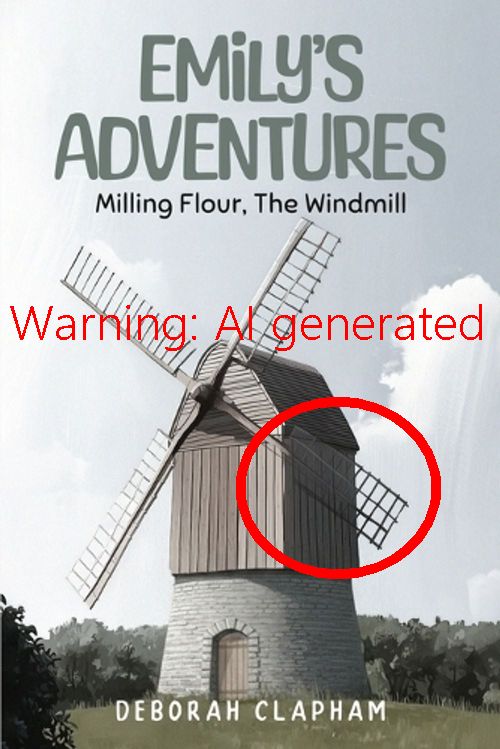
According to the author's bio
Deborah Clapham is a Worcestershire-based author with a passion for bringing the forgotten lives of the nineteenth century into the light. Drawing inspiration from the region's rich industrial heritage, she explores the lives, struggles, and quiet resilience of ordinary people whose stories have often been overlooked by history.I've highlighted the bit about a eye for detail, since it's clear from the book cover that no such eye has been applied here.
With a keen eye for historical detail and a deep appreciation for the human spirit, Deborah brings the past vividly to life. Her stories echo with the clang of hammers in dim workshops, the warmth of hearth-lit homes, and the determination of families facing hardship. Through emotionally rich and authentic storytelling, she invites readers to step beyond the pages of history and experience the hopes, challenges, and courage of those who lived it.
Rooted in her love of Worcestershire and its history, Deborah's work celebrates the communities and forgotten voices that helped shape the world around them, ensuring that the lives of ordinary people are remembered and their stories continue to resonate with readers today.
The cover shows a vaguely Midlands style post mill (where the buck is part supported on the roundhouse walls), where the example at Avoncroft is indeed in Worcestershire where the author lives. Unusually the buck shows vertical weatherboarding, which is not really common. The image shows shadows cast by the doorway and the buck as if the the sun is high in the sky to the left of the picture, yet the lower left sail casts no shadows. The lower right sail does cast a strong shadow (against a wall that is itself in shadow!), as if the sun is now in the upper right of the picture, yet this shadow is both incomplete, and yet also takes concrete form, becoming part of the actual sail itself in a sort of Escher like merging of objects. Of the sails, 3 rotate anticlockwise, but the lower right one is set to rotate clockwise! The sails are mounted in places to the front of the stocks, but also merging with, and behind the stocks. It's hard to make sense of what form the poll end and sail attachment takes. In some places as expected we can see the sky or other parts of the mill through the open sail frames, yet in other places the sails are opaque, showing a different colour than the sky behind.
In conclusion, this book cover is an AI generated pile of slop - I don't hold out much hope for the quality of the actual contents of the book itself. Looking at the catalogue entry, this is unsurprisingly a self published book - I hope no respectable editor would have handled such AI generated material. Kids certainly deserve better.
Not that it was in any doubt, but I uploaded the image to SynthID Detector. It reported
SynthID was detected
This media was made or edited with Google AI
Please note that this media may have been edited further since then.
| Last generated 05/11/2026 | Text and images © Mark Berry, 1997-2026 - |