Mechanics Magazine, no 616, May 30, 1835
The only windmill I have ever seen in this country, is one at the town of Baypoore, near Calicut, on the Malabar coast, which was erected by the Bombay Government, twenty-five or thirty years ago, at an expense (it is said) of about four lacs of rupees, (40,000l sterling,) for the purpose of sawing timber; it was found to go at a splendid rate for some time, and the harder the wind blew, the faster it revolved; but like the Dutchman with his self-moving leg, it was discovered, when too late, that a trifling error had been made in its construction, viz. how to stop it, or lessen its speed. It soon afterwards received some injury, and has ever since remained in status quo, a monument of the folly of the Bombay Government.
The practical sugar planter, Leonard Wray, 1848
THE USE OF WINDMILLS IN UPPER INDIA.
If wells are sunk to a depth of from twenty-five to thirty feet, and are properly constructed, each one should be capable of affording full employment to a pump worked by a windmill or steam-engine of two horse-power; and every well might have its own little windmill of about that power, which should work the most simple and economical pump a planter can procure. With a lift not exceeding thirty feet, an exceeding simple kind of pump may very advantageously be used.
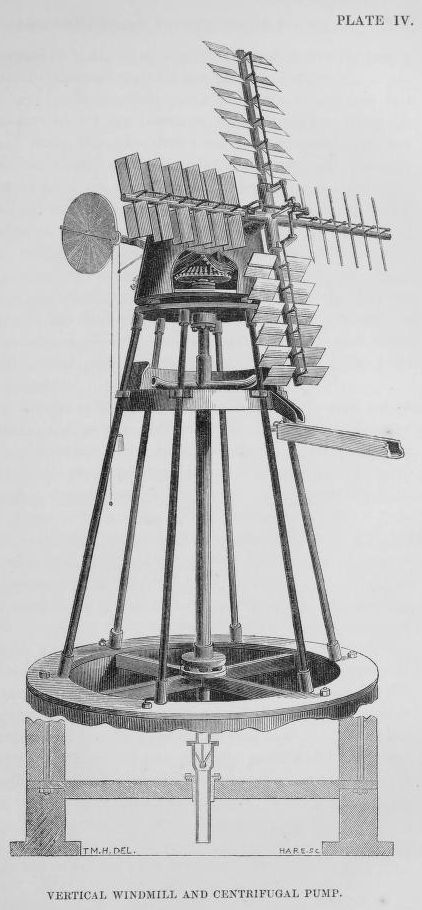
Plate IV. represents a windmill attached to that simple and much neglected kind of pump, which acts by centrifugal force; causing the water to fly from the centre of rotation, (through arms having openings at their extreme and curved ends) thus tending to form a vacuum, towards which the water in the well is forced by the pressure of the atmosphere; it can, therefore, only act where the column of water is less than thirty-three feet high.
The circle described by the curved arms is sixty-six inches all over, equal to 16.96 feet circumference moved through in one revolution; the pipes and apertures are three inches diameter, = 7.068 inches area, and each revolution of the machine is equivalent to delivering about five gallons of water from the two arms, which at fifty-five revolutions a minute, would equal 265 gallons of water delivered. [At this rate, it would raise, twenty-five feet high, 518,000 gallons in ten hours; - equal to the irrigation of seven acres of land, allowing one inch water to the foot.] This quantity, raised twenty-five feet high, and, divided by 33,000, gives 66,000 lbs. lifted one foot high per minute, or two horse-power; and at a moderate calculation, a wind at the velocity of twenty miles an hour would effect this service with the amount of sail provided. A simple valve is placed at the bottom of the upright tubular shaft, which revolves with the arms, and retains the water when the pump is at rest, in readiness to perform its functions when the wind arises: and it is necessary to fill this shaft and the arms previous to putting it to work in the first instance. The windmill itself is made on the most approved principle, and its sails are self-acting, to prevent accidents. The engraving is taken from a design executed at my particular request by Messrs. J. Woods and Co., civil engineers, Bucklersbury; and is intended expressly to suit the requirements of the East India planter, although it is alike applicable wherever the winds are sufficiently favourable. There are many other forms in which windmills could be advantageously made use of: as, for instance, that of Vallance's Horizontal Windmill, or Biddle's Patent Eolian Engine, which is also horizontal; and as the upper districts of India have a very great power in the winds prevailing during the hot months, so no doubt the planters will see the positive necessity of using some of these various descriptions of windmill: but I have considered it preferable to represent the vertical mill, as it will in all probability be better understood by the natives who are placed to work it.
| Last generated 20/10/2026 | Text and images © Mark Berry, 1997-2026 - |