
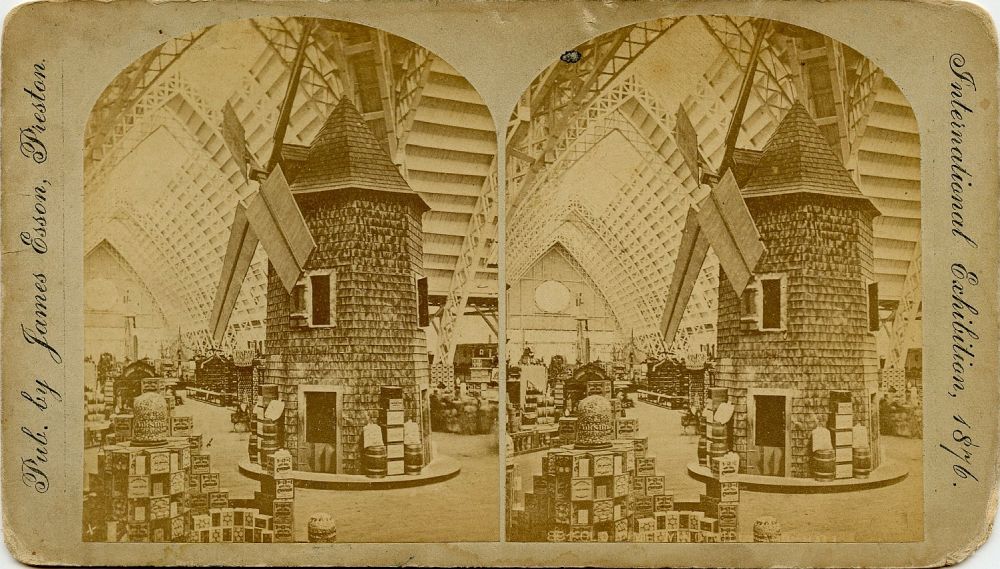
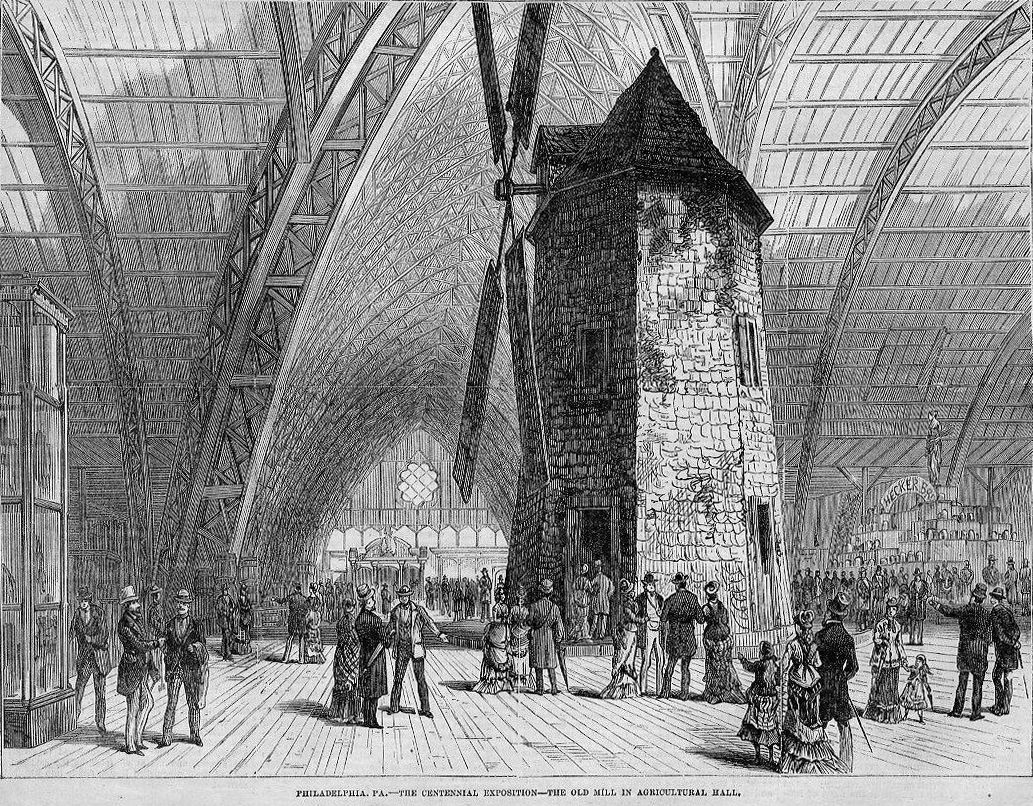
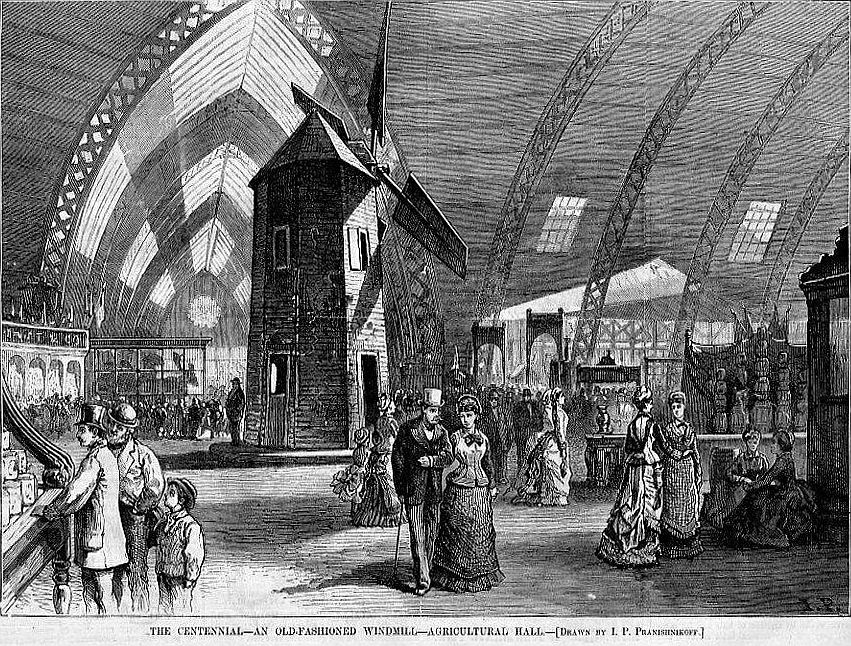
All evidence points to this being a mock mill, not something that was actually constructed using millwrighting techniques, and capable of being put to work. Being installed inside the Agricultural Hall it clearly was not exposed to the wind, though it was at least built with sails that have a realistic twist to them, though they do not appear to be very strongly constructed. Photos show a shingle clad two storey octagonal smock mill. The Centennial Exhibition was extremely popular, and the masses expected their souvenirs, so the mill featured in quite a few of these, in particular stereo photographs seem to have been all the rage, though unfortunately I've not found any images of any machinery inside the mill.
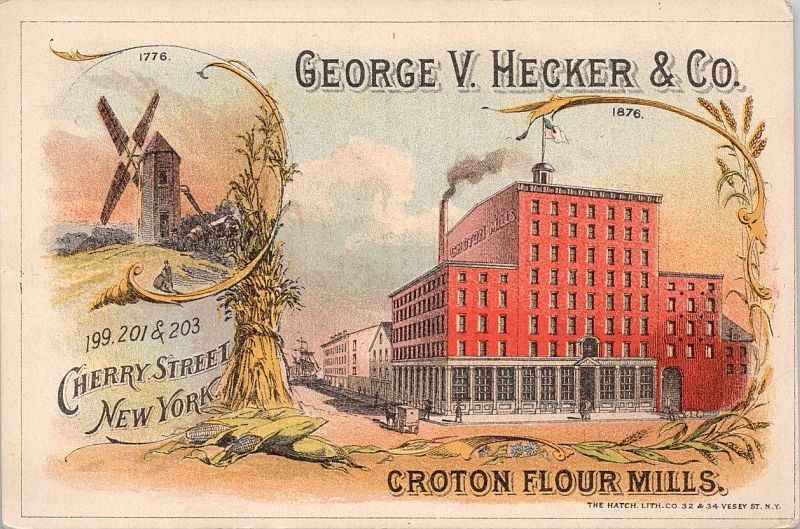
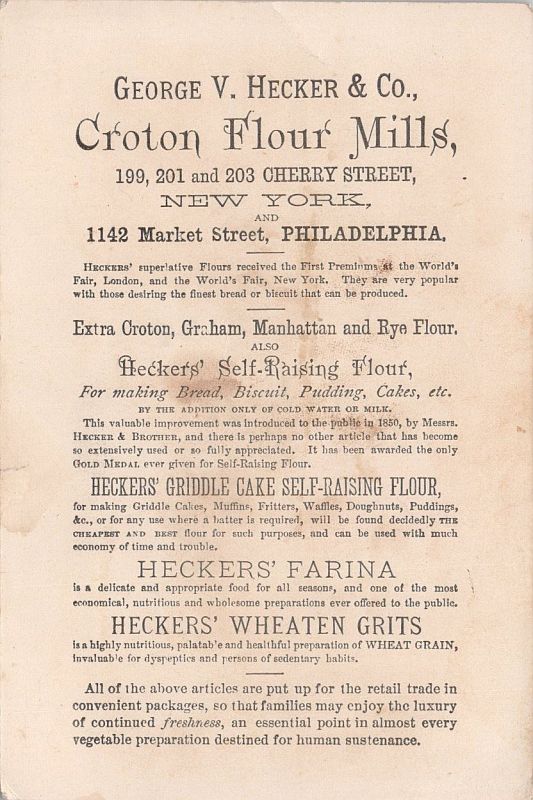
The mill was part of the Hecker Bros. stand (though they had mostly restyled the company as George V. Hecker & Co. by now). This New York flour milling firm had attended previous Worlds Fairs in London (1851) and New York (1852), and the successful publicity arising from their being awarded gold medals there is credited with allowing the firm to expand into new premises at Croton Flour Mills, Cherry Street, New York City. Clearly they were after an attention grabbing display for the Centennial Exhibition, and the mill provided it. Slightly surprisingly I can't find that they specifically advertised on the back of the exhibition, though they certainly produced trade cards that showed an old windmill dated 1776, contrasting it with their then current Croton Flour Mill dated 1876. The back of the card shows that at this time as well as the New York mill at 199, 201 and 203 Cherry Street, they also had a Philadelphia presence at 1142 Market Street, Philadelphia.
FreeLibrary.org has an excellent zoomable, high res photo of the old mill, which shows a slightly different view than the stereo photo - the sails have been rotated, and one of the boxes of flour has been taken off the top of the pile! The photo allows us to see that the sacks stacked up against the mill say "Geo. V. Hecker & Co. 98 Lbs. CROTON MILLS. 203 CHERRY ST, NEW YORK". The boxes also against the mill are for Heckers Self-raising flour, and on the general exhibition stand in the background we can see more self raising flour, Farina, and creamed wheat. The barrels of flour are probably labelled on their ends, but we cannot see the ends in the photo. Of the mill itself, we can see that there is a 1776 painted on the shingles of the smock to the left of the door. Through the open stable door, we can see that there are things inside the mill, but we can't make out what form they take, and the part doors look very thin, as if they are merely a permanent barrier, not an opening one. The mill sails look to be canvas covered (we can see light through them in the view looking North along the nave), but the canvas is not removable or reefable - it looks like the canvas is permanently fixed via nails or staples. It does look as if the cap is not turnable - there appear to be wooden brackets from the tower sides to the roof at each of the corners. The windshaft did rotate, since there are photos of the sails in the St Andrew's cross position, and the St George's one.
Centennial Exhibition.
[From an Occasional Correspondent of the Brooklyn Times.] PHILADELPHIA, June 13, 1876. - A Centennial celebration would not be complete without some implements illustrative of old times husbandry ... The Messrs. Hecker Bros. of New York, have built AN OLD FASHIONED WIND-MILL to represent the kind used by our ancestors one hundred years ago when they used to throw their sacks of grist across their horses and ride horseback fifteen to twenty-five miles to mill. THE MACHINERY, which has been very backward, is now in running order and was put in motion to-day, the belts and proper appliances being adjusted so that mowing, reaping and threshing machines and various agricultural implements exhibited can be shown off to an advantage.
[ED: I don't believe this is machinery inside the mill - I think it simply refers to other machinery in the agricultural hall]
The windmill was one of the exhibits that was retained (in a new location in the Main Hall) when the Centennial Exhibition closed and transitioned to a so called permanent display.
THE PHILADELPHIA EXHIBITION.
The Permanent Display - Its Opening on the 10th Inst. It will be a gratification to many individuals to learn that the permanent exhibition on the Centennial Grounds at Philadelphia, the outgrowth of the world's fair of last year, promises to be of unusual interest and immense extent, and that special trains will probably be run to the grounds, for which tickets may be scoured at reduced rates. Those who were so neglectful or unfortunate as not to attend the magnificent display of last year, will be glad of this opportunity to see an exhibition second only to that, while to those who did visit Philadelphia, and obtained some knowledge of how to see exhibitions, the completeness of the new enterprise and its many new features will be regarded with more than ordinary attention. The permanent exhibition will be confined chiefly to the Main Building, though the entire grounds will be opened, together with such of the Centennial Buildings as remain, namely, Machinery Hall, the Art Gallery or Memorial Hall, Horticultural Hall, the Judges' Pavilion, the principal English building, the Japanese, Brazilian, German, Portuguese, and several of the State buildings. The lake, walks, fountains, statuary and botanical gardens form additional attractions, and the price of admission will be reduced to twenty-five cents. ... The glass works, which were last year established in a separate building, the tobacco factory, Jacquard Looms, and other features from Machinery Hall, the old wind-mill from Agricultural Hall, the most important portion of the contents of the Shoe and Leather Building, and the working models of the Empire Transportation Company will all be transferred to the Main Building.
As well as the full size mock windmill on the Heckers flour exhibit, the Agricultural Hall also had had a model wind engine on show, mounted on an exquisitely engineered model of a flour mill. The wind engine appears to have 20 sails in its windwheel (the tower obscures the view in the available photos, making counting hard), but these are not solid vanes, each consisting of 10 shutters, and twin 8 blade fantails turn the sails to the wind. The skeleton tower of the wind engine is mounted on top of a flour mill, with three pairs of stones, and great detail such as centrifugal governors shown. There are also pieces of ancillary equipment, cleaners or bolters modelled in other parts of the mill.
A Zoomable photo and another allow a great view of the detail in this model. However the captioning on these photos is suspect - they clearly show the same model, yet the captions describe different things
| Last generated 05/11/2026 | Text and images © Mark Berry, 1997-2026 - |
 (


