
Restored windmill, in good condition. Retains its iron gearing, which makes it unique in the USA.


Located on a small mound at the East end of the village, next to the Eastern graveyard. Well maintained over the years, and retaining a lot of unusual machinery, including the interior hand turned mechanism to turn the mill into the wind; a power take off to drive the stone governors from the base of the upright shaft, and a stone crane for when the millstones needed to be dressed.
[info]
The Pantigo mill has been moved around the village several times. It is now in the gardens of Home Sweet Home - a house celebrated for the author of the song of that name who lived there.
[info]
Still retaining its internal machinery, this windmill was unusual for the Island, in that it has a fantail to turn the sails into the wind. Moved from Hayground to open space in East Hampton in the 1950's, this mill is now unfortunately surrounded by other newer buildings and trees.
Painted white, which is unusual in this area where plain wooden shingles are the order of the day.
The Gardiners Island sunken post saw mill remained unidentified for many years, since it is rectangular, and the remains are built into other buildings.
This mill has stood for many years without sails.
Moved a number of times, this mill now forms part of a cottage.
This mill on the campus of Southampton College is house converted.
Moved several times, now preserved by The Georgica Association.
The hamlet of Water Mill is proud to have both a windmill and a watermill.
[info]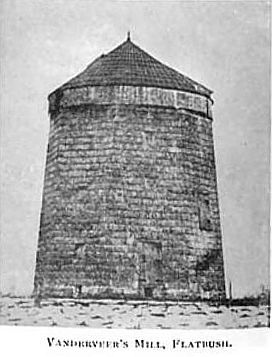
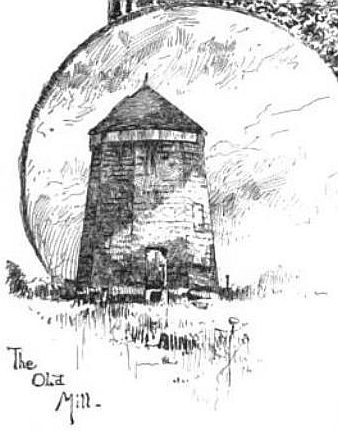
Larger than any other in the place, the Vandeveer homestead is the magnet for every house-lover who journeys to Flatbush. From time to time in the last century additions were made to the original building, until it became a long, low, but spacious structure, many-roomed, airy, comfortable, and light. Within a stone's throw of the old house, and on the Vandeveer farm, stood, until it was destroyed by fire a few years ago, the oldest existing landmark on Long Island, a Dutch windmill, whose round, fat sides and great arms were brought over from Holland piecemeal and erected on the Vandeveer place. In the mill every grain of corn used by the Flatbush colony was ground. The foundation stones of the windmill may still be seen. Of the Vandeveer homestead but little can be said that has not already been said of other houses of the period it represents. Its sloping roofs, its long, stout shingles, its small-paned windows and narrow doorways, are all of a pattern long since become obsolete, but to the eye of the artist and the student of the past always beautiful and suggestive. PERRITON MAXWELL.
From the N. Y. Mechanic of Feb. 4. The Flatbush wind-mill grinds 4000 bushels of grain annually.
MILITARY ENCAMPMENT.- The officers of the two city regiments of militia have selected as their place of encampment on the 16th, 17th and 18th inst., a field of Judge Martense, near the windmill, in Flatbush. Besides the above officers, the men composing Capt. Crooke's Flatbush Artillery Company will be on the ground. This exhibition of the "pomp and circumstance" creates a deal of excitement among those interested in the military. We are of such.
THE ENCAMPMENT.- We understand that the 'pomp and circumstance of glorious war,' now in process of enactment on a peaceful scale at Flatbush, is quite a striking feature in the placid and picturesque scenery of that beautiful town, and the camp of our Brooklyn military is visited by throngs of curious and interested spectators. Against the horizon near the scene a windmill raises its head in mute astonishment at so unusual a scene. We trust that the mill will be safe from attack on all sides.- If any one should have the temerity to meditate an onslaught upon it, let him ponder a short time upon the fate of an unfortunate gentleman yeleped Don Quixotte, who once placed himself in a very bad predicament by such an attempt.
The Lefferts homestead, owned by John Lefferts, who inherited it from his mother, Mrs, Maria Lefferts, is a low heavy-roofed colonial house, with double roof slant and old-fashioned gables. It was burned in part at the battle of Flatbush and afterwards rebuilt and restored. It is on the east side of Flatbush avenue, opposite the home of J. Lott Vanderbilt. Vanderveer's mill was the first windmill erected on Long Island. To it the farmers brought their grist from far and near. It was begun by John C. Vanderveer in 1801 and was three years in building; it was constructed with great solidity; the main timbers were hewn out of trees which grew on the Vanderveer farm and were two and a half feet in thickness. On a three-foot stone foundation it rose to the height of four stories. The arms and sails, which were twenty-six feet long, were blown off in the famous gale of September, 1821. Ten years later a similar accident occurred and it was not repaired. From that time it was used as a storehouse for hay. It stood between Carnarsie lane and Pardaegat pond, and during the draft riots of 1863 the colored people fled to the old mill for safety. It was destroyed by fire in 1879; its stout old timbers defying the flames for hours.
AFTER busy hours in the exciting world of trade, we long to rest from our cares and escape them awhile. It is at some such time that we should entertain ourselves with a recountal of the scenes that stirred with life, long years ago, the homesteads yet about us. Soon these buildings must be gone forever. What then shall link the present with historic days, except some musty manuscript and book or, it may be, stray relics out of their accustomed place and scattered through a museum, silent and little seen? In those few remaining houses built at least seven-score years ago there are the voices of another century as well as of this, that still speak to us; there are the visible surroundings of a former time; and, permeating all, there is an atmosphere of mystery. In 1876 ... My reverie was interrupted by a glimpse I caught of an old Dutch windmill in the hazy distance. I knew this to be the surviving one of the only two such structures ever erected in Flatbush. I watched the mill contemplatively ...
Fact and Rumor
... An ancient windmill at Flatbush, L.I., long used as a store-house for oats, was burned last week. It has for the better part of a century been a landmark for that suburb of Brooklyn. Tramps?
Old Mills.- In former days two large windmills formed a conspicuous feature in the village landscape. ... Another old mill stood upon Mr. John C. Vanderveer's farm, in the southern section of the village, and was always called "Vanderveer's Mill." This is said to have been the first windmill erected upon Long Island. The Rural Gazette, March 4, 1879, states that it was completed in 1804 by John C. Vanderveer. It was of immense strength, the main timbers being twenty-eight feet high and two and a half feet thick. It was four stories high, with a stone foundation of about three feet. The arms and sails, similar in construction to the Holland mills, were twenty-six feet long. There were three sets or "run" of stones. The sails were first blown off in the famous September gale of 1821. About ten years after the sails were blown off again, after which they were not repaired. During the drafting riots of 1863 it was a refuge for the colored people, who were threatened by the Irish. It was destroyed by fire on the night of the 30th of April, 1879.
The Vanderveer property extended over a large tract of land, and the family were among the oldest settlers in Flatbush. They are the descendants of Cornelis Janse Vanderveer, who emigrated to this country from Alkmaar, a free city on the North Holland Canal, in 1659. He bought a farm of Jan Janse in Flatbush, and settled there. An old mill formerly stood on this farm in sight of the road. It was recently destroyed by fire. We give the history of it from the newspaper account published at that time.VANDERVEER'S MILL.
"Last Tuesday night [March 4, 1879], about a quarter before seven o'clock, a fire broke out in the 'Vanderveer Mill,' on the farm of Messrs. John Vanderveer & Sons, between Canarsie Lane and Pardaegat Pond. The spectacle of its destruction was such as has rarely been witnessed, and, mingled with the many people of the town who had gathered, were those who had been attracted for miles by the flames which lit the sky. The strong oak timbers stood up until the very last, while the shingles which covered it fell away, sending up showers of sparks, which, against the sky, looked like gold-dust sprinkled on a cloth of blue. Still the flames burned on till nothing remained but the bare timbers raising gaunt arms appealingly against destruction; but the element did its work, and after a couple of hours had passed, that which it had taken years to build, and which had stood time's ravages for three quarters of a century, was laid in ruins. "It was the first windmill erected on Long Island. It was completed in 1804, having been begun about three years before by John C. Vanderveer, father of the present owner. It was of immense strength, the main timbers being twenty-eight feet high and two and a half thick, hewn from trees grown on the farm. The carpenter was Abijah Baldwin, Joseph Mead being the millwright. John Oakey, Sr., father of the present Assistant District Attorney, worked on it as an apprentice. It was four stories high, with a stone foundation of about three feet. The arms and sails were twenty-six feet long, and it had three run of stone. The sails were first blown off in the famous September gale of 1821, and repaired by Baldwin. About ten years after the sails were again blown off, since which time they have not been repaired, the building being used as a storehouse for hay, etc. It was full at the time of the fire. When it was working, farmers came from the adjoining counties with their grist for the famous mill. The view from the upper windows was very fine, including Coney Island, the Narrows, Jersey, and Rockaway, and all places within a radius of twenty miles. During the draft riots of 1863 it was a refuge for the colored people of the village, and they will hold it in grateful remembrance."
Sketches of Long Island
No.14.
Ancient Landmarks.
Of all the antiquated landmarks, however, which seem visibly to connect the present with the past, is the dismantled and grim-looking old Wind-mill, standing on the farm of Jobn Vanderveer, Eeq., of Flatbush. This is indeed a thing wholly of the past, and stands like an aged chieftain, bereft of his native power and glory, and musing in sullen solitude, all unconscious of the busy world around it. A ghastly skeleton of a once moving and almost breathing thing, now alas! motionless and dead, yet standing to remind us of the mutability of all things earthly. How many memories cluster around this aged pile! It is the embodiment of an idea brought from Fatherland, and takes one back instinctively to the dykes of Holland. Here the farmers of a generation past came to get the products of their farms prepared for food. Farmers from Brooklyn, Bushwick, New Utrecht, Gravesend and Flatlands, all came here. This was a time when waving fields greeted the eye, where now blocks of houses and busy streets are seen. A time when steam had not revolutionized the world, and performed with its Titanic and Briarcan arms the labor of earth's toiling millions. May this weather-beaten, dismantled embodiment of other days, other ideas, and other generations, be allowed to stand, to remind our children's children of the almost forgotten and fast fading things of the past. This mill was built by John C. Vanderveer, Esq., the father of the present owner, in 1804, at a cost of $8,000. The building is four stories high, and constructed of immense white oak timbers, which seem capable of withstanding alike the ravages of time and the storms ot centuries. The propelling power was a vertical fan, with wings fifty-two feet in diameter, the top of the structure being so constructed as to revolve to suit the direction of the wind. There were three rows of stones, all of which an ordinary wind would carry, and each stone would grind about one hundred bushels of grain in twenty-four hours. The price charged for grinding was ten cents per bushel, making the concern a profitable investment when it had plenty to do. It was in profitable use until the wings were blown off in the great September gale of 1828, after which it was never repaired. This is the only windmill that has ever been erected on this part of the Island, excepting the one on the property of Mrs. A. L. Zabriskie, which was taken down and removed only a few years. since, to make way for modern improvements.
From the Historic American Engineering Record (dated 1973):
Gladden Wind Turbine. Date : 1890-1891 Location: Pidgeon Valley Rd, Napoli, Cattaraugus County, New York Built by: George Gladden Owned by : Originally : George Gladden Presently : John Milks Significance : The Gladden wind turbine is a well preserved example of a vertical wind turbine built during the 19th century. Although no longer operational, the turbine (and associated mill structure) is a rare example of wind power technology in the United States.[info]
A RELIC OF THE PAST.- Last week an old windmill was burned in the village of Southold, Long Island. It originally was erected on Brooklyn Heights, whence it was moved to Jersey City where it was bought by Hampton Young in 1838, for $2,000, and moved to Southold; it was seventy-five years old at the time of its destruction.
| Last generated 06/11/2026 | Text and images © Mark Berry, 1997-2026 - |
 (


