
Search: Google images eBay wikipedia YouTube
NGR: TQ318967Enfield Windmill: smock mill function:Corn mill
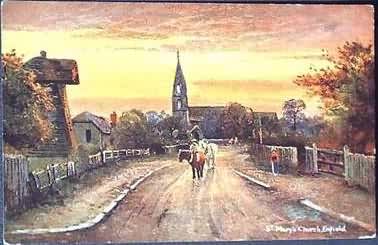
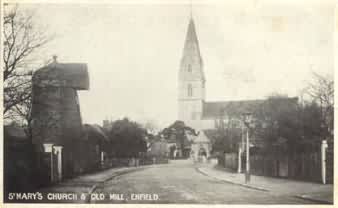
Enfield windmill, a smock mill, was operated for many generations by the Robinson family, continuing a milling business established in 1720. Around 1800 the old post mill was replaced with the smock mill. Joseph Robinson was miller between at least 1802-1826, followed by his son Isaac around 1842-1856, and his son Benjamin in 1867. By 1896 the Ordnance survey map noted the mill was disused, and in 1901 the sails were removed. The last miller from at least 1890 onwards was also called Isaac Robinson, who moved the business away from the windmill to a building on Chase Side in 1904. The mill was demolished soon afterwards.
The mill stood on Old Park Road, towards the top of Windmill Hill, near the Church of St Mary Magdalene. It is remembered by the current road names of Windmill Hill and Millers Green Close.
STOLEN or STRAYED, from Enfield-Chase, on Wednesday the 9th of June, a BAY GELDING, six years old, of about sixteen hands high, a blaze down his face, blind of the off-eye, with two white feet before and one behind, has a scar under his off-flank six or seven inches long. If strayed, a reward Of Two Guineas, and all reasonable charges will be paid on having him again; if stolen Five Guineas will be paid upon conviction by me Joseph Robinson, Enfield Wind-mill, Middlesex.
GEORGE TYLER, CHARLOTTE LIVERMORE and ANN MOLE were indicted for stealing, on the 30th of April, 4 sovereigns, the monies of John Newman, from his person.
...
SARAH ROBINSON. I am the wife of Isaac Robinson, who has a cornmill in Enfield parish. On Saturday evening, the 30th of April, between eight and nine o'clock, Livermore and Mole came together to buy flour - I gave them change for a sovereign, which Livermore gave me — Mole give me a half-sovereign, and I gave her change.
Cross-examined. Q. You have known 'Livermore before? A. Yes, her husband is a labourer - I have not known much of Mole.
...
NOT GUILTY.
THOMAS JONES, WILLIAM LEARY , and JOHN SHARP , burglariously breaking and entering the dwelling house of Isaac Robinson, with intent to steal. MR. CAARTEN conducted the Prosecution. ISAAC ROBINSON. I am a miller, and live at Windmill-hill, Enfield. Between 1 and 2 o'clock on 17th June I heard a noise— I had had a cow blown the night before, and I thought my son had got up to look at it—I took no notice of it— in three or four minutes afterwards I heard a noise in the lower part of the house; I got out, and looked out of the window— the room I sleep in is in the front of the house—I did not see any one, but saw the path gate was open— there is a garden in front of the house, which leads into a private road—the shutter of the lower room window was broken open— I called my son, and after that saw the prisoner Sharp run out of my house, by the front door—he ran down the path into the road— (it was between light and dark)—when Sharp got out in the road he whistled, and Jones came out at the same door, and went down the same road after him, and they whistled again—I saw Leary standing in the road when Sharp ran out of the door—when they had whistled again, the three of them ran away down the road towards Barnet—they ran away, as if together—one of my sons, Benjamin, went after them— I afterwards examined my house—the window was open—the shutter was hanging off; the iron plate through which the pin went was wrenched off— I had fastened it up, between 9 and 10 o'clock at night—in the front room I had two tea caddies, which had contained tapes, and threads, and a parcel of things—all the contents were pulled out of them—they were in a room on the same floor as the room where the window had been forced— nothing had been taken away to my knowledge—I observed the men's dress—they seemed to me to be dressed in the same way that the prisoners are now. Cross-examined by MR. METCALFE. Q. Where were you standing when you saw the men go out of the house? A. At my bed-room window, which may be six or seven feet from the ground—I was looking out of the window when the men went out of the door— the door is not exactly under the window, but by the side of it—they walked straight along the path to the gate—there was no lamp or light of any kind— one of my sons sleeps in the next room, and the other in the next to him—I called to my son before I saw the man go out at the door— I said, "Get up, I think there is somebody in the house"—I said it in a moderate tone—the man went out—I believe him to have been in the cellar— when I called my son he slipped on his trowsers, waistcoat and shoes, and away he went—this was between 1 and 2 o'clock— I have not the least doubt of Sharp being the man who ran out—to the best of my belief he is; I say that from his dress and from his size— I did not see his face—his general appearance resembles him. COURT. Q. Did you examine the cellar? A. The cellar door was wide open when I went down—I did not miss anything from the cellar. BENJAMIN ROBINSON. I am a son of the last witness and live with him. Between 1 and 2 o'clock on the morning of 17th June my father called me, I got up immediately—I saw one man run out, and a whistle was given—I had not heard any noise before I saw a man— he ran out from the front door of the dwelling house—my room is just over the door, I saw the back part of the man— he never was out of my sight from the time he left the house till I left him at the police station—it was Sharp— when I looked out he was running down the path—on seeing him run I followed down stairs— I first put on my clothes and went down and went out of the front door—I heard a second man go out as I was going down the stairs— after I saw the first man running and heard the second man go out, I heard a whistle again—I heard the first whistle when the first man ran out— I could not tell who whistled—I went down the path, and saw three men running on Slade's-road to Barnet— they might be fifty yards down the road when I saw them running, and between fifty and a hundred yards from me—I followed them— they went as far as Mr. Slade's and turned into Russell's footpath-field—I should think Mr. Slade's is a quarter of a mile from my father's house, it is in the Barnet-road—I heard them speak one to the other—I followed them up Russell's footpath-field
...
FOR SALE, an Alderney Cow, just calved, with cow calf.—Apply, Isaac Robinson, The Mill, Enfield.
BURNT BALLAST for sale, any quantity. - J. Robinson, Windmill, Enfield.
ISAAC ROBINSON, MILLER AND CORN MERCHANT, THE WINDMILL, ENFIELD, & STEAM MILLS, GOFF'S OAK. Established 1720.
HORSE FOR SALE, cheap, 15-2, suit a tradesman, price £12, lowest. - I. Robinson, Windmill, Enfield.
Just published. A PICTURE OF THE OLD WINDMILL, ENFIELD CHASE. Engraved from an Original Painting in 1880. To be obtained at MEYERS' LIBRARY, ENFIELD TOWN. Framed, 2s. Unframed, 1s.
Mr. Ebben's specialities include mincemeat and Christmas cakes, some artistically designed: while an interesting feature on show is a cleverly-constructed windmill, which serves as a reminder of that picture of Enfield's old windmill which has been brought out by Mr. W. Harris, of "Mill Side."
JOHN ISAAC ROBINSON, son of Isaac Robinson, of the Windmill, Enfield, wishes to state that be is not the I. J. Robinson, of Goffs Oak, charged with firing stacks, &c.
On January 6th, ISAAC ROBINSON, of the WINDMILL, ENFIELD, WILL REMOVE to the Premises for many years in the occupation of MR. PENNYFATHER, CHASE SIDE, ENFIELD, and which he intends opening as a FIRST-CLASS Millers and Corn Merchant's Hay, Straw, &c. &c.
Links with the Past.
ENFIELD WINDMILL & ITS TENANTS. To write of Enfield's old windmill is to refer to one of the best-known landmarks for many miles around; and the mention of the archaic building will at once call to the mind of Enfield folk a recollection of the equally well-known occupants, the Robinson family. Many a writer, both of prose and poetry, have done some of their best works in the elaboration of such subjects as mills and millers; but in the present instance it is not within our province to treat in glowing terms topics suggested by reference to the familiar erection on the Ridgeway. Rather should we deal with the mill and its history in a strain of melancholy, for this week, so we understand, will see the snapping of one of the oldest remaining links, in this neighbourhood, with the 18th century. Probably but very few instances can be found here wherein, as in the case of the Robinson family, son has succeeded sire in the occupancy of the same premises under similar circumstances to those which have obtained in connection with Enfield's windmill. So long ago as 1720 was this familiar spot first tenanted by a Robinson; and from that day until this week his descendants have lived beneath the same roof-tree, and carried on the milling business. What a host of reflections does this interesting fact call up! In these days of change and migration, it is indeed remarkable to find the direct descendants of an old English miller, when George 1. was King, still living on the same spot, and, in some measure, carrying on the same business. Now, however, this long association is coming to a close, Mr. Isaac Robinson (whose father Benjamin tenanted the premises for 40 years) being about to remove to Chase Side, where he will occupy the extensive buildings once occupied by the late Mr. Pennyfather, dairyman, and whose widow only recently passed away at a good old age. Originally, as we understand, the Robinson family were millers and farmers, tilling what was known as Old Park Farm; and one feature particularly interesting is that, so far as is known, each succeeding tenant held the Windmill and house on a yearly tenancy during the whole of the 184 years since the Georgian subject first took possession. The present mill is not the building in which he pursued his dusty calling. That was what was known as a post mill, revolving according to the wind. It was this old structure which is referred to in the amusing story of the mill and the great Earl of Chatham, who will for ever be remembered for his dying protest in the then House of Lords against the war with the American Colonies. The Earl became the owner of South Lodge, and seems to have entertained an objection to the appearance of the mill, which was so prominent a feature in the landscape. Accordingly, so the story goes, he sent for the Master Miller of that period and desired that he would paint that side of the mill which faced South Lodge, the work to be done at his lordship's expense. History does not say if the miller had covenanted to do repairs, etc.; but at all events he carried out the wishes of his noble neighbour. Anon the Earl came again to his Enfield abode, but to his surprise the mill appeared to be still unpainted. We can imagine how the choler of the elder Pitt rose at the sight, and the imperiousness of the message in which he summoned the miller to his presence. Good Master Robinson was evidently, a smart man of business, and had his answer ready—the wind had changed, but he was quite ready to paint the other side on the same terms! We can only hope that so convincing a reply mollified the wrath of the Earl, and secured the complete beautifying of the mill, which some years later was blown over, and the present one — a "smock" mill — erected on its site. It was constantly worked until about seventeen years ago, and dismantled some three years since. The mill-house, which sheltered the Robinsons, practically remains to-day, though it has been somewhat modernised and the old "dogs." etc. on the hearth have given place to the more modern range, though iron hooks, etc., in the chimney remain as reminders of the days when mighty flitches of bacon were hung up to dry. The northern end of the domestic buildings was added some ninety years ago. What will be the future of the old place we know not; but so fine a site will, perhaps, some day be occupied by a mansion for which it seems so well fitted. We should add that although now removing to another abode, Mr. Robinson will continue to carry on his business of corn merchant. etc., at the Chase Side premises mentioned above.
I. ROBINSON, Miller, Corn, Hay and Straw Merchant. GARDEN SEEDS OF ALL DESCRIPTION'S. WINDMILL GRANARY, CHASE SIDE, ENFIELD. ESTD. 1720.
Obituary: An aged member of one of the oldest of Enfield families - Mr Chas. Robinson of Hawthorne Cottage, Hawthorn Grove, passed away on the 3rd inst., within two months of his 86th birthday. His father and brother were, in turn, tenants of the still remembered windmill on Enfield Ridgeway, and for the space of about 30 year, Charles Robinson lived at the historic King and Tinker public house, White Webbs.
To let.-Mill House, Goffs Oak, containing six bedrooms. drawing and dining rooms, parlour, kitchen, and every convenience, stabling, coach house, etc., with half an acre of garden ground. Three years' agreement. Apply. Isaac Robinson, Chase Side, Enfield.
DEATH. ROBINSON. —On the 14th instant, the Poplar Farm. Goffs Oak, Sarah, the wife of Frank Robinson, and only sister of Isaac Robinson, Chase Side. Interred on the 19th, at Lavender Hill Cemetery, in the grave of her parents.
GRAHAM - ROBINSON. A quiet wedding took place at the Enfield Parish Church early on Wednesday morning, Miss Grace Julia Robinson, the eldest daughter of Mr. Isaac Robinson, a well known local tradesman and a member of one of the oldest families in the locality, becoming the wife of Mr. William John Graham.
Link with Enfield's Old Windmill
Death of Mr. Isaac Robinson.
Last of long line of millers
...
The new county magazine, "Middlesex Quarterly", published for the first time this month, contains much to interest readers of this column. ... In an article on "The Old Windmills of Middlesex" is reference and a drawing of Enfield windmill.
The story of the Earl Of Chatham The history and antiquities of Enfield, in the county of Middlesex by William Robinson, 1823
A pleasant story is told of the great Chatham, who desired the miller to paint the windmill, which stood on a post, the whole body moving to face the wind, on that side next the South-lodge, at his expence. The miller did so, and when his lordship looked out of his window and found the mill not painted, he sent for the miller, who declared that it had been done agreeably to his direction. Mr. Pitt pointed to the mill, when the miller informed him that the wind had changed, but that he was quite ready to paint that side on the same terms. This mill was pulled down about twenty-five years ago, and the present mill, which stands on its site, is of a different construction.By subtracting the "about 25 years" mentioned here from the publication date of 1823, we get an approximated date of around 1798-1800 for the replacement of the post mill with the smock mill. The almost exact copy of the book issued a few years later by a different author changes the "about 25 years" to read "many years ago".
Entry in Mills Archive database - #12209 - Enfield Windmill, Enfield (has photos)
The mill was in existence by 1720, had ceased working by 1896 and was demolished in 1904.
| Last generated 15/09/2026 | Text and images © Mark Berry, 1997-2026 - |
 (
(


